






 Portuguese


Built about 1,000 years before Stonehenge, the Chleby monument tracked the cycles of the Sun and Moon, housed 18 burials, and preserved remains of bulls linked to prehistoric ritual practices in Central Europe
The Chleby monument, constructed approximately 6,500 years ago in present-day Czech Republic, has been identified as one of the oldest known ritual centers in Central Europe. This structure tracked the movements of the Sun and Moon and contained 18 human burials along with bull remains.
Led by archaeologist Petr Krištuf from the University of West Bohemia, the research indicates that the circular enclosure was established roughly 1,000 years before Stonehenge, demonstrating how prehistoric agricultural communities related sky observation to seasons and farming activities.
-
67-Year-Old Man Falls into Forgotten Cistern While Helping Friend Move into Historic 1843 Home, Rescued by Firefighters from 6-Meter Drop with 2 Meters of Water

-
About 30 Humanoid and Quadrupedal Robots Take to the Streets of Warsaw, Wave Flags, and “Shout” for AI Regulation in a Protest Warning of Job Replacements
-
Farmer in Namibia Discovers World’s Largest Intact Meteorite, Still in Its Original Spot Over a Century Later Without Any Visible Crater
-
Archaeologists Astonished to Open 4,400-Year-Old Egyptian Tomb and Discover Original Colors Preserved, Animal Reliefs, and Two Funeral Chapels for Father and Son in Saqqara



Chleby monument tracked the cycles of the Sun and Moon
The structure was built around two observation elements designed to track different celestial rhythms.
One of them followed the lunar cycle, allowing observation of the Moon as it advanced into increasingly extreme positions in the sky before reversing direction.
The second was oriented to two significant moments of the solar cycle: the sunrise at the summer solstice and the sunset at the winter solstice.
Around the perimeter, researchers identified another 12 openings associated with the solar and lunar cycle axes.
The ensemble could serve as a reference for agricultural communities to organize activities such as planting and harvesting.
According to Krištuf, for these prehistoric populations, the sunrise at the summer solstice symbolized a beginning, while the sunset at the winter solstice represented an end.
The archaeologist also noted a similarity between this orientation logic and the main axis of Stonehenge.
The difference lies in the chronology: the Chleby monument was designed similarly over a thousand years earlier.
Its age was established through the dating of organic material recovered from the site.

Trench contained 18 human burials and bull remains
Another important element of the discovery lies in a trench approximately 2.4 meters in depth, located around the enclosure.
Archaeologists found human and animal bones within it. In total, 18 human burials were identified, apparently carried out gradually rather than during a single event.
It is still unclear why these individuals were selected for burial at the site. The team has also not determined whether social or religious factors were related to the burials.
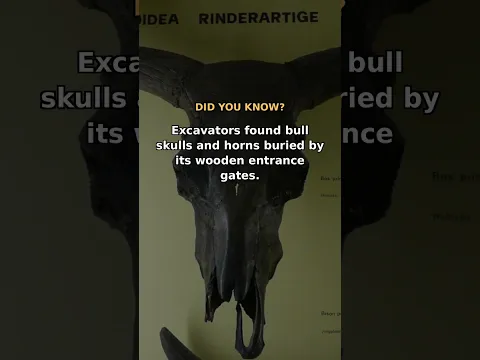
Near the main entrance, skulls and other bones of bulls were discovered. Based on the positioning of the remains, researchers believe the skulls were originally placed by the gate.
The material connects this practice to the symbolic importance attributed to the bull in parts of prehistoric Europe, within a tradition described by scholars as “bull cult.”
Structure Attributed to Únětice Culture
The site has been attributed to the Únětice culture, which spread across regions that currently correspond to western Poland, eastern Germany, Czech Republic, western Slovakia, and northern Austria.
In the present Czech Republic and Slovakia alone, around 1,400 archaeological sites related to this culture have been documented.
The material also describes the Únětice people as traders who imported copper and tin and transported amber from the Baltic along long-distance trade routes.
They are also associated with stone or clay tablets known as Brotlaibidole, or “bread-shaped idols,” marked with repeated geometric patterns used to record goods and transactions.
Researchers Will Further Study Human Remains and Soil
Krištuf and his team now intend to analyze the human remains found at the Chleby monument to gain more information about the individuals buried at the site.
Soil analyses are also planned to understand how different parts of the site were utilized over time.
According to the researchers, by the time the Iron Age arrived, the monument no longer held the same significance it had acquired in earlier periods.
This article was developed based on information provided about the research led by Petr Krištuf from the University of West Bohemia, with data, figures, and statements preserved as per the consulted material.


