






 Portuguese
  Spanish


Datafolha survey shows change in Brazilians’ perception of poverty, work, and opportunities amid public debate on Bolsa Família and labor market.
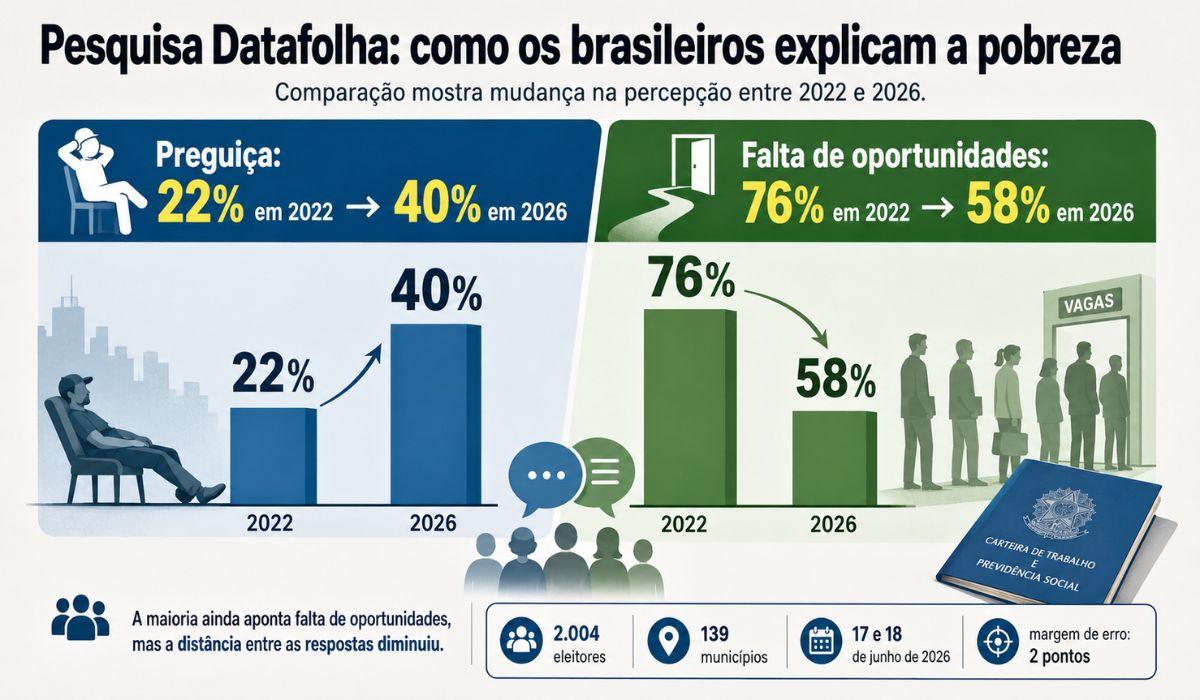
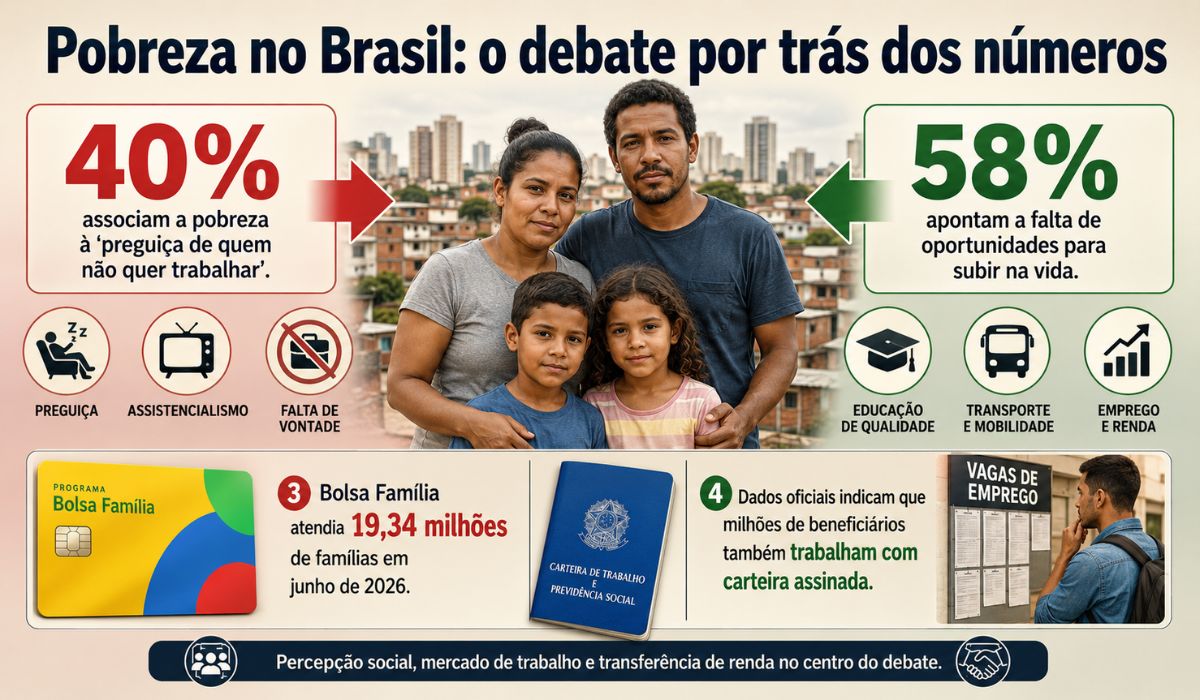
The portion of Brazilians who associate poverty with “laziness of people who do not want to work” reached 40%, according to a Datafolha survey released on July 3, 2026.
In 2022, 22% of respondents chose this explanation. The result is the highest percentage recorded in the historical series of the question.
However, the majority of respondents still relate poverty to the lack of equal opportunities to get ahead in life. This option was pointed out by 58% of participants, down from 76% recorded four years earlier.
-
U.S. tariff hike pressures Brazilian exports, which fall 13% and total US$ 17.4 billion in the first half of 2026, while the U.S. share declines to 9.4%, the lowest level since 1997, with losses concentrated in coffee, oil, and steel, and new surcharges increasing pressure on the industry.

-
China delivers a 230-meter car carrier for 10,800 vehicles, with 14 decks and a 200 kW solar system that generates about 1,000 kWh per day, while dual-fuel engines use LNG and conventional fuel on global routes between Asia, Europe, and North America.
-
Europe opens voting to choose new euro banknotes featuring Beethoven, Marie Curie, Leonardo da Vinci, colorful birds, and rivers that could transform the look of the currency.

-
Young people are tired of pretending to be wealthy on social media: debts over R$ 100,000, high interest rates, and the distant dream of homeownership are turning TikTok and Instagram into financial confessionals.


Another 3% did not know how to respond.
The survey was conducted in person by Datafolha on June 17 and 18, 2026. A total of 2,004 voters aged 16 and over were interviewed in 139 municipalities.
The maximum margin of error is two percentage points, more or less, in the total sample, with a confidence level of 95%. The survey is registered with the TSE under number BR-09956/2026.
Perception of poverty changes in historical series
In the historical series of Datafolha, the association between poverty and laziness was recorded at 32% in 2013. The following year, it rose to 37%.
In 2017, it dropped to 21%, before settling at 22% in 2022. In the 2026 round, the index reached 40%.
The question is part of the behavior block of the institute’s ideological matrix. This set includes topics such as weapons, poverty, migration of poor people, crime, death penalty, drugs, homosexuality, belief in God, unions, and punishment of adolescents who commit crimes.
According to Datafolha, the ideological matrix considers responses to questions about social, political, cultural, and economic values. In the case of poverty, the survey records the perception of respondents in response to alternatives presented by the institute.
Lack of opportunities remains the majority response
Even with the increase in the portion that attributes poverty to a lack of willingness to work, the explanation based on inequality of opportunities remained the majority.
The alternative was chosen by 58% of respondents. In 2022, this percentage was 76%.
In the same interval, the response that associates poverty with laziness went from 22% to 40%. Thus, the difference between the two alternatives decreased in comparison between the last two rounds of the survey.
The survey does not measure the economic causes of poverty in the country. The research shows the declared opinion of respondents regarding the options presented in the questionnaire.
For this reason, the numbers indicate social perception on the topic, and not a technical conclusion about income, employment, inequality, or social mobility. The distinction is necessary because the question deals with values and interpretations of voters.
The result appears within a broader block of behavior, used by Datafolha to analyze positions on social and economic issues.
Household income shows differences between groups
Among respondents with a monthly household income of up to two minimum wages, the percentages follow the overall sample result. In this group, 40% relate poverty to laziness, while 58% point to a lack of opportunities.
In the household income range between two and five minimum wages, 43% associate poverty with a lack of willingness to work. Another 55% attribute the condition to the absence of equal opportunities for social advancement.
Among respondents with a household income above ten minimum wages, the lack of opportunities alternative appears with 63%. This is the highest percentage recorded in this segment for the explanation based on inequality of conditions.
The data by income indicate variations between groups, but do not allow us to affirm, in isolation, that the salary range explains the choice of an alternative. The survey presents cross-references of responses, without establishing a causal relationship between income and perception of poverty.
Entrepreneurs and public employees diverge in the occupation segment
The economic occupation of respondents was also analyzed by Datafolha. Among entrepreneurs, 56% state that a good part of poverty is linked to the laziness of people who do not want to work.
This was the highest percentage recorded among the occupations mentioned in the survey. Among public employees, 28% chose the same alternative.
The group recorded the lowest rate of association between poverty and laziness within this segment. The difference between the categories shows that the declared perception varies according to the occupation reported by the respondents.
The survey, however, does not detail the individual reasons that led each group to choose a response.
The question offered two main explanations for poverty: lack of equal opportunities for everyone to get ahead in life or laziness of people who do not want to work. The responses, therefore, reflect the respondents’ choice between these formulations.
Young people point more to the lack of opportunities
The age breakdown also shows differences. Among voters aged 16 to 24, 22% associate poverty with laziness, while 74% cite the lack of opportunities as an explanation.
This group records one of the highest proportions for the alternative linked to inequality of conditions. Among respondents aged 60 and over, the responses are closer.
In this segment, 49% attribute poverty to laziness and 48% point to the lack of opportunities. According to the survey, the percentages constitute a technical tie.
The division by age group shows differences in perception between young and elderly people. Datafolha, however, does not attribute a specific cause for this variation in the disclosed segment.
Electoral preference also appears in the responses
The cross-referencing by presidential electorate shows differences among groups of voters. Among those who declared a vote for Luiz Inácio Lula da Silva (PT) in the first stimulated round, 28% associate poverty with laziness.
In this same group, 70% point to the lack of opportunities. Among voters of Flávio Bolsonaro (PL), 52% attribute poverty to laziness.
Another 44% relate the condition to the absence of equal opportunities to get ahead in life.
Datafolha also released, in the same set of surveys, data on the ideological matrix of Brazilians. This classification considers responses on behavioral and economic thinking themes, with scores assigned to each question.
In the case of the question about poverty, the breakdown by vote indicates differences in perception among electorates. The survey, nevertheless, does not establish a causal relationship between electoral preference and response to the questionnaire.
Datafolha survey interviewed voters in 139 municipalities
Datafolha interviewed 2,004 voters aged 16 or over, in person, in 139 Brazilian municipalities. The interviews were conducted on June 17 and 18, 2026.
The maximum margin of error for the total sample is two percentage points, for more or for less. The confidence level reported by the institute is 95%.
In our internal cuts, the margin varies according to the size of each stratum. The question about poverty is part of Datafolha’s ideological matrix.
The block brings together themes of behavior and economic thought, used to classify respondents’ perceptions of social, cultural, and political issues.
On the topic of poverty, the survey records that the majority still attribute the problem to a lack of opportunities. At the same time, the portion choosing the alternative linked to the laziness of people who do not want to work has grown.
With the change in percentages, the survey shows a convergence between two readings on poverty in the country: one based on the lack of equal conditions for social mobility and the other centered on individual responsibility.
Bolsa Família enters the debate on poverty and work
The discussion raised by Datafolha also connects to the public debate on Bolsa Família, which has regained space after statements by businessmen and communicators about social programs, the labor market, and income dependency.
In June 2026, the program served more than 19.34 million families, according to the Ministry of Social Development and Assistance, Family and Fight Against Hunger.
The average benefit that month was R$ 677.66 per family, within a federal investment of R$ 13.08 billion.
The topic gained national attention in May 2026, when host Luciano Huck commented on the program during the 5th Esfera Forum, held in Guarujá, São Paulo.
According to a report by Poder360, Huck stated that there would be no incentive for families to leave Bolsa Família and mentioned the city of Senhor do Bonfim, in Bahia, when discussing the economic dependency on the program.
After the repercussion, the host said in a video posted on social media that he was not against social programs and claimed that his statement had circulated out of context.
In the same period, businessman Luciano Hang, owner of Havan, also criticized the program when talking about the labor market and hiring employees.
In a video released on social media and echoed by the press, Hang associated the lack of workforce with welfare and mentioned people who, according to him, would get used to living on R$ 600.
The statements help contextualize why the Datafolha survey gained a new layer of interpretation in the public debate.
The survey, however, did not directly ask about Bolsa Família, nor did it measure the respondents’ opinion on the program.
Even so, the data shows that the portion of the population associating poverty with a lack of willingness to work has increased.
This perception often appears in discussions about income transfer, the labor market, and participation in social programs.
Official data indicates the presence of beneficiaries in the labor market
Official data from the federal government indicates that receiving Bolsa Família does not prevent participation in the formal market.
In May 2026, Minister Wellington Dias stated that 7.1 million families received the benefit and had members working with a formal contract.
In the same statement, the minister said that another 5.9 million families had some small business, although they still remained in the program due to family income.
According to the Ministry of Social Development, more than 5.1 million households stopped receiving Bolsa Família since March 2023 due to increased income.
The data was presented by the government as part of the information on families that exceeded the income limit set by the program’s rules.


