





 Portuguese
  English
  Spanish
  4 min of reading
  1 comment


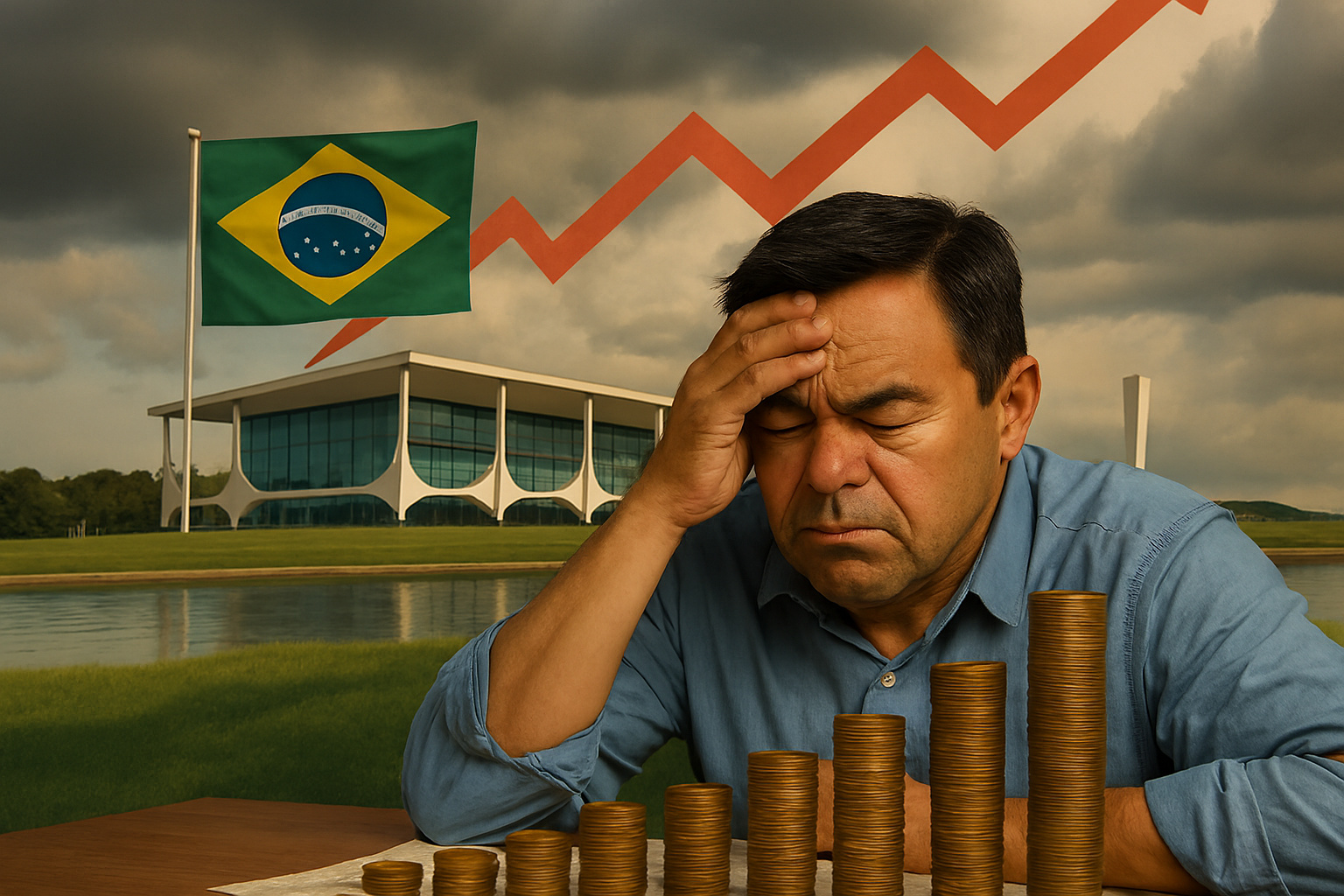


Projections Indicate Historic Jump in Taxes and Warn of the Impact of Population Aging and Rigidity of Public Spending
Brazil could achieve, by 2050, the largest tax burden increase in the world, according to a study by the Esfera Institute of Studies and Innovation, released in September 2025.
The projections indicate that the weight of taxes could rise to 42.8% of GDP, surpassing countries like Germany and Sweden.
The survey, authored by economist Pedro Fernando Nery, shows that this advance will be driven by the accelerated aging of the population and the expansion of mandatory spending, especially in health and Social Security.
Study Reveals Critical Demographic Change
According to the IBGE, the share of Brazilians over 60 years old increased from 5.1% in 1970 to 15.6% in 2022.
The projection for 2070 is 37.8%, putting strong pressure on the social security system and public spending.
-
Inflation in March reaches 0.88% according to IBGE and pressures the Brazilian economy, impacting family budgets and requiring more strategic decisions to maintain financial control.
-
In Paraná, distributor Pacto connects 100% of the load in Coronel Vivida to batteries: a BES of 10 MW and 20 MWh costs just over R$ 30 million and lowers the local tariff now.

-
With a dependence of up to 80% on gas imported from the United States, Mexico is responding with a robust energy strategy, betting on shale gas, creating a scientific committee, and preparing to expand natural gas production to reduce vulnerability and strengthen its energy security in the coming years.

-
The United States proposes to Brazil a critical minerals agreement with a minimum price to combat Chinese dumping and priority for investment, but the Planalto is blocking the signing out of fear of upsetting China and due to electoral calculations in a year of competition.

The average age of the population has also increased: from 28.3 years in 2000 to 35.5 in 2023, potentially reaching 48.4 years in 2070.
This demographic change requires the State to collect more to maintain fiscal balance, as shown by international experiences.
Currently, 90% of public spending is mandatory by law.
According to the Central Bank, public debt rose from 71.7% of GDP in December 2022 to 77.5% in August 2025, the highest level since 2021.
In the 32 months of President Luiz Inácio Lula da Silva’s third term, the budget ended in the red on 25 occasions.
Growth of Spending Threatens Fiscal Balance
With a 33% tax burden in 2023, Brazil already has a tax weight 50% above the average of emerging markets and 30% higher than the Latin American average.
Even so, the pressure on tax collection tends to grow.
Economists warn that, without deep structural reforms, the country will enter a cycle of continuous tax hikes.
This is because the aging population demands more public resources, while the room for cuts is minimal.
The study warns that raising taxes could reduce the competitiveness of companies and exacerbate social inequalities, impacting economic growth.
Structural Reforms May Not Be Enough
The tax reform under discussion, which creates the dual VAT (CBS and IBS), simplifies the collection on consumption, but does not solve the rigidity of mandatory spending.
Even if it progresses in Congress, it does not address the core issue, which is the constant growth of public expenditure.
Cutting expenses is almost impossible, as most of the budget is locked by the Constitution.
Thus, the government will depend on increasing tax collection to sustain its finances.
Tax Benefits Come to the Forefront of the Debate
Given this scenario, the Esfera Institute advocates revising tax benefits, also known as tax expenditures — exemptions and reduced rates that function as indirect subsidies.
According to the Federal Revenue and the Ministry of Finance, these incentives consume between 4.4% and 6% of GDP.
Among the main business incentives are the Simples Nacional, the MEI regime, and the regional benefits of the Free Trade Zone of Manaus.
For individuals, notable mentions include deductions in the IRPF and exemption of profits and dividends.
The economist Pedro Nery emphasizes that revising these benefits is essential to contain the deficit and stabilize the debt.
According to him, “reducing tax benefits is essential to restore the primary result and avoid a public debt explosion”.
Escape Valve and Economic Dilemma
The Esfera Institute describes tax benefits as a paradox:
while they relieve companies and taxpayers, they also reduce revenue and pressure the public budget.
This effect creates a vicious cycle — the government raises taxes on those not receiving incentives, and new sectors push for exemptions.
Consequently, the tax burden rises even further.
With an aging population, the demand for maintaining these incentives grows, but the country still lacks effective control mechanisms.
Failures in Controlling Incentives and Proposals for Correction
The study shows that the federal government created hundreds of benefits without clear criteria, without expiration dates, and without effectiveness assessments.
Some have remained active for decades, favoring the wealthiest.
For example, IRPF deductions benefit those with higher incomes, while exempting basic food items favors those who consume more.
In 2021, the 109th Constitutional Amendment set a ceiling of 2% of GDP for tax expenditures starting in 2027 and anticipated the General Law of Tax Expenditures (LGGT).
However, the law has never been presented, due to political resistance and lack of consensus.
Today, benefits remain above 4% of GDP, with no prospect of reduction.
How to Avoid Fiscal Imbalance
Pedro Nery recommends not abolishing benefits, but administering them with clear and evaluable criteria, as advised by the IMF.
The LGGT should include parameters of relevance, efficiency, equity, and simplicity.
The Special Regime for the Chemical Industry (Reiq) is a positive example, as it requires counter-guarantees and has a defined expiration period.
Similar models operate in India, where exemptions expire automatically if not justified by results.
These measures would make the system more transparent and sustainable, avoiding distortions and waste.
Narrow Path to 2050
If nothing is done, the tax burden could reach 43% of GDP, a level similar to the wealthiest economies in Europe.
However, Brazil does not have the same social welfare structure as those nations.
Economists warn that the country risks having taxes of a wealthy nation with services of an emerging country, increasing public discontent.
Thus, experts advocate for a responsible fiscal policy, careful review of incentives, and transparency in public accounts.
Ultimately, the balance between revenue and expenditure will be crucial for Brazil’s economic future.
What do you think the country should prioritize: reducing tax benefits to stabilize finances or maintaining exemptions to stimulate the economy?









Depois que o PT voltou ao poder o Brasil ficou amaldiçoado.