






 Portuguese


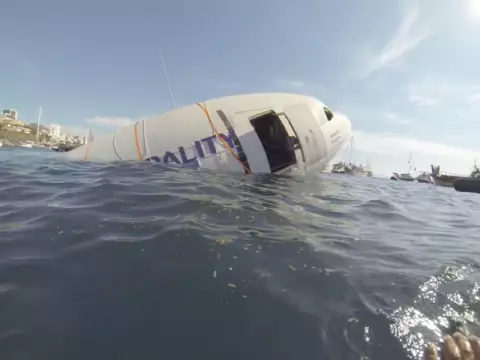
A retired Airbus A300 was purchased by authorities in Aydın for approximately US$93,000, dismantled, transported on five trucks, and intentionally sunk in the Aegean Sea. Measuring 54 meters and weighing 47 tons, it rests over 20 meters deep, where fish occupy the fuselage and divers can now reach the submerged cockpit.
An Airbus A300 that served for decades ended its operational life in a rather unconventional manner in Turkey. The aircraft was purchased by the Aydın authorities for approximately US$93,000, dismantled, transported to the coast, and intentionally sunk in the Aegean Sea to become an artificial reef and diving site.
The information was published by the Coastal Journal on August 22, 2026, in a report by Luiz Dias from the Diário Agency. The plane measured about 54 meters in length, 44 meters in wingspan, and 47 tons, and was installed in a sandy area approximately 20 to 24 meters deep.
Airbus Selected for the Project Was Delivered in 1980

The aircraft selected for the artificial reef was the SX-BEF, named “Ajax.”
-
Man Discovers Rare Stolen Picasso Lithograph After Tenant Eviction in Milwaukee Apartment

-
Paul Pogba’s Mega Mansion in Cheshire Listed for £3.5 Million: Features 688 m², Indoor Soccer Field, Gym, Home Theater, Five Bedrooms, and 45 m² Suite
-
World’s Tallest Prison to Be Built in New York’s Chinatown, Reaching 102 Meters with 13 Floors and 1,040 Beds
-
Carpenter Finds Nugget During Mill Construction in 1848, Sparks Gold Rush and Transforms California into a Center of Dispute That Would Change the United States


The Airbus A300 was delivered to Olympic Airways in 1980 and remained in service with the airline for nearly two decades before changing roles and owners.
Aircraft Transitioned from Passenger Transport to Freighter
The SX-BEF was sold in 1999.
After the sale, the aircraft was converted for cargo transport and began operating under the registration TC-ACZ, including service with companies such as ACT Cargo.
A300 Was Retired from Service in 2012
The operational career ended after more than three decades.
A photo from September 2012 captures TC-ACZ at Atatürk Airport in Istanbul, the same year the aircraft was retired from service.
Aircraft Had Accumulated 36 Years Since Its Entry into Service
By the time the sinking project was executed, the aircraft had already accumulated decades of use.
The A300 had 36 years of service since its delivery in 1980, a period during which it transitioned from a passenger aircraft to a freighter before its permanent retirement.
Aydın Authorities Paid Around US$ 93,000 for the Aircraft
Instead of sending the structure directly for dismantling as scrap, local authorities decided to repurpose it.
The Airbus was acquired for approximately US$ 93,000 at the time, with the proposal of transforming it into an artificial reef off the Turkish coast.
Project Combined Tourist and Environmental Purpose
The declared intention was to give a new function to an aircraft already retired from service.
The project aimed to create a point of interest for divers while providing a large submerged structure capable of hosting marine life.
A300 Needed to Be Dismantled Before Leaving Istanbul

The size of the aircraft prevented overland transport with the plane fully assembled.
The Airbus was dismantled in Istanbul, separating large components to allow movement to the coast.
Five Trucks Transported the Aircraft Parts
The parts were transported on highways in a large logistical operation.
It required five trucks to transport the A300 components to the Kuşadası region, as parts of the aircraft exceeded dimensions that could normally navigate a highway.
Aircraft Was Reassembled Near Kuşadası
After the overland journey, the components arrived at the coastal region.
The Airbus was taken to Güzelçamlı, in the Kuşadası region, where it was reassembled prior to its final stage in the Aegean Sea.
Buoyancy Balloons Helped Control the Sinking
Placing a 47-ton aircraft on the seabed required control throughout the operation.
Buoyancy balloons, divers, and vessels were used to position the Airbus over the selected area and guide the sinking.
Aircraft Was Placed on Sandy Seabed at Depths Up to 24 Meters

The selected spot is located in an area of sandy bottom.
The A300 is resting at approximately 20 to 24 meters deep, although current diving operators indicate the structure is within a range of about 20 to 22 meters.
54-Meter Fuselage Transformed into Diving Structure
The aircraft retains much of the recognizable volume of an airplane even underwater.
With approximately 54 meters in length and 44 meters in wingspan, the former cargo plane is now a destination for divers visiting the area.
Divers Can Navigate Parts of the Interior
The visit is not limited to external observation.
Diving operators in Kuşadası conduct routes that allow divers to pass through certain areas of the fuselage and explore the interior of the submerged aircraft.
Route Can Reach the Old Cockpit
One of the main points of interest is at the front of the plane.
Certified divers can navigate the structure and reach the cockpit, transforming a space once used to pilot the aircraft into part of an underwater route.
Airbus Maintains Three Doors on Each Side
Original elements of the aircraft’s configuration are still part of the scene.
The A300 has three doors on each side, while various openings allow the flow of divers and marine life through the former interior.
Entry into the Fuselage Requires Compatible Training

Entering a submerged structure presents risks different from those encountered during a dive in open water.
PADI recommends advanced training as useful preparation for this, while local operators require compatible diving certification and conduct the routes with instructors.
Area Almost Did Not Receive Divers Before 2016
The location where the plane was installed was not a well-established destination before the project.
Instructor Tağmaç Saraçoğlu told Anadolu Agency that there were virtually no divers in that area prior to the arrival of the Airbus.
Four Years Later, Fish Already Occupied the Aircraft

An expedition carried out in 2020 found a different scenario from the one observed before the sinking.
Schools of fish were swimming inside and around the fuselage, demonstrating that the structure had already been incorporated into the submerged environment.
Eels and Crabs Were Also Recorded at the Site
The occupation was not limited to schools of fish.
The expedition also identified eels, crabs, and other animals, which began to use parts of the aircraft and the surrounding area.
Structure Became a Draw for Underwater Photographers
The unusual visual of the old plane also transformed the site into a photographic destination.
Underwater photographers began to seek out the location due to the combination of the large metallic structure of the A300 and the marine life installed around and within the fuselage.
Retired Airbus Remains an Artificial Reef in the Aegean Sea
The former TC-ACZ remains at the bottom of the Aegean Sea, transformed from a retired cargo plane into an artificial reef and diving spot in the Kuşadası region.
Years after the sinking, the 54-meter aircraft hosts fish and other animals, while properly trained divers can explore parts of the fuselage and reach the cockpit at depths of over 20 meters.
In your opinion, what stands out the most about this project: repurposing a retired Airbus as a reef, transporting the aircraft on five trucks, or being able to dive inside the fuselage up to the cockpit? Share your thoughts in the comments.


