





 Portuguese
  English
  Spanish
  6 min of reading
  0 comments


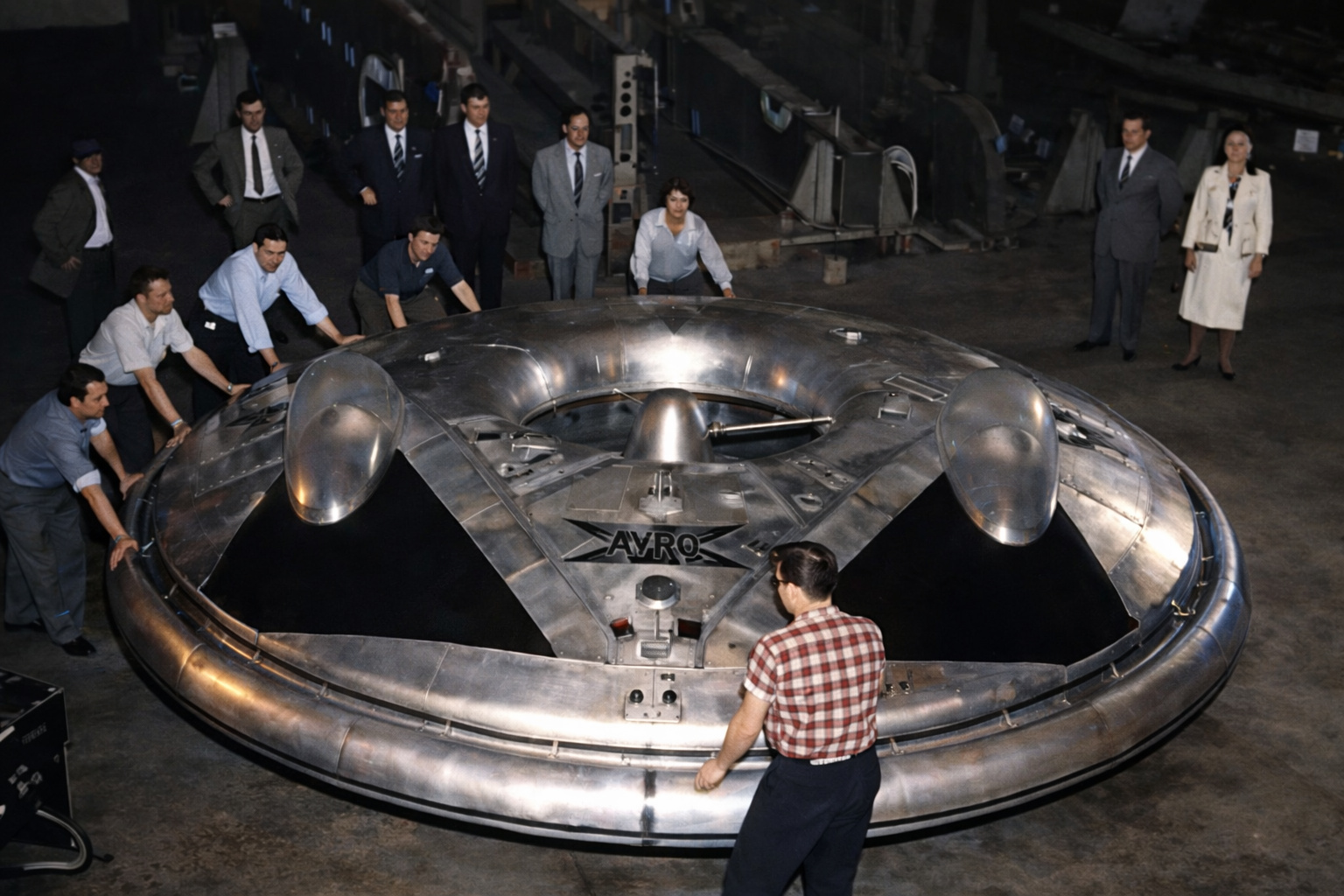
The Avro Canada VZ-9 Avrocar Was an Experimental Military Project in the Shape of a Flying Saucer Created in the 1950s for Vertical Take-Off. The Aircraft Managed to Fly in Tests Before Being Canceled.
During the Cold War, when the United States and the Soviet Union competed intensely in military technology, several experimental projects emerged attempting to revolutionize aviation. Among the most curious is the Avro Canada VZ-9 Avrocar, a circular aircraft designed to take off and land vertically — a concept known as VTOL (Vertical Take-Off and Landing).
Developed in the 1950s by the company Avro Canada, the Avrocar had an unusual shape reminiscent of a flying saucer. The project aimed to create a military aircraft capable of operating without runways, allowing armed forces to use makeshift bases anywhere.
According to records from the National Museum of the U.S. Air Force, NASA, and documents from the United States Army, two prototypes were built and flight-tested. However, stability issues prevented the project from progressing to mass production. Nonetheless, the Avrocar became one of the most fascinating aeronautical experiments in military aviation history.
-
These are the drivers who may stop paying tolls on highways in a project that promises to reduce costs for those who live from transportation in Brazil.

-
(Video): Italian pilot lands plane on moving train at 120 km/h and achieves unprecedented feat in aviation, even with a narrow runway and without direct visual contact.

-
It seems to have come out of a science fiction movie: A Brazilian city where it rains almost every day, recording over 4,000 mm per year, driven by climatic factors — a direct result of its strategic location in the Amazon.

-
The water crisis that could change everything this year has already begun; it’s not just about the climate, it affects technology, raises product prices, and can halt entire companies without warning.


Origin of the Avrocar Project in the Cold War
The development of the Avrocar began in a period marked by an intense technological race between military powers. In the 1950s, both the United States and its allies sought aircraft capable of operating without relying on traditional runways.

The military concern was clear: in the event of nuclear war or destruction of airbases, conventional aircraft could become unusable. Therefore, engineers began studying VTOL aircraft, capable of taking off vertically from small spaces.
It was in this context that British engineer John Frost, working for Avro Canada, began developing a radical concept: a circular aircraft that would use directed airflow to create lift. The project received financial backing from the United States Army and the U.S. Air Force, interested in exploring new aerial mobility technologies. The goal was to create a compact military aircraft, capable of flying low over terrain and operating in practically any location.
The Flying Saucer Shape
One of the most striking characteristics of the Avrocar was its appearance. The aircraft had a circular shape similar to a disc, measuring about 5.5 meters in diameter and approximately 1.1 meters in height. The cockpit was located at the center of the structure, while the propulsion system occupied nearly the entire interior of the disc.
This design was chosen not only for aesthetics. It was part of an attempt to apply an aerodynamic phenomenon known as the Coandă effect. This effect occurs when an airflow tends to adhere to curved surfaces. Engineers believed they could use this principle to direct high-speed air around the disc and generate lift. In practice, the Avrocar would work like a kind of floating air platform propelled by turbines.
Unusual Propulsion System
The Avrocar used a propulsion system quite different from traditional airplanes. Inside the disc were three Continental J69 turbojet engines, responsible for powering a large central fan.

This fan directed the airflow downward, creating an air cushion that would allow the aircraft to lift vertically. The idea was similar to the operation of a hovercraft, but adapted for flight. Pressurized air would be distributed around the edge of the disc, creating lift and allowing maneuvers.
According to technical reports from the U.S. Army Transportation Museum, the system was designed to generate enough thrust to lift the vehicle and allow horizontal movement. It was an attempt to create a hybrid between an aircraft, helicopter, and ground-effect vehicle.
Initial Flight Tests
The Avrocar tests began in the late 1950s. The prototypes were initially evaluated at Avro Canada facilities and later transferred to military test centers in the United States.
During the experiments, engineers found that the Avrocar could indeed lift off the ground and hover at low altitude. However, significant problems arose. The aircraft exhibited considerable instability when attempting to rise above about one meter in height.

This phenomenon became known as “hubcapping”, an oscillation that caused the disc to sway in a difficult-to-control manner. When the Avrocar tried to climb higher, the airflow became turbulent, and control became extremely challenging. This prevented the aircraft from achieving stable flight as planned.
Performance in Tests
During tests conducted between 1959 and 1961, the Avrocar prototypes demonstrated limited capabilities. Some approximate data observed during the tests include:
- operational altitude of less than 1 meter in stable flight
- maximum speed of approximately 50 km/h
- ability to lift only about one meter off the ground
These numbers were far below military expectations. The original goal was for the Avrocar to achieve speeds exceeding 480 km/h and fly at significant altitudes.

However, aerodynamic limitations prevented the project from achieving this performance. Despite partially functioning, the concept did not manage to achieve the necessary capabilities for military use.
Cancellation of the Program
Due to stability and performance problems, the Avrocar program was ultimately canceled in 1961. The United States Army and Air Force decided to stop their investments in the project.
Although tests showed that the concept could work in theory, the technical challenges were too great for the technology available at the time. The aircraft also faced control difficulties and high fuel consumption.

With the advancement of more efficient military helicopters and the development of VTOL aircraft with different concepts, the Avrocar lost relevance. The project was officially terminated after the construction of only two prototypes.
The Technological Legacy of the Avrocar
Even though it was canceled, the Avrocar left significant contributions to aeronautical engineering. Studies on airflow, lift fans, and VTOL vehicle control aided in the development of later technologies. Some concepts tested in the Avrocar influenced research related to:
- vertical take-off aircraft
- ground-effect vehicles
- aerodynamic flow control systems

These researches ultimately contributed to the advancement of experimental aircraft in the following decades. Various NASA studies and military research centers analyzed the results of the Avrocar to better understand its limitations and possibilities.
Where Are the Prototypes Today
Of the two prototypes constructed, both have been preserved as historical pieces. One is on display at the National Museum of the United States Air Force in Ohio. Another prototype can be found at the U.S. Army Transportation Museum in Virginia.
These examples remain as testimonies of a period in aviation history marked by radical experiments. The Avrocar’s unusual appearance continues to attract the attention of visitors, often being compared to reports of unidentified flying objects.
One of the Most Curious Projects in Military Aviation
The Avro Canada VZ-9 Avrocar occupies a unique place in the history of military technology. Although the project did not achieve the expected results, it represents an example of how engineers and military personnel explored innovative ideas during the Cold War.
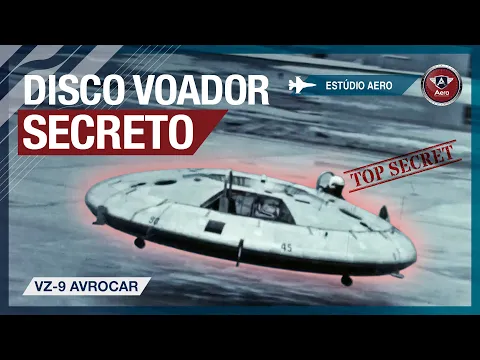

With its circular shape, attempt at vertical flight, and unusual propulsion system, the Avrocar became one of the most curious aeronautical experiments ever conducted. Even decades after its cancellation, the project is still remembered as one of the boldest attempts to turn the concept of a “flying saucer” into a real military aircraft.








-

Uma pessoa reagiu a isso.