





 Portuguese
  English
  Spanish
  4 min of reading
  0 comments



The Lack Of Clear Regulation For The Carbon Market Prevents The Country From Taking Advantage Of A Billion-Dollar Economic Opportunity, Generating Legal Uncertainty For Investors, Says Debate At The Senate Agency.
Brazil has in hand the chance to earn up to US$ 100 billion per year from the carbon market, turning its vast environmental potential into a powerful economic engine. However, the lack of definitive and detailed regulation creates a scenario of profound legal uncertainty that drives away investments and delays the utilization of this opportunity, as highlighted in a recent debate in Congress reported by the Senate Agency.
The discussion, which took place in the Parliamentary Group for Relations with the BRICS, revealed a consensus among experts and parliamentarians: without clear rules, the Brazilian System of Greenhouse Gas Emission Trading (SBCE), although established by law, cannot advance practically. This delay impacts not only large industrial projects but also the small rural producer, who could become a major beneficiary of the sale of carbon credits generated by sustainable practices.
The Billion-Dollar Potential And Competitive Advantage Of Brazil
The potential of US$ 100 billion annually is not a random number, but a projection based on Brazil’s unique comparative advantages. The country has the largest tropical rainforest in the world, a predominantly renewable energy matrix, and an agricultural sector with enormous capacity to adopt low-carbon practices. Every ton of carbon dioxide (CO₂) that is not emitted or is removed from the atmosphere can become a carbon credit, a tradable financial asset globally.
-
Inflation in March reaches 0.88% according to IBGE and pressures the Brazilian economy, impacting family budgets and requiring more strategic decisions to maintain financial control.
-
In Paraná, distributor Pacto connects 100% of the load in Coronel Vivida to batteries: a BES of 10 MW and 20 MWh costs just over R$ 30 million and lowers the local tariff now.

-
With a dependence of up to 80% on gas imported from the United States, Mexico is responding with a robust energy strategy, betting on shale gas, creating a scientific committee, and preparing to expand natural gas production to reduce vulnerability and strengthen its energy security in the coming years.

-
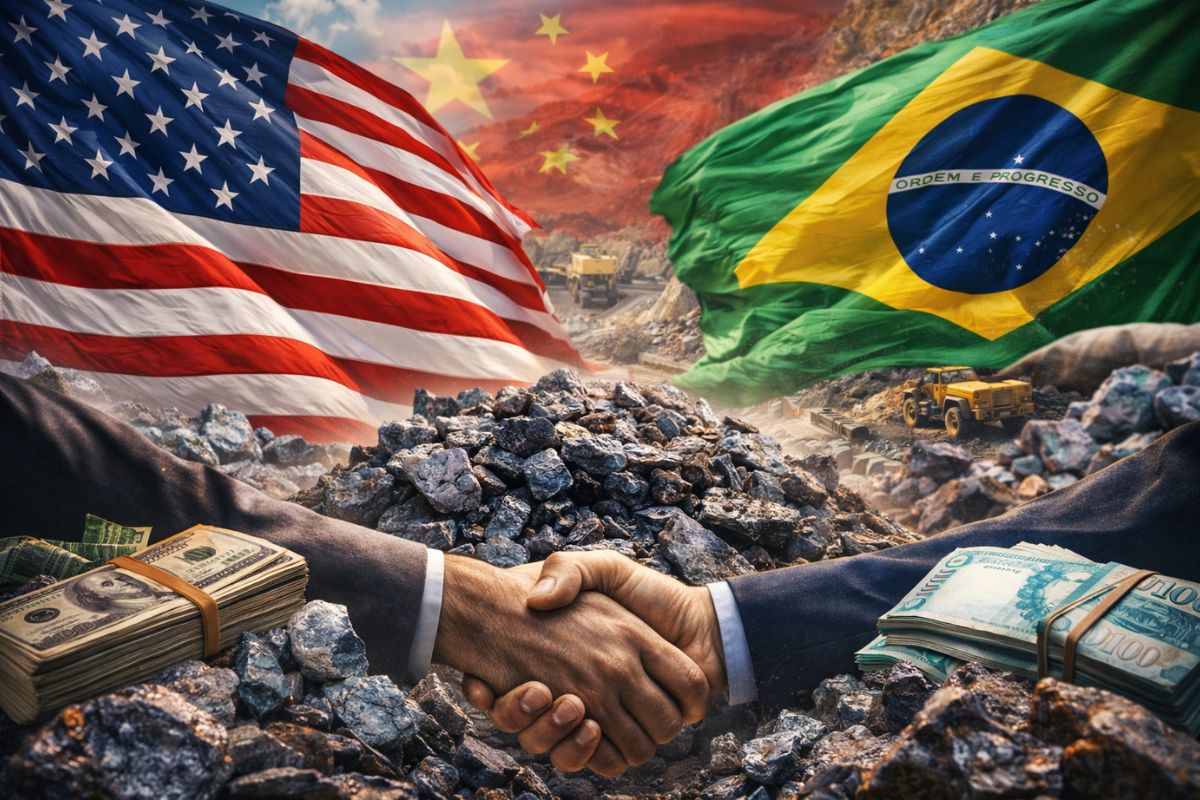
The United States proposes to Brazil a critical minerals agreement with a minimum price to combat Chinese dumping and priority for investment, but the Planalto is blocking the signing out of fear of upsetting China and due to electoral calculations in a year of competition.
This asset can be traded in two environments: the voluntary market, where companies buy credits to offset their emissions on their own initiative, and the regulated market, where buying and selling are mandatory for specific sectors of the economy. While Brazil already participates in the voluntary market, it is in the regulated environment that the largest financial volume resides. The lack of clear rules on how credits will be generated, certified, and traded in the SBCE prevents the country from accessing this capital flow.
Legal Uncertainty: The Main Obstacle To Investments
The creation of the Brazilian Emission Trading System was a “great advance”, as stated by Pedro Neto, secretary of the Ministry of Agriculture and Livestock, during the hearing reported by the Senate Agency. However, the law alone is not enough. National and international investors need security and predictability to allocate capital to decarbonization projects, which are usually long-term. Without decrees and regulations detailing the rules of the game, the risk of investing in Brazil becomes high.
According to Artur Silva Boaretto, advisor to the Ministry of Development, Industry, and Commerce, the carbon market in Brazil needs to be governed by principles of “transparency, fairness, and collaboration”. As reported by the Senate Agency, he advocated for the creation of a “link” between the Brazilian system and the markets of other countries. This integration is essential to ensure that Brazilian credits have international validity and liquidity, but it will only be possible when the measurement, reporting, and verification (MRV) methodologies are established and globally recognized.
Democratization And Integration: The Next Necessary Steps
One of the most important points raised in the debate was the need to democratize access to the carbon market. Pedro Neto from the Ministry of Agriculture advocated for measures that facilitate small producer participation. This means creating simplified mechanisms so that farmers who adopt techniques such as no-till farming, recovery of degraded pastures, or integrated crop-livestock-forest systems can quantify their environmental contribution and sell carbon credits, creating a new source of income.
In addition to inclusion, international alignment is crucial. The proposal for an “open coalition for the integration of carbon markets,” mentioned by Boaretto, is strategic. This would allow a company in Brazil to sell its credits to a European company that needs to meet its emission targets. Without this compatibility, the carbon market in Brazil runs the risk of becoming an island, with lower-value assets and little attractiveness for foreign capital.
Brazil At The Crossroads Of The Green Economy
Regulating the carbon market is undoubtedly one of the most strategic issues for the future of the Brazilian economy. The opportunity to align sustainable development with billion-dollar gains is on the table, but it depends on clear and swift political decisions. The debate at the Senate Agency reinforces that the diagnosis is known, and the path to be followed is clear. The question that remains is whether the country will be able to overcome bureaucratic barriers in time.
What do you think about the topic? Do you believe that Brazil will be able to unlock this potential in time, or will bureaucracy cause us to miss this historic opportunity? Leave your opinion in the comments below; we want to hear from those closely following the topic.








-

Uma pessoa reagiu a isso.