





 Portuguese
  English
  Spanish
  5 min of reading
  0 comments


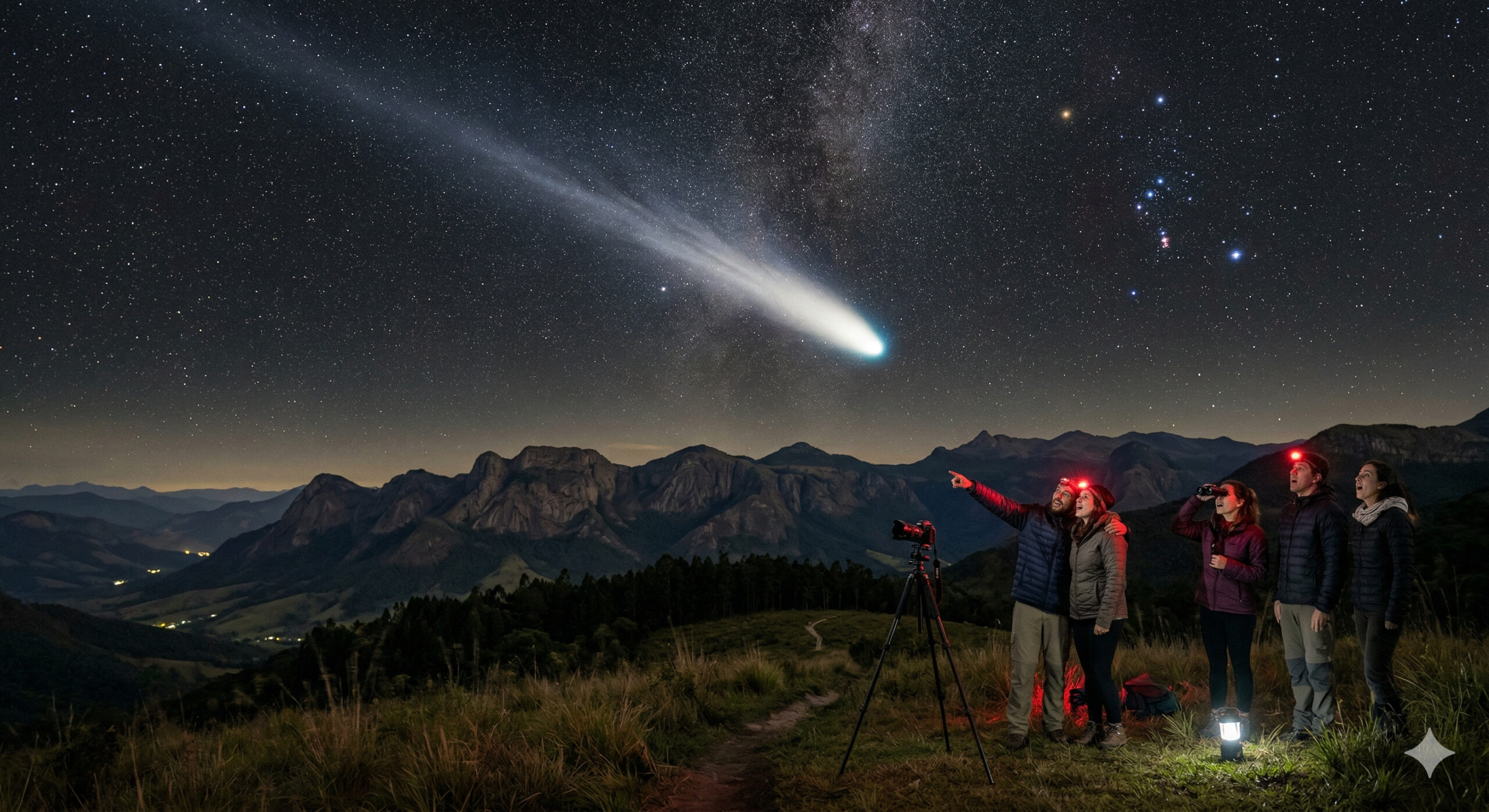
Comet C/2025 R3 may be visible to the naked eye in April and promises one of the greatest recent astronomical spectacles.
On April 8, 2026, astronomical tracking platforms and specialized vehicles such as Live Science began to highlight the increasing brightness of comet C/2025 R3 (PanSTARRS), an object whose trajectory has been monitored by NASA/JPL and records compiled in the Comet Observation Database (COBS). The attention surrounding the phenomenon grew because the comet is approaching the Sun towards its perihelion, expected on April 19 to 20, 2026, a phase in which this type of body usually gains activity and brightness. The comet, officially registered by the Minor Planet Center, was discovered in images from the Pan-STARRS program and exhibits behavior consistent with objects rich in ice and dust. As it moves inward into the Solar System, its surface heats up and begins to release gas and particles, forming the coma and tail that characterize this type of celestial object.
This process, known as sublimation, is described by NASA as the transformation of ice into gas when the comet approaches the Sun. In the case of C/2025 R3, the brightness curves compiled by COBS and reported by Live Science indicated in April a consistent increase in luminosity, opening the possibility that it could become visible to the naked eye in dark sky regions, although this type of evolution still depends on the comet’s behavior in the final weeks before its closest approach to the Sun.
Approach of the Sun intensifies activity and may transform the comet into a visible spectacle
The central point of this evolution lies in the comet’s orbital trajectory. According to astronomical calculations, C/2025 R3 reaches its perihelion — the closest point to the Sun — on April 20, 2026.
-
After a devastating fire that left 3 injured and 200 intoxicated by smoke in the Red Sea, the most expensive warship ever built — $13.3 billion — returns to the front in Iran after quick repairs in Croatia.

-
In the Saudi Arabian desert, the world’s largest green hydrogen plant is 80% complete and will use 4 gigawatts of solar and wind energy to produce 600 tons of clean fuel per day when it opens in 2027.

-
Sixteen years after the largest environmental disaster in oil history, BP has just received approval to open its first new field in the Gulf of Mexico, and the 10 billion barrels are 10 kilometers below sea level.

-
It shouldn’t exist — but it’s there: James Webb telescope captures impossible atmosphere on giant exoplanet that challenges all known astrophysics.
It is at this moment that the comet’s activity tends to reach maximum levels. Solar heat causes the accelerated release of material, expanding the coma (cloud around the nucleus) and elongating its tail, which can extend for millions of kilometers into space.

A few days later, on April 27, the object also approaches relatively close to Earth, which further increases its visibility.
This combination of factors — proximity to the Sun and Earth — is what transforms certain comets into rare and highly observable events.
Possibility of visibility to the naked eye depends on specific conditions
Although there is anticipation that the comet will become visible without instruments, this depends on a series of variables.
The apparent magnitude of the object, which measures its perceived brightness, needs to reach sufficiently low levels to allow direct observation. Additionally, factors such as light pollution, atmospheric conditions, and position in the sky directly influence the experience.
In areas far from urban centers, with clear skies and little light interference, the chances of observation increase considerably.
Even when it does not reach ideal levels for naked-eye observation, the comet can still be easily seen using binoculars or amateur telescopes.
Comets are primitive records of the formation of the Solar System
Beyond the visual spectacle, the scientific importance of comets is significant. These objects are considered remnants of the formation of the Solar System, preserving materials that date back billions of years.
The nucleus of a comet is primarily composed of ice, dust, and organic compounds, forming a kind of “frozen archive” of the conditions that existed at the time when the planets began to form.
By studying the composition of these bodies, scientists can obtain clues about the origin of water on Earth and even about the chemical processes that may have contributed to the emergence of life.
Structure of the comet reveals complex dynamics in space
The C/2025 R3 exhibits the classic elements of cometary structure. The solid nucleus, usually a few kilometers in diameter, is surrounded by the coma, a cloud of gas and dust that expands as material is released.
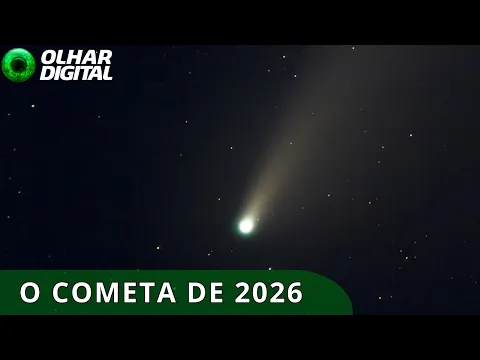
From this region, two distinct tails form. The dust tail, more visible, reflects sunlight and follows a curved trajectory. The ion tail, composed of electrically charged particles, is pushed directly by the solar wind, forming a straighter line.
This structure can be observed at different levels depending on the intensity of the comet’s activity.
Events like this are not frequent and depend on specific trajectories
Although comets regularly pass through the inner Solar System, few reach ideal conditions to become visible spectacles from Earth. The necessary combination involves factors such as:
- Rich composition of volatile materials
- Favorable trajectory in relation to the Sun and Earth
- Low interference from sunlight at the time of observation
Therefore, events like the possible brightness of C/2025 R3 often generate great interest, both among scientists and the general public.
Continuous monitoring allows predicting the behavior of the comet
Astronomers continuously monitor the comet using ground-based telescopes and automated observation systems.
This data allows adjusting predictions about brightness, trajectory, and activity evolution. However, comets are notoriously unpredictable objects.
Small variations in composition or internal structure can significantly alter behavior, resulting in brightness greater or lesser than expected. Astronomical events visible to the naked eye have a direct effect on public interest in astronomy.
- Phenomena such as eclipses, meteor showers, and bright comets tend to attract global attention, encouraging sky observation and engagement with science.
In the case of C/2025 R3, the possibility of visibility without equipment further amplifies this reach.
Curiosity about comets continues to be one of the main drivers of popular scientific interest
The presence of a visible comet in the sky always sparks curiosity, both for its visual aspect and historical significance.
Ancient civilizations interpreted these objects as signs or omens. Today, they are studied as fundamental pieces to understand the formation of the Solar System.
Still, the visual impact remains one of the main factors that make these events relevant. The evolution of brightness in the coming weeks will be decisive in determining the level of visibility of the comet.
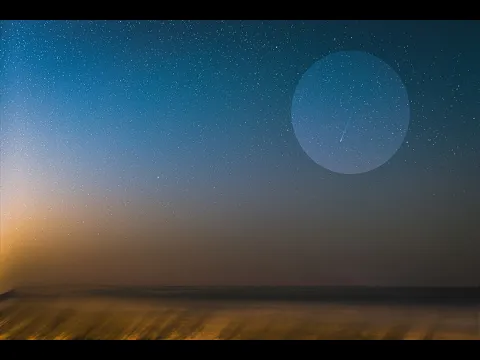
If the predictions are confirmed, C/2025 R3 may become one of the most remarkable astronomical events in recent years, entering the list of comets that were easily observed from Earth without the aid of instruments.
Now, with the comet approaching the most critical point of its trajectory, attention turns to the sky and the question that always accompanies these events: will it really become visible to the naked eye or will it remain a spectacle reserved for telescopes?










Seja o primeiro a reagir!