





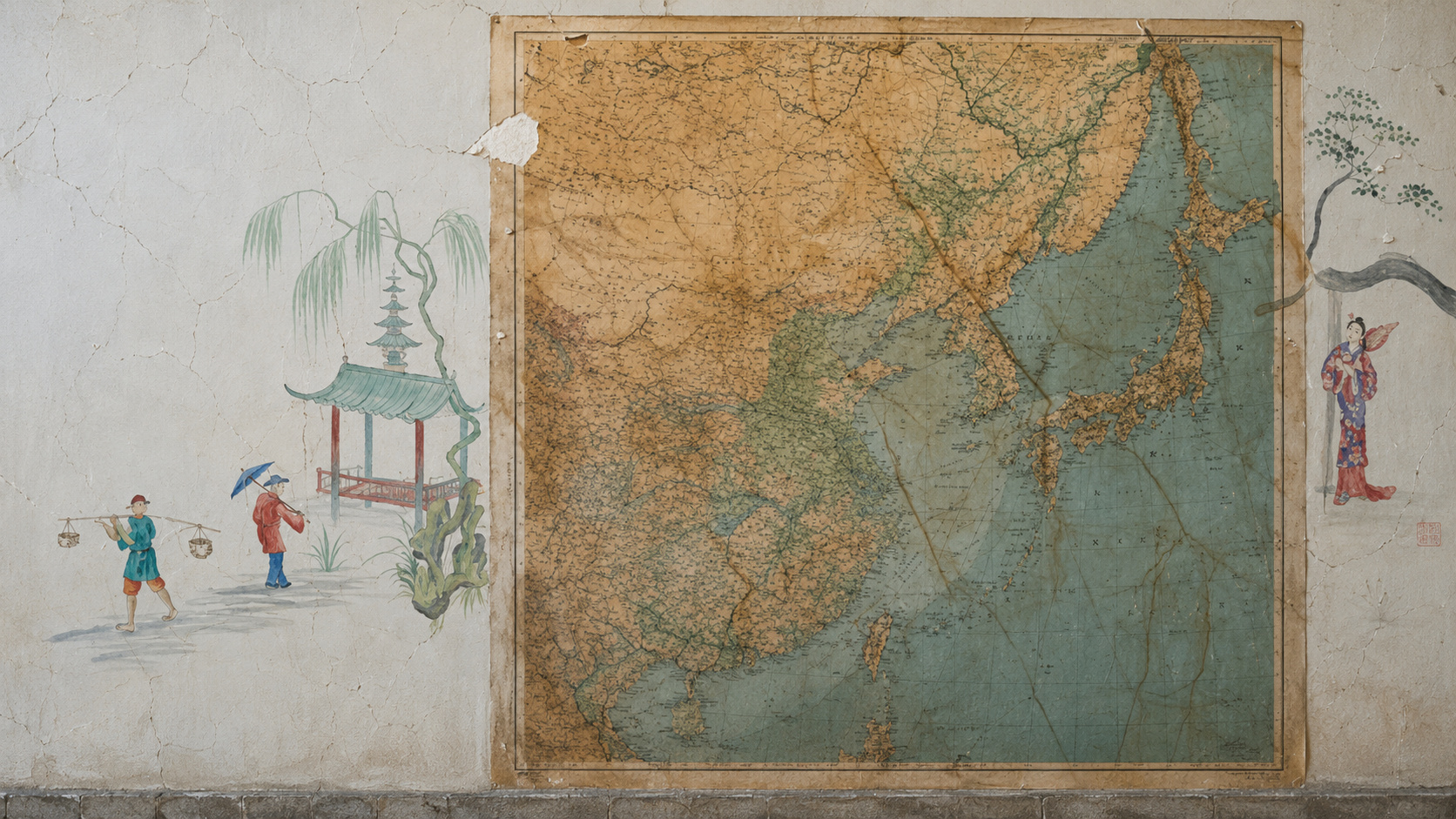

An apparently ordinary storeroom concealed an entire room covered by 11 maps and watercolors from the 1930s. After removing two layers of wallpaper and decades of paint, conservators revealed volcanoes, cities, animals, and a fantastic creature.
For decades, a storeroom inside the historic Eltham Palace in London seemed to hold only common remnants of the building’s various occupations. However, small fragments found on the walls indicated that something much larger remained hidden beneath the surface. When conservators began to carefully remove two layers of wallpaper and decades of paint, colors, geographic lines, and hand-drawn illustrations emerged. The room concealed an entire space decorated with 11 maps of different regions of the planet.
The work revealed an environment created in the 1930s for Stephen and Virginia Courtauld, owners of the Art Deco mansion built next to the medieval structures of Eltham. The restoration required approximately 1,600 hours of specialized work.
Small fragments revealed a hidden room
The discovery began when conservators identified pieces of maps on the walls of a space used as a storeroom. The room had originally been the office of Virginia Courtauld’s secretary, responsible for assisting in organizing the family’s activities and travels.
-
Celtic trumpet with animal head sounds again after 2,000 years and reveals musical mystery of the Iron Age

-
Archaeologists finally explain why faceless knights appear tiny in decorated tombs in Japan, while horses gain impressive details and reveal an ancient collective ritual to guide the dead in Kyushu.
-
King Charles III opens the gardens of his royal residence for the first time for a historic flower exhibition, arrives by carriage with Camilla, and is surprised by a toilet transformed into a sustainable planter.
-
Balcony immortalized by Michael Jackson in Pelourinho may change for good after 17 years, as merchant receives order to leave and the fate of the famous tourist spot remains surrounded by doubts.


The presence of those fragments raised the possibility that the wallpaper concealed a more extensive decoration. The team then began a careful investigation, gradually removing the layers applied over the walls over the decades.
What seemed to be just a small image turned out to be part of a complete set. As the covering was removed, the conservators realized that practically the entire environment had been transformed into an illustrated representation of the Courtaulds’ travels.
Two layers of paper hid 11 maps
The paintings were covered by two layers of wallpaper, as well as successive applications of paint. These interventions hid the images for decades, but also prevented part of the decoration from being directly exposed to light and everyday contact.
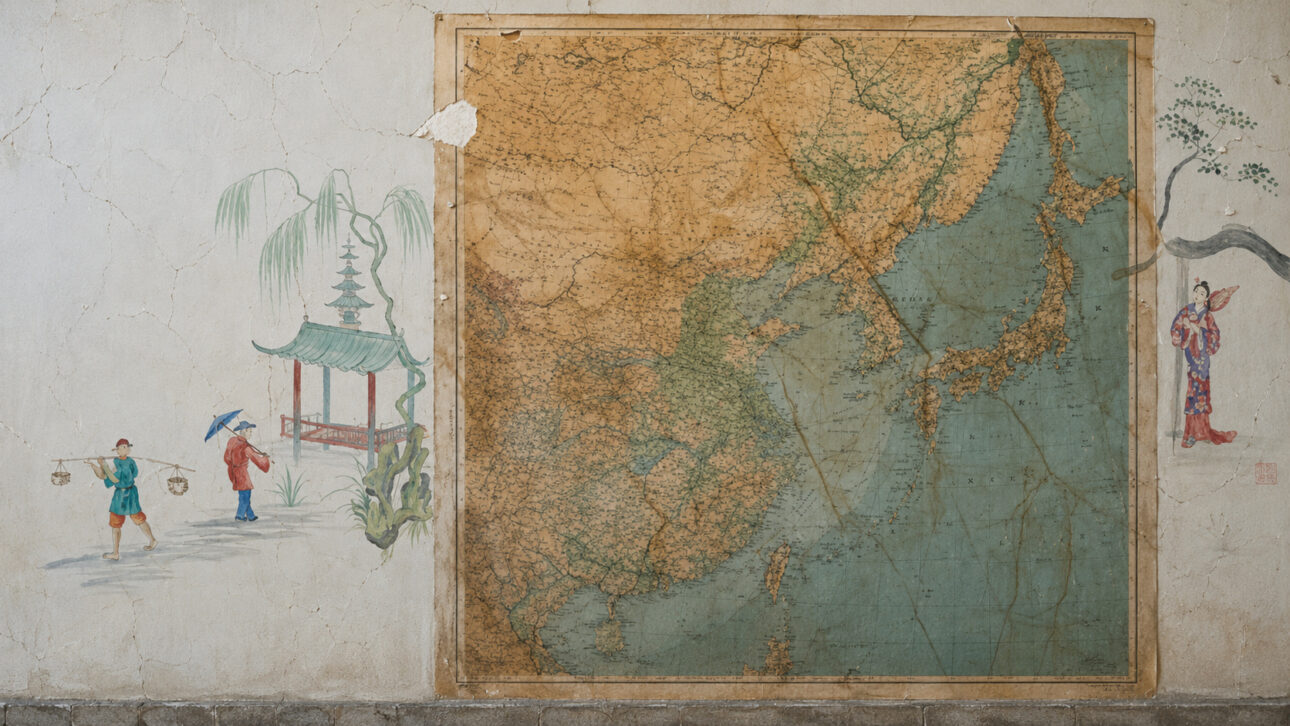
Beneath the coverings, specialists found 11 maps representing places distributed around the world. The images were accompanied by watercolors, characters, monuments, animals, means of transport, and references to the represented regions.
The room did not function only as a decorative composition. It was linked to Stephen and Virginia Courtauld’s interest in international travel and helped the family and their secretary plan trips, expeditions, and long cruises undertaken aboard a private yacht.
Volcano, mythical creature, and Santa Claus appear on the walls
Among the recovered images was the depiction of an erupting volcano, positioned next to a geological map. Near the map of London, conservators found airplanes, St. Paul’s Cathedral, and the city’s coat of arms accompanied by the United Kingdom’s flag.
Another scene showed Santa Claus crossing the sky of Iceland in his sleigh. A mythical creature holding elephants with its claws was also identified, one of the most unusual images of the entire set recovered by the team.
The walls also featured figures associated with different cultures and regions, including Balinese temples, Japanese characters, a camel with its driver, a pagoda, and marine elements near the world geological map.
Maps recorded the Courtauld’s travels
Stephen and Virginia Courtauld were known for frequently traveling and documenting their experiences in photographs, albums, and diaries. Many trips were made aboard the yacht Virginia, used by the couple for journeys across Europe and other regions of the world.
The maps and murals were probably conceived to recall the places visited and assist in planning new trips. The set created a kind of permanent geographic diary, in which cartography, memory, and decoration appeared together on the walls.
The presence of such different references, from London and Iceland to Bali and New Guinea, demonstrates the scale of the family’s geographical interests. The environment also helps to reconstruct how wealthy families of the period used maps, images, and travel records before the popularization of digital resources.
Conservators worked directly on fragile paper
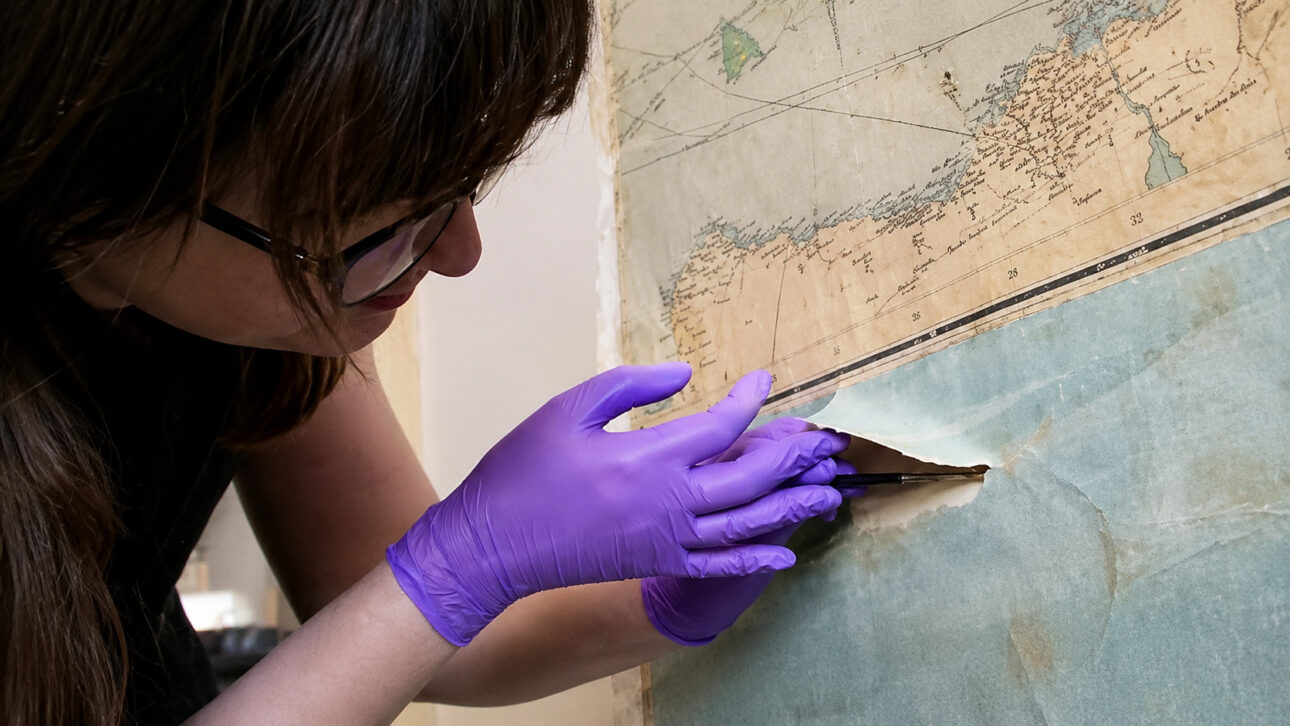
The recovery was especially complex because the maps and illustrations had not been painted directly on the plaster. The images were on a lining paper applied to the wall, material that had become extremely fragile after decades hidden.
The specialists used scalpels to slowly remove the residues of paint and wallpaper. The process needed to avoid cuts, scratches, or accidental removal of the original pictorial layer, requiring precise control over each small area worked on.
After exposing the images, the team removed a yellowish layer of varnish that altered the colors. In places where the paper was detaching from the plaster, the conservators injected adhesive into the empty spaces to reattach the material to the wall.
Restoration consumed 1,600 hours of work
The complete recovery of the Map Room required approximately 1,600 hours of work by the conservators. The duration demonstrates the fragility of the paintings and the need to carry out each step without compromising a set that had survived hidden for almost eight decades.
Part of the project was carried out in front of visitors to Eltham Palace. The public could watch the professionals removing the coverings, cleaning the images, and stabilizing the paper, turning the conservation itself into an educational activity.
The intervention was funded by public donations allocated to English Heritage. The funding allowed the hiring of specialists, protecting the deteriorated parts, and preparing the space so that the maps and murals could be presented to visitors.
Medieval palace was transformed into an Art Deco mansion
Eltham Palace was an important royal residence during the Middle Ages and the Tudor period. The great hall preserved in the complex was built for Edward IV in the 1470s and was linked to the childhood of the future King Henry VIII.
In 1933, Stephen and Virginia Courtauld obtained the right to occupy the land and hired architects John Seely and Paul Paget. The project restored the medieval hall and added a modern residence, completed in 1936 and decorated with Art Deco interiors.
The result brought together structures separated by several centuries. The ensemble came to combine walls, moat, and medieval hall with a mansion equipped with heating, communication systems, luxurious bathrooms, built-in bars, and solutions inspired by modern ships.
Room lost its function and became a storage
The Map Room was originally used as the office of Virginia Courtauld’s secretary. There, appointments were organized and international trips were planned, including cruises taken by the family on their yacht.
After the Courtaulds left Eltham at the end of World War II, the building underwent new occupations and adaptations. The former room was transformed into storage, while its decoration ended up covered by paint and wallpaper.
With the visual disappearance of the maps, the original function of the space was also forgotten. Only the small fragments found by conservators allowed recognition that those walls hid one of the mansion’s most personal decorations.
Discovery recovered part of Eltham Palace’s identity
The restoration did not only recover decorative objects. The maps offer material evidence about the interests, travels, and daily life of Stephen and Virginia Courtauld during the period when they transformed Eltham Palace into one of the most modern residences in England.
The ensemble also demonstrates how renovations carried out over time can temporarily erase important parts of a building. In this case, an old workroom disappeared under common coverings and remained unknown even while being inside a palace managed as a historical heritage.
After conservation, the Map Room became part of the public tour. Visitors can observe the recovered images and understand how an apparently common storage hid 11 maps, watercolors, and travel records preserved for decades behind the walls.


