Portuguese


Renault Twingo returns in 2026 as an electric vehicle with 82 horsepower, LFP battery, up to 263 km of range, and a design directly inspired by the classic from the 1990s.
Few European popular cars from the 1990s were as recognizable as the Renault Twingo. Small and rounded, with large headlights resembling eyes and a front that formed a sort of smile, the model launched in the early part of that decade completely deviated from the square design of many compacts from that period.
More than three decades later, Renault has decided to revive that personality in the Twingo E-Tech electric, the fourth generation of the model, set to be sold in Europe in 2026, featuring a 60 kW (82 horsepower) motor, a 27.5 kWh LFP battery, and an official range of up to 263 kilometers based on the WLTP cycle.
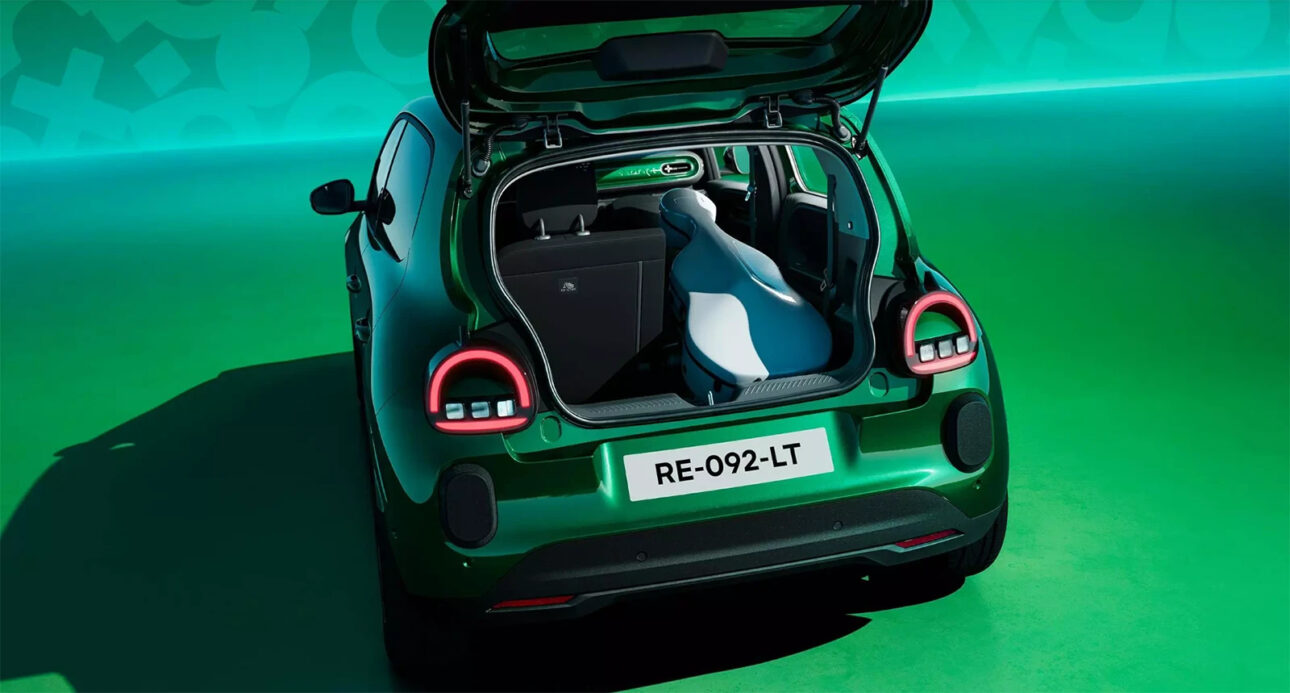
The new car aims not to transform the Twingo into an SUV, crossover, or premium compact. At just 3.79 meters long, with five doors and two rear seats that can slide independently to prioritize space for passengers or luggage, Renault returns to the same concept that made the first generation stand out: a minuscule car on the outside but extremely efficient on the inside.
-
Volkswagen introduces 1.5-liter TSI Evo2 turbo engine for its first flex-fuel hybrid in Brazil, to be produced in São Bernardo do Campo with a 2027 launch, combining ethanol, gasoline, and electricity

-
Denza Bao 3 debuts in Brazil with 354 hp, five-minute charging and price still under wraps

-
Pickup buyers waiting for the $24,950 Slate Truck now have the first drive reports, as reviewers took pre-production prototypes around Pasadena and found a 65-kWh battery, a single rear motor and up to 205 miles of claimed range

-
Toyota, the world’s largest automaker, closes Brazil factory with 1,500 workers after 28 years, negotiates severance over 80 months’ pay, centralizes production in Sorocaba


The original Twingo appeared when small cars were still extremely simple
The story began at the 1992 Paris Motor Show, with sales starting the following year. The first Twingo surprised many because it did not simply look like a smaller version of another Renault model.
The unique body style resembled a small minivan. The large, rounded headlights gave personality to the vehicle, while the interior explored unusual modularity solutions for such small cars.
Renault claims that the Twingo has surpassed 4.1 million units sold in 25 countries across its various generations. This number helps to explain why the manufacturer is once again seeking a look similar to the original model.
Thus, the name Twingo has not been absent for three decades. What Renault has truly resurrected in the 2026 model is mainly the visual language and practical philosophy of the first-generation model from the 1990s.
The “little frog” returns primarily in the car’s face
At the front, the connection between past and present becomes most evident. The new Twingo features rounded headlights once again, now completely LED, and a small grille that reinforces the impression of a smiling face.
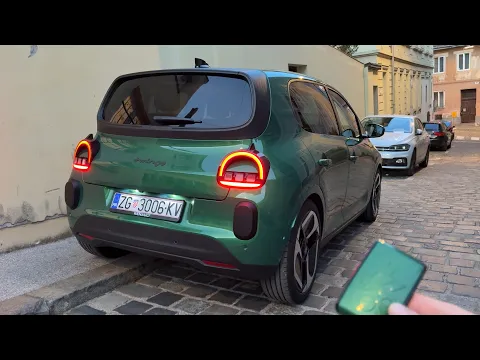

Renault explicitly states that the headlights and front end are references to the first generation.
The body lines also recall the rounded style of the original. The short hood meets a significantly sloped windshield, once again forming a silhouette resembling a small bubble.
The difference is that what was once a result of mechanical simplicity in the 1990s now must coexist with aerodynamics, sensors, electronic systems, and modern safety requirements.
The Twingo now completely abandons the gasoline engine
The biggest transformation cannot be seen from the outside. The Twingo E-Tech electric is 100% electric.
Its motor delivers 60 kW, equivalent to 82 hp, a relatively modest power compared to the increasingly higher numbers of modern electric vehicles, but consistent with the proposal of a lightweight urban car.
Renault avoided installing a huge battery and hundreds of horsepower in a car that was primarily developed for city driving.
The strategy was to do the opposite: reduce weight, consumption, battery size, and cost.
According to the manufacturer, the Twingo weighs approximately 1,200 kg, a low figure by today’s electric vehicle standards.
Battery has only 27.5 kWh
While larger electric vehicles may utilize batteries over 60, 80, or even 100 kWh, the new Twingo operates with a pack of just 27.5 kWh.
The chosen chemistry is LFP, which stands for lithium iron phosphate. It is the first application of this type of battery in the Renault Group, according to the manufacturer.
The company claims that the combination of LFP chemistry and cell-to-pack architecture helps reduce the battery pack cost by approximately 20% compared to the reference solution used in the project.
This choice helps explain how Renault managed to keep the starting price below the threshold of 20,000 euros in Europe.
Range reaches 263 kilometers in the WLTP cycle
With the 27.5 kWh battery, the approved range can reach 263 km in the European WLTP cycle. This is not a number intended to compete with long-range electric vehicles.
The focus is urban.
Renault itself positions the Twingo as a vehicle primarily designed for urban commuting and nearby regions.
In March 2026, the manufacturer also reported a consumption of 12.2 kWh per 100 kilometers, which at that time was still described as subject to final homologation.
For those who drive just a few dozen kilometers each day, the logic is to use a smaller battery instead of carrying hundreds of extra kilos just to achieve range that is rarely necessary for everyday use.
Fast charging can take the battery from 10% to 80% in about 30 minutes
The standard version uses an onboard AC charger of 6.6 kW. According to data released by Renault, charging from 10% to 100% can be completed in approximately 4 hours and 15 minutes, based on the conditions specified by the manufacturer.
There is also the Advanced Charge package. It adds a bidirectional AC charger of 11 kW and a DC fast charging capability of 50 kW.
In this configuration, Renault estimated approximately 30 minutes to go from 10% to 80% of the battery. The package also supports V2L and V2G functions in compatible markets.
With V2L, the battery can supply power to external devices, reaching up to 3,700 watts through an appropriate adapter.
Technical specifications of the Renault Twingo E-Tech electric 2026
| Item | Renault Twingo E-Tech electric |
|---|---|
| Powertrain | 100% electric |
| Power | 60 kW, 82 hp |
| Battery | 27.5 kWh |
| Battery chemistry | LFP |
| Range | Up to 263 km WLTP |
| Declared consumption | About 12.2 kWh/100 km |
| Standard AC charging | 6.6 kW |
| Optional AC charging | 11 kW bidirectional |
| Optional DC fast charging | 50 kW |
| 10% to 80% in DC | About 30 minutes |
| Length | 3.79 meters |
| Wheelbase | Approximately 2.49 meters |
| Doors | 5 |
| Seats | 4 |
| Weight | Starting from approximately 1,200 kg |
| Trunk | Up to 360 liters, depending on seat position |
| Rear seats | Two independent, sliding seats |
| Digital display | 7 inches in the Evolution version |
| Multimedia | About 10 inches |
| Launch price in Europe | Starting from € 19,490 before incentives |
The rear seats are one of the most important secrets of the new Twingo
The electric motor may represent the greatest technological transformation, but perhaps the characteristic most true to the original Twingo is found inside the car.
The two rear seats can slide individually. This allows for modification of the space distribution according to needs.
If there’s a tall passenger sitting behind the driver, the seat on that side can be moved back. If the other side is occupied only by luggage, the second seat can slide forward.
Renault has been using this system since the base version, not just in the more expensive configuration. This solution directly recalls one of the most memorable features of the first generation.
Interior blends nostalgia with integrated Google and up to 24 driving assistants
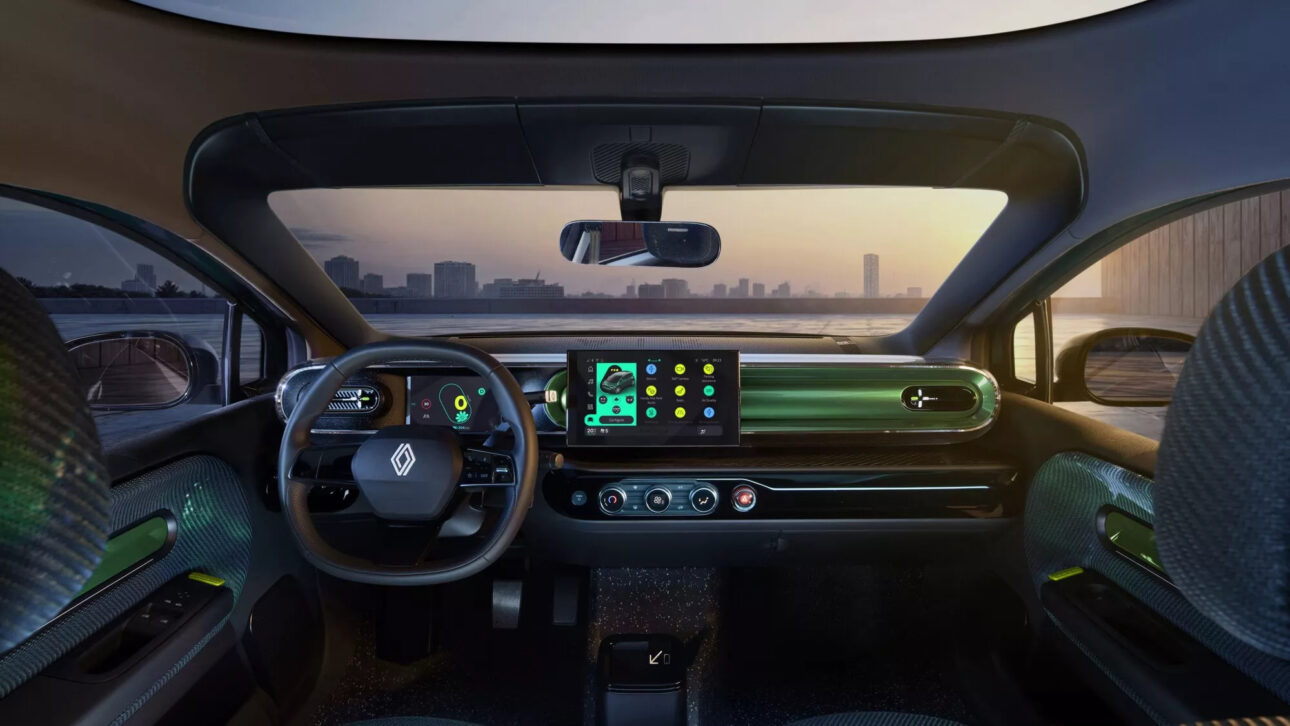
The resemblance to the past decreases dramatically when the driver looks at the dashboard. The Evolution version features a 7-inch digital display and an approximately 10-inch multimedia screen, along with wireless smartphone mirroring.
In the Techno version, the OpenR Link system appears with integrated Google. The driver can utilize services like Google Maps and other features directly through the vehicle’s center console, depending on the market and configuration.
Renault also reports the availability of up to 24 advanced driving assistance systems, an unimaginable number for the small economy car launched in the 1990s.
The package may include features like automatic emergency braking, driver monitoring, and parking assistants.
One Pedal function allows driving most of the time using only the accelerator
Another available technology is the One Pedal. When activated, the system significantly increases energy regeneration by lifting off the accelerator.
The car decelerates with enough intensity to come to a complete stop in certain situations.
This allows for driving most urban time while only modulating the accelerator pedal.
In heavy traffic, at stoplights, and during slow movement, the need to constantly switch between the accelerator and brake can be reduced.
In addition to comfort, regenerative deceleration helps return some energy to the battery.
European price was one of the biggest bets of the project
When the prototype first appeared, Renault made a clear promise: to keep the price of the new Twingo at less than €20,000 before government incentives.
The goal was achieved. The Evolution version was announced at €19,490.
As of September 2, 2026, this would translate to approximately R$ 115,000 in a direct mathematical conversion.
However, this amount should not be interpreted as a potential price in Brazil.
Taxes, logistics, certification, commercial strategy, and production would completely change the calculations if the model were officially sold in Brazil.
The Techno version was initially announced in Europe for € 21,090.
In Brazil, Renault Still Shows the Twingo as a Prototype
Renault currently has a Brazilian page dedicated to the Twingo E-Tech electric Prototype. On it, the company highlights the round headlights inspired by the first generation, the sliding rear seat, and the interior designed to maximize space.
The Brazilian page continues to refer to the locally presented model as a prototype, while confirmed sales are focused in Europe.