





 Portuguese
  English
  Spanish
  3 min of reading
  0 comments


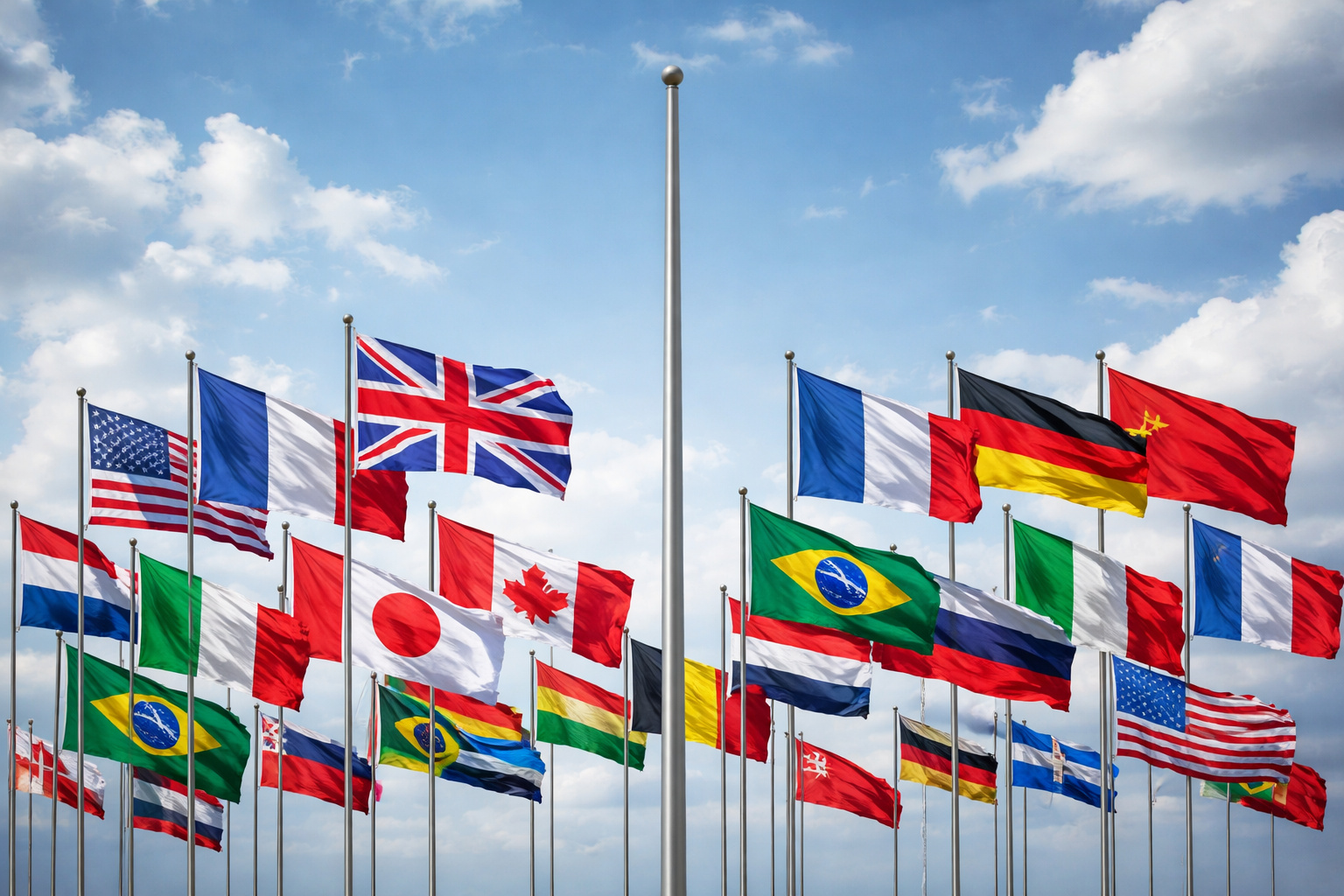
Understand Why Some Nations and Territories Have Not Adopted Their Own Flags and How This Affects Their Official Representation
The existence of a national flag is often viewed as something automatic and universal.
Nevertheless, when observing the international scene more closely, relevant exceptions arise.
Although almost all recognized countries have an official symbol, not all nations or territories have a flag established by law.
This fact draws attention because it reveals how national identity, sovereignty, and political agreements do not always go hand in hand.
Although rare, these situations exist and follow specific historical and legal criteria.
Northern Ireland Emerges as the Main Exception in the Global Scenario
Northern Ireland is the most cited case when it comes to the absence of its own official flag.
Although it is considered a nation within the United Kingdom, it does not have an officially adopted national symbol.
In formal acts and institutional representations, the region exclusively uses the flag of the United Kingdom, known as the Union Jack.
-
Goodbye iron: new technology from Xiaomi promises to revolutionize the way we iron clothes with 500 kPa steam, continuous flow of 120 g/min, heating in 65 seconds, and six smart modes for different fabrics.

-
Rio Pardo, the most mysterious city in Rio Grande do Sul: untouched Pampas castle, the missing treasure of the Devil Boy, bride’s saint, invisible tunnels, and a 200-year curse today.
-
China retires the J-7 fighter after years of military protection and can now transform military items into drones, following more than 60 years of operation of the J-7, derived from the MiG-21, with thousands of units produced and strategic use in the PLAAF and PLANAF.

-
Volunteers are sought to live in the mountains for a month: a study pays people to stay at 2,500 meters, with 24-hour monitoring of sleep, metabolism, and blood pressure.


This absence occurs because Northern Ireland has never legally approved its own flag.
Even though there are symbols used in sports, cultural, or community contexts, none of them have received official recognition.
Thus, from a legal and institutional perspective, the region does not have an independent national emblem.
This scenario reflects local historical and political disputes.
After all, the definition of symbols involves agreements that, in the case of Northern Ireland, remain sensitive to this day.
Why Almost All Countries Adopt National Flags
In practice, the vast majority of sovereign states have official flags.
This is because these symbols facilitate identification in diplomatic events, international organizations, and sports competitions.
Additionally, flags serve as visual representations of a country’s sovereignty and political identity.
Despite this, there is no international rule requiring a state to have its own flag.
Organizations like the UN accept countries with different formats of symbols, as long as there is formal recognition of their sovereignty.
For this reason, the absence of a flag does not hinder participation in international agreements or institutions.
All countries recognized by the UN, for example, have flags associated with their official representation.
Nonetheless, some non-sovereign regions follow different rules.

Territories Without Their Own Flags Also Are Part of This Scenario
Besides Northern Ireland, certain non-sovereign territories have also not adopted their own official flags.
An example is Akhrotiri and Dhekelia, areas under British administration located on the island of Cyprus.
In these territories, official representation occurs through the flag of the United Kingdom.
Although there may be flags used informally, none of them have been declared an official symbol.
Thus, the visual identity remains linked to the country responsible for the territory’s administration.
This pattern repeats in other dependent regions around the world.
In general, when there is no full autonomy or political consensus, the flag of the administering state assumes this role.
Curious Exceptions Help to Understand the Rule
Even among countries with official flags, there are curiosities that reinforce how symbols vary.
The Nepal, for example, has the only national flag that is not rectangular, officially adopted in 1962.
This case shows that, although almost all countries have flags, the shape and meaning can be unique.
At the same time, micronations or entities without international recognition may adopt their own flags.
However, these symbols do not have official validity in the global scenario.
What the Absence of a Flag Reveals About Sovereignty and Identity
In summary, Northern Ireland remains the best-known example of a nation without its own official flag.
Additionally, some dependent territories follow the same path by using symbols from other countries.
Aside from these exceptions, almost all recognized states maintain defined national flags.
This panorama shows that flags are not merely decorative elements.
They reflect political agreements, historical disputes, and the degree of autonomy of each region.
To what extent is the existence of one’s own flag essential to affirm a nation’s identity in the contemporary world?










-

-

2 pessoas reagiram a isso.