





 Português
  Inglês
  Espanhol
  4 min de leitura
  1 comentário


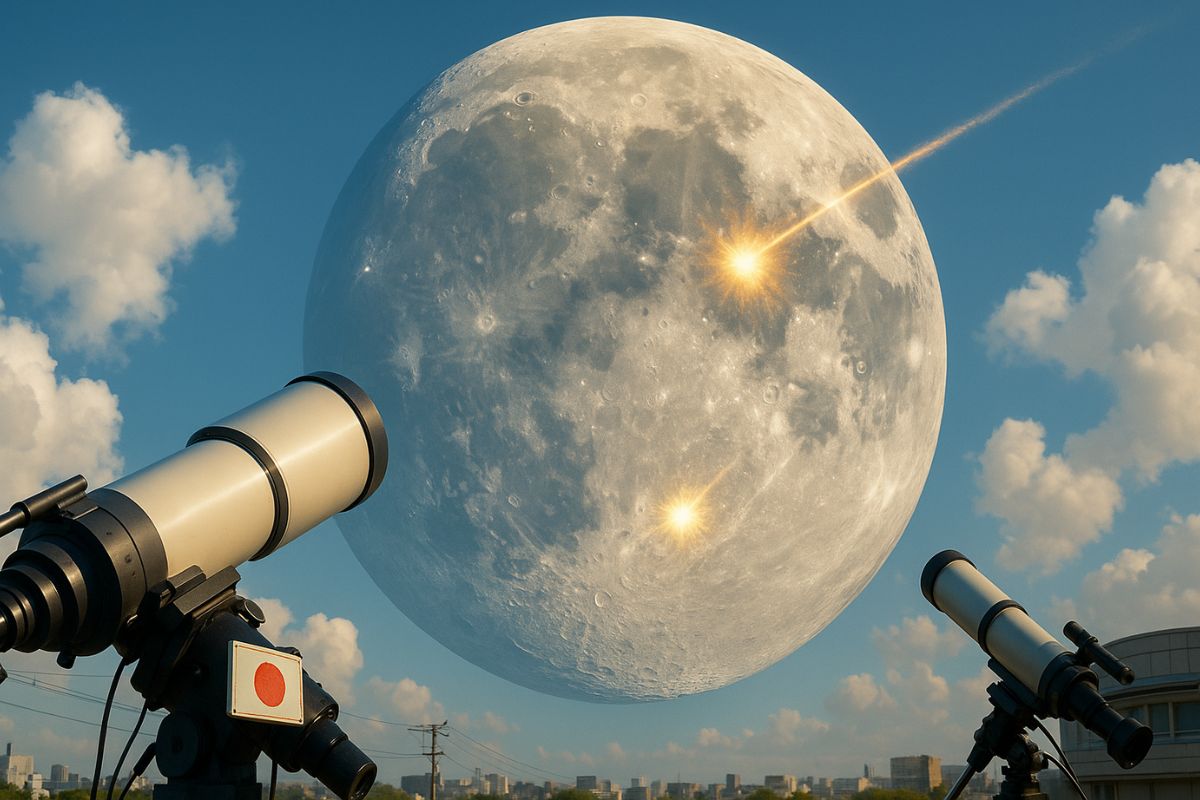


In a Span of Two Days, the Moon Showed Two Bright Flashes Separated, Recorded by a Japanese Astronomer with Monitoring Telescopes; the Signals, Confirmed by Multiple Instruments, Reinforce the Occurrence of Asteroid Impacts and Help to Calculate Frequency, Energy Released, and Analogous Risks for Earth
The Moon once again served as a natural laboratory for collisions. Two visible flashes from Earth were observed on consecutive nights by a system of telescopes operated by Japanese astronomer Daichi Fujii, curator of the Hiratsuka City Museum. The events occurred on Thursday the 30th and Saturday the 1st, with estimated speeds that may have reached 96,560 km/h and energy release compatible with conventional explosives, within what is expected for small bolides hitting the lunar regolith.
The confirmation that these were real impacts came from simultaneous observation by distinct instruments, which reduces the chance of interferences like cosmic rays. Sequential documentation and temporal coincidence support the transient nature of the flashes, indicating heated ejecta and instantaneous vaporization of material on the surface.
Where and How the Flashes Were Captured
The first flash was recorded to the east of the Gassendi Crater, a structure 112 km in diameter located near the northern boundary of the Mare Humorum.
-
With an unusual prize, Japan transforms office chairs into a resistance race on the streets, ISU-1 Grand Prix grows, fills stages, and pays 90 kilograms of rice.

-
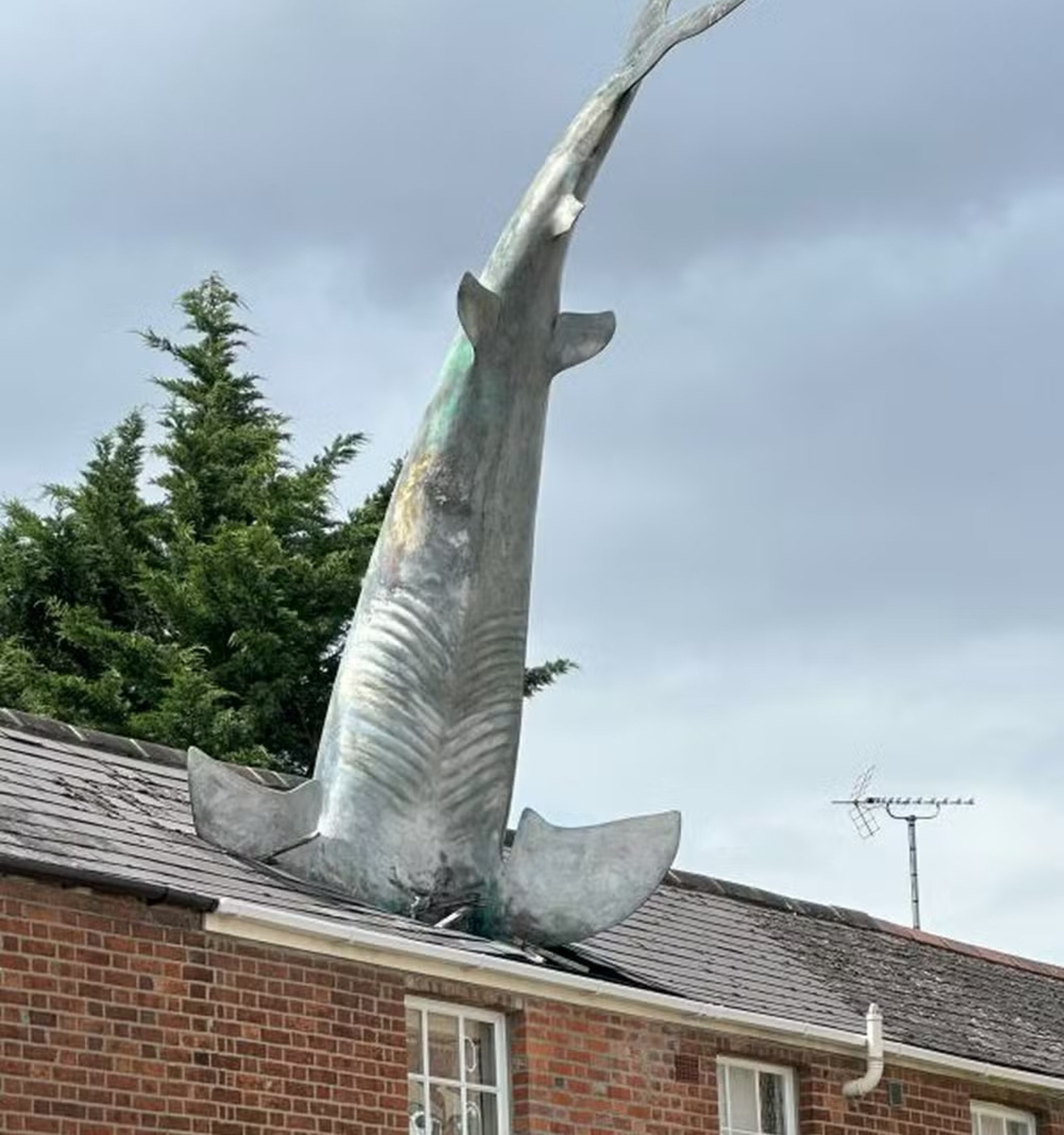
House in England with a 7.6-meter shark embedded in the roof attracts attention worldwide and becomes a curious attraction in Oxford.
-
Masterpiece in Spain, under construction since 1882, receives 4.8 million visits in a year and impresses with its gigantism and architecture.

-
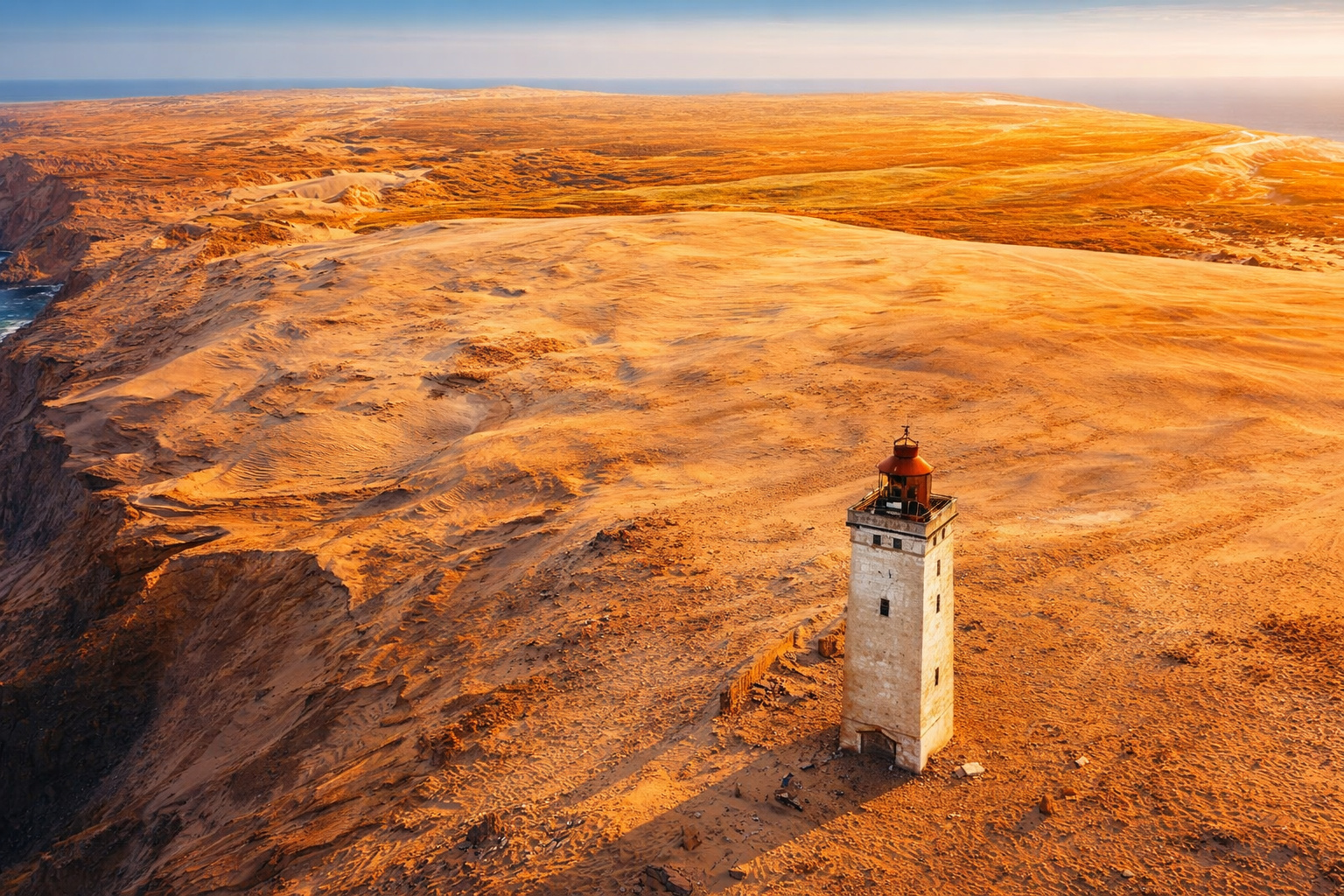
Attracting around 250,000 people a year, a lighthouse 200 meters from the sea, on a 60-meter high cliff, on the North Sea coast in Denmark, becomes one of the most impressive examples of how nature can threaten historical buildings.

The luminous signature appears as a brief pulse, typical of micro-impacts, followed by rapid dissipation.
The location in a high-contrast region favors detection by sensitive cameras operating at a high cadence.
The second event occurred to the west of the Oceanus Procellarum, a vast volcanic plain. The repetition within 48 hours is rare but compatible with peaks of meteoroid activity.
The spatial coincidence with extensive and relatively flat areas increases the chance of capturing flashes, as the brightness stands out against the background.
What Explains the Flashes on the Moon
The signals are consistent with meteoroids hitting the regolith and producing sudden heating, plasma, and incandescent ejecta.
As the Moon has no significant atmosphere, the impact occurs directly, without a prolonged ablation phase as on Earth, generating very brief but intense flashes.
There is a hypothesis of association with the Taurid meteor shower, linked to Comet Encke, known for containing larger fragments.
If confirmed seasonal patterns are established, records will help refine models of the flux of smaller bodies in the vicinity of Earth, a valuable input for planetary defense studies.
Why This Matters for Science and Risk
Each detection adds a point in the statistics of impact frequency and energy, serving as a basis for extrapolations on the probability of events on Earth.
The Moon acts as a natural detector, as it preserves marks of collisions and displays flashes when struck by smaller projectiles.
For exploration programs, the data guide criteria for habitat design and surface operations.
Understanding the spectrum of energy and event rate is crucial for positioning modules, shielding, and schedules for extravehicular activities on future lunar bases.
How the Observational Validation Was Done
The team used automated monitoring, with high-sensitivity cameras and precise temporal recording.
The correlation between independent telescopes rules out electronic artifacts or energetic particles hitting sensors.
The analysis includes verification of local seeing, noise patterns, and absence of trails that would characterize satellites or aircraft.
Even so, a degree of photometric uncertainty remains, common to such brief events.
New surveys by observer networks and comparison with previous impact databases are likely to consolidate estimates of magnitude, energy, and, when possible, size and speed of projectiles.
Recent Context and Operational Limitations
The case occurs while some centers face operational restrictions and limited observation windows due to local conditions.
There were reports that the ESA could not observe due to brightness in Europe during the impacts, while the Japanese system was active at the critical moment, which explains the near-exclusive capture by the Asian observer.
In addition to the scientific value, public engagement is significant.
Records like these bring the monitoring astronomy community closer, stimulate collaborative networks, and expand distributed detection capability, essential for robust statistics of transient events.
What Comes Next in the Investigation
The next steps include screening parallel records, searching for high-resolution post-impact images, and numerical modeling to estimate masses and entry angles.
If there is correlation with the Taurids, the historical series may be updated with a seasonal bias, improving predictions of windows of higher risk.
Meanwhile, the technical community discusses minimum calibration and reporting standards for lunar flashes to standardize light curves, filters, and detection thresholds.
The better the standardization, the more comparable the events become, and the more reliable the inferences for Earth.
The two flashes within 48 hours reinforce the Moon as a sentinel for impacts and update the discussion on frequency, energy, and risk mitigation.
In your view, what should be the priority now: to expand automatic monitoring networks, invest in high-resolution post-impact images, or standardize calibration and reporting protocols for lunar events?






Deve ser minha vó que acendeu a lamparina kkkkkkkkkkkk