





 Portuguese
  English
  Spanish
  8 min of reading
  41 comments


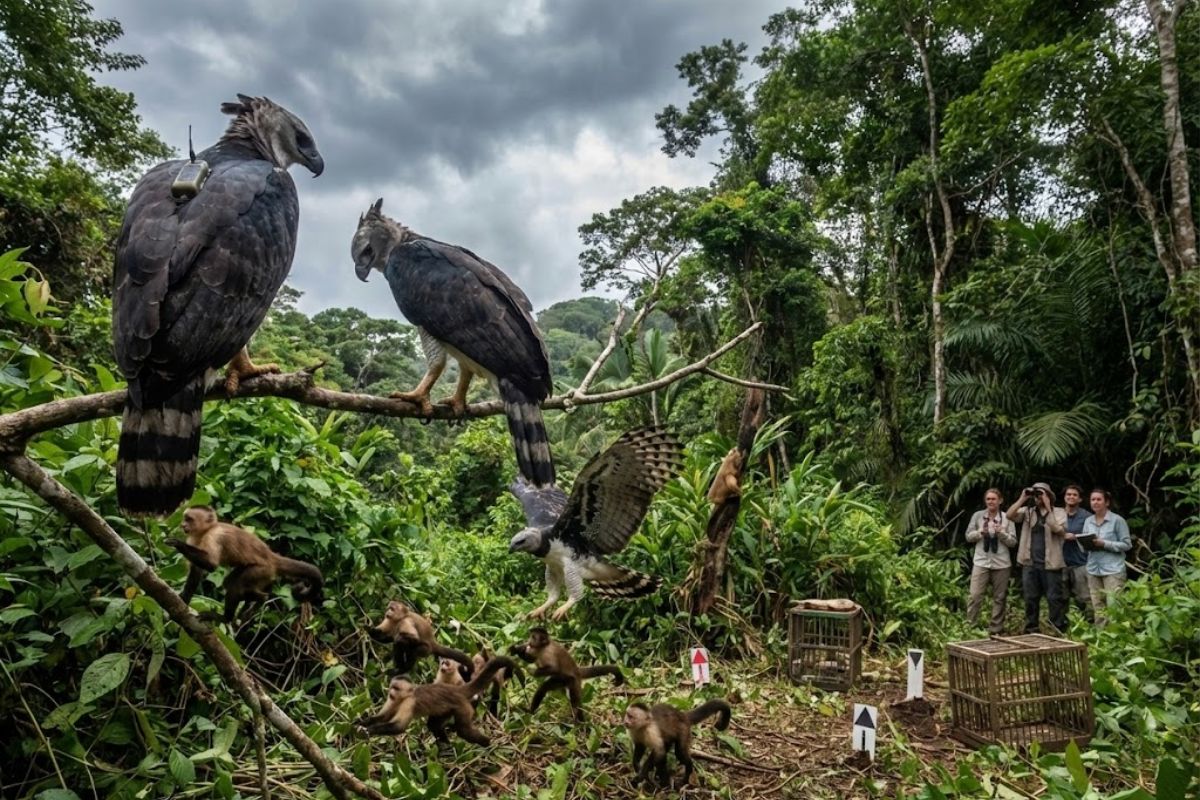


On Barro Colorado Island, created when the waters of the Panama Canal flooded the forest, primates lived for almost 100 years without hunting. In 1999, two radio-tagged harpies were introduced, began capturing prey in cycles of a few days, and forced monkeys and sloths to quickly relearn fear.
The harpies were brought to Barro Colorado Island, in the heart of the Panama Canal, and their arrival broke a century of routine without hunting. In an environment where disease was the only threat, the return of a top predator placed monkeys and sloths under daily pressure and turned the experiment into a practical warning about reintroduction.
The island was already a natural laboratory: spider monkeys, howler monkeys, marmosets, and capuchin monkeys shared territory without conflict and without overlap. The average size of each group of howler monkeys was about 20 individuals, and there were approximately 65 groups, a population design sensitive to any change in balance.
An Island Without Hunting and a Forgotten Fear

Barro Colorado Island emerged when the water level rose during the construction of the canal and flooded tropical forests.
-
Giant structures 14 meters beneath Egypt are revealed by satellites and expose a millennia-old secret buried in Buto.

-
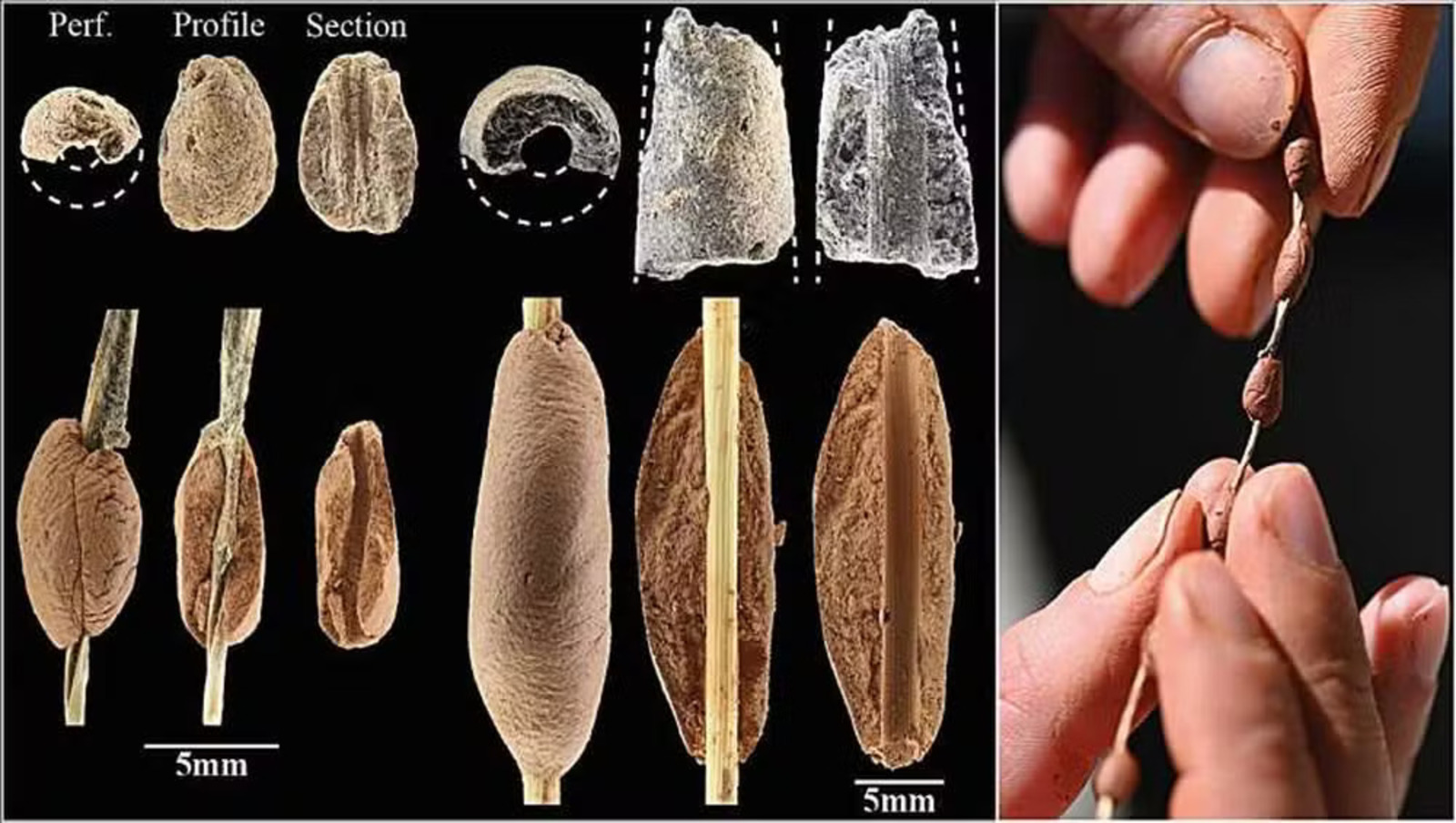
Children have been making clay pieces for 15,000 years in Southwest Asia, and fingerprints preserved on 142 ornaments helped archaeologists prove this.
-
New semi-autonomous legged robot technology challenges the limitations of space exploration by operating almost without human intervention on the Moon.

-
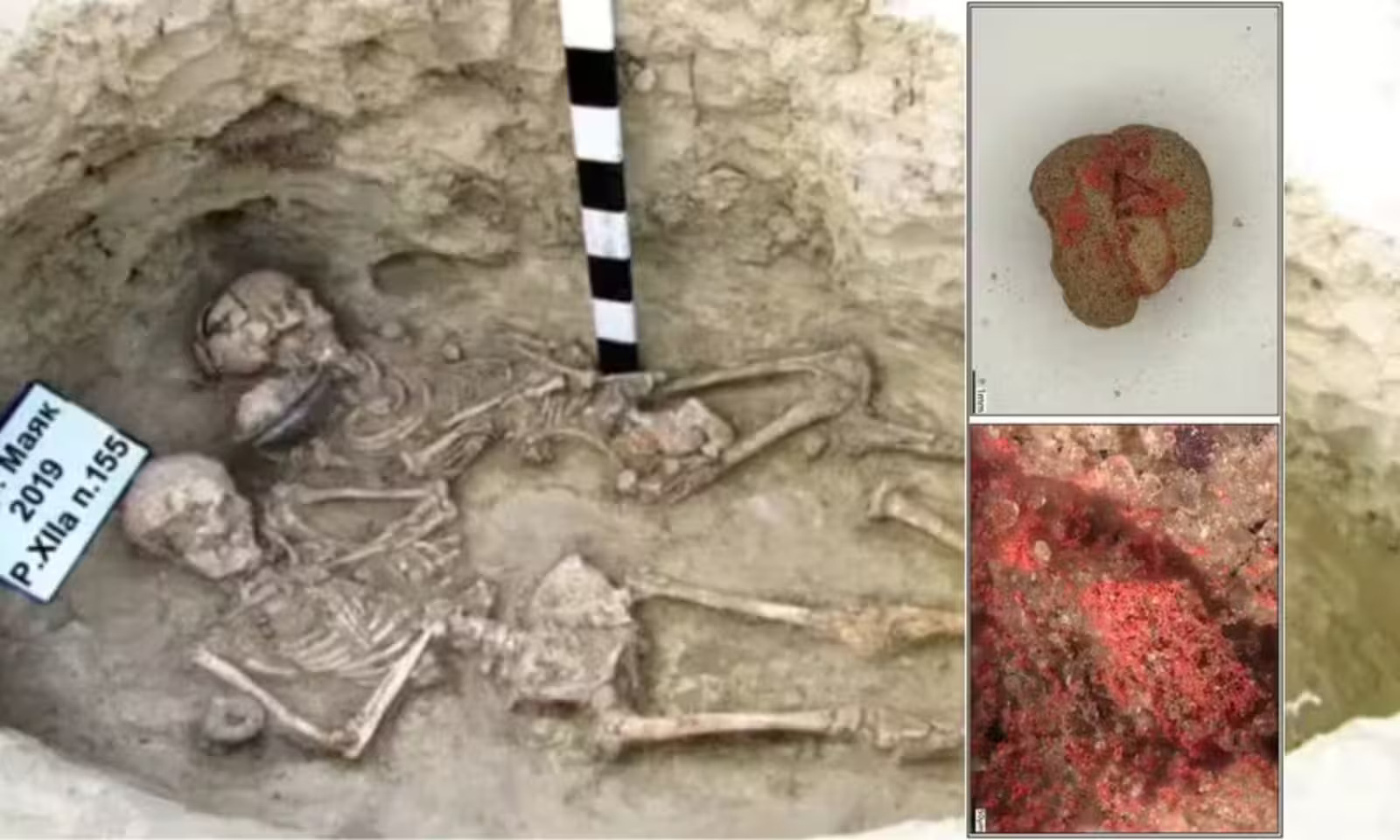
Super toxic red mineral found in the double burial of two women aged 1,900 years near the banks of the Dnieper River in Ukraine.

Since then, the island has been declared a protected natural reserve, and the ecosystem has functioned as a regular mechanism: without predators, without disputes, and with rare mortality.
In this scenario, the monkeys lost their instinct to fear.
The island became a place where the threat did not come “from someone’s hands” and the routine was repeated in predictable cycles.
It was this void, described as almost 100 years of peace, that prepared the ground for the shock caused by the harpies.
Arrival of the Harpies in 1999 and the Break in the Experiment

The male arrived in June 1999 and the female in October 1999, both with radio tags.
They were brought by people to the island, and tracking allowed monitoring how the harpies moved and where they hunted, with remote observation.
The impact was rapid.
What was an experiment designed to observe adaptation became, for the monkeys, a regime of constant threat.
The island began to be described as hell for the primates, and reintroduction stopped being an abstract concept to become a concrete consequence.
What Makes Harpies Top Predators
The harpies have been described as enormous: females can weigh up to 10 kg, males around 11 kg, with heights of 31 to 39 inches and wingspans of up to 6 feet.
The most striking detail is their talons, which can grow over 5 inches, larger than an adult man’s finger.
They are top predators and eat meat, capturing whatever they can dominate.
Among the described prey are sloths, monkeys, porcupines, anteaters, iguanas, and opossums.
When resources run out, the harpies can shift to larger targets, including other birds and young of larger species, reinforcing the logic of hunting by opportunity.
Hunting Technique: Talons, Fall, and Compression
The described attack pattern is mechanical and brutal. If the prey is perched, the harpy grabs it with its talons and brings it down to the ground or simply drops it.
Then, it pierces the body and tightens until the victim stops moving.
With three-toed sloths, the routine tends to be direct: dive, capture, and compression.
With two-toed sloths, which hang upside down, the harpy can attack from below, do a somersault in the air, and tear the prey immediately after taking it off the branch.
For an island without predators, every capture was a violent lesson about risk.
Hunting Frequency and Pressure on Monkeys
The radio tags helped measure the pace.
It was recorded that the female captured prey every 4.39 days, while the male hunted more frequently, every 3.71 days.
Over time, howler monkeys appeared as the most common prey, with each troop under repeated attack.
The description is of continuity: there was always someone being devoured.
In addition to monkeys, both two-toed and three-toed sloths were also hunted, and the male and female captured them in approximately equal proportions.
In a system with few death events, this regularity altered the perception of safety on the island.
How Monkeys Reacted When Danger Came from Above
With the return of the harpies, the monkeys began to fear sounds and sweep the forest for signs of the predator.
Adult females grabbed infants and ran to denser foliage. Adult males spread out, triggering alarms to cover the largest area possible and warn the group.
The responses varied by species.
Male howler monkeys might run towards the predator, waving their arms, trying to drive it off.
Capuchin monkeys jumped up and down to the ground. Tamarins jumped and then froze.
Sloths snarled, hissed, and waved their claws, trying to hide in dense vegetation under branches, even though this rarely prevented the attack.
The Experiment Between June 1999 and August 2000
Everything described occurred on Barro Colorado Island between June 1999 and August 2000, within a controlled experiment.
The goal was to understand how predators hunt primates and how primates learn to defend themselves when pressure returns, like in an evolutionary arms race.
The method was simple and rigorous: track the harpies daily through their radio tags and record their behavior, trying not to interfere and maintaining distance.
The expectation was to observe, over about a year, whether the howler monkeys would develop a new alarm instinct and how this would integrate into the group routine on the island.
Quick Learning and a New Specific Alarm
The described result was a rapid behavioral gain.
The howler monkeys not only included the harpies in the general alarm of danger but also invented a separate signal for danger from above.
In practical terms, it was like creating a new word for a new predator, without needing an entire generation for it.
Similar reports indicate that when a prey spends 50 to 100 years without encountering a predator, it can forget appearance and sound.
When the predator returns, relearning tends to be quick and generally takes less than a year for new reactions, behaviors, and survival strategies to emerge.
Synchrony, Panic, and the Choices of Harpies
The experiment also highlighted an operational detail: when prey reacted in synchrony, with organized alerts and without chaos, the harpy could delay the attack or switch targets.
When panic began, with some running and others freezing, that was when the attack occurred most frequently.
There was also a difference attributed to sex.
The male displayed a preference for variety, alternating creatures including younger and animals closer to the ground.
The female, on the other hand, seemed to prefer repeating the same type of large prey. These preferences matter because they condition the type of pressure that falls on monkeys in a small island.
Why Harpies and What Does That Say About Reintroduction
The choice of harpies had two described justifications.
The first is that they emit a loud and characteristic sound before the attack, allowing tests with recordings to observe alarm cries from the monkeys.
The second is larger: large predators are disappearing, and without them, prey lose evolutionary pressure, become less vigilant, and can reproduce without brakes.
It is at this point that the experiment becomes a warning for reintroduction.
If ecologists discuss bringing back predators to areas where they lived, data on fear, sound, and adaptation help predict initial shock and adjustment speed.
Reintroduction ceases to be just a symbolic rescue and requires fine design to avoid turning an island into a permanent test field.
Harpies Endangered, Slow Reproduction, and Forest Requirement
The harpies have already been described as nearly threatened internationally and, in parts of Central America, they would be on the brink of extinction or may have already disappeared.
Reproduction is slow: in the wild, they produce only one chick every 2 or 3 years; the egg is incubated for almost 2 months, and the chick stays in the nest for another 6 months.
To maintain a stable population, an adult would need to live for decades and successfully raise at least two chicks that survive to reproduce.
In Panama, a number of less than 450 birds has been cited, and each harpy would need about 38 square miles of forest to hunt and raise chicks, which makes habitat loss a direct bottleneck.
Captive Breeding: Boise, Panama, and the Meat Logistics
Between 1987 and 2006, a captive breeding program was described.
The first facility was built in 1987 in Boise, Idaho, at the World Center for Birds of Prey, with six temperature-controlled rooms.
Boise was not tropical: about 12 inches of rain per year, with temperatures from -4°F in winter to over 100°F in summer.
In 2001, a second site opened in Panama, the Neotropical Raptor Center, on a secluded hill of humid tropical forest near the canal.
There, seven outdoor breeding chambers and one chamber for raising chicks were built, where young could see and hear adults without direct interaction.
The surrounding area totaled about 99 acres of forest.
Feeding was described on an industrial scale: rats, rabbits, chickens, guinea pigs, and mice, with vitamin and mineral powder.
In one year, they managed to breed about 6,000 mice and 400 rats, purchase 800 live rabbits, freeze 50 stillborn calves, and import 7,000 frozen rats.
Gradual Release, Hard Release, and the Leap to Wildlife
The reintroduction of the harpies was based on falconry techniques but with longer timelines, sometimes up to two years.
First came the gradual release: birds were taken to an accessible location for staff and away from people, monitored and fed until they began hunting on their own.
Then, they were recaptured and transferred to the final location, where they would live without human assistance, the hard release.
Between 1998 and 2008, several releases were reported in Panama and Boise.
The program is said to have started with five harpies and ended with about 50, a significant leap for a slow-reproducing species.
Finding Nests, Walking Miles, and Falling from 115 Feet
Protecting harpies requires locating nests, and this was described as exhausting: marking a potential GPS point and walking through dense vegetation, hills, and streams.
They prefer taller trees, such as Brazil nuts, cited at up to 164 feet tall, and the nest may be hidden among branches.
The search comes with a human cost: it is possible to walk 31 miles in a day to find a nest and then cover 248 miles in three months without finding anything.
Therefore, a reward of US$ 100 per nest has been mentioned, and nut collectors help by recording calls on phones and identifying signals on the forest floor. In 2020, 34 nests were found with this support.
High-altitude work is also risky. A Venezuelan veterinarian, Alexandre Blanco, was struck by a female and received a 7.6 cm cut that pierced his chest.
On another occasion, he fell from 115 feet with a chick still in hand; he sustained broken leg and wrist, while the chick emerged unharmed.
Human Conflict, Fear, and the Role of Ecotourism
Part of the problem is social.
Residents may believe that harpies attack children, eat birds and livestock, creating conflict.
In conflict with humans, even a top predator loses because it can be killed out of fear, meat, or curiosity.
The described change comes through education and local income.
When residents see biologists working to save harpies, some hunters become allies.
Ecotourism has also been mentioned: observation towers near nests, with owners receiving about US$ 20 per visitor, in addition to earnings from building towers, maintaining trails, and providing meals.
In the end, the island and the experiment show a simple thing: reintroduction interacts with behavior, risk, and economy at the same time. Leave your opinion in the comments: would you accept harpies back near your community?








Muito boa reportagem!
Isso tbm dá uma sra inspiração pra roteiros cinematográficos, como por exemplo Ficções “científicas”, nas quais ETs 👽 Ou seres super dimensionais queiram fazer experimentos do tipo, “Vamos introduzir na Terra um predador d humanos, só pra ver o q r0l@ 👹” 😝
Excelente reportagem. Harpa, o Gavião Real da Amazônia Brasileira é foco de estudos, também, no Instituto Nacional de Pesquisas da Amazônia (INPA)