





 Portuguese


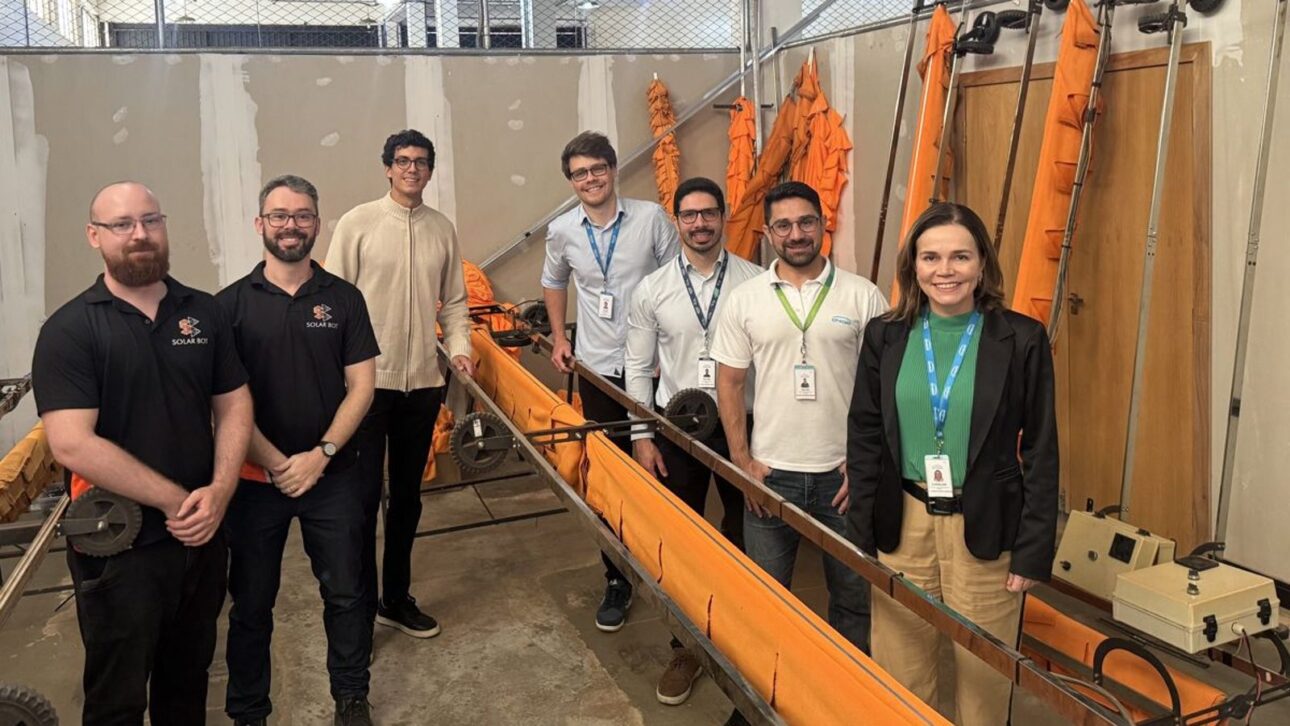

ENGIE Brasil and startup Solar Bot on Monday, Nov. 16, 2026, presented results from an autonomous robot that cleans solar panels without water. Tested at an ENGIE solar farm, it increased power generation by 4.7% to 5.4% after R$3.56 million in research and development funding from Brazil’s electricity regulator, Aneel
ENGIE Brasil and startup Solar Bot completed development and testing of an autonomous robot that cleans solar panels without using water. The equipment was tested at an ENGIE-owned solar farm.
The results were published by the Petronotícias website on Monday, Nov. 16, 2026. The two companies worked together on the project for about a year and a half.
The Portal Energia Limpa also reported on the project on Wednesday the 18th, in an article by Luzia Aires.
-
EcoFlow Launches DELTA 3800 Gen4 with 3,763 Wh and 3,600 W, 44% Smaller than DELTA Pro, Weighs 15 kg Less, Powers a Refrigerator for Over 70 Hours, and Reaches 12 kWh with Extra Batteries

-
New Floating Solar Panel System Tracks the Sun Daily and Promises Up to 20% More Energy, with Deliveries Set for 2027
-
While Brazil Bets on Pecém and Açu, Rival Advances with Colossal Project of up to 30 GW to Produce 1.2 Million Tons of Green Hydrogen and 6.6 Million Tons of Ammonia per Year

-
Brazilian Municipality Prepares $45.6 Million Factory to Convert Renewable Energy into Hydrogen and Produce 2,000 Tons of Green Ammonia Annually


Why does dirt have such a big impact on a solar farm?
Dust and other particles build up on solar farm photovoltaic modules. ENGIE Brasil studies indicate that this dirt can reduce power generation by as much as 15%.
Traditional cleaning uses water. In June 2025, then-ENGIE Performance and Innovation Manager Felipe Rejes de Simoni told Canal Solar that the method is unsustainable in semiarid regions.
Simoni also said that washing is complex and expensive, and can damage the system, especially when water that has not been demineralized is used.
Why are cleaning robots still rare in Brazil?
Simoni noted in 2025 that cleaning robots are common in countries such as Israel, England, Germany and India. In Brazil, he said, the practice is still in its infancy.
In the same Canal Solar report, Rédytton Brenner Sousa, founder of Solar Bot, said water-free operation is cheaper and more practical. The advantage is greater at solar farms in remote areas.
How much did ENGIE’s robot cost?
The project received R$3.56 million in research and development funding. The money came from the Research, Development and Innovation program regulated by Aneel, Brazil’s National Electric Energy Agency.
The partnership was announced in June 2025, with completion expected in October 2026. At the time, Baguete reported a budget of R$3.5 million and a project timeline of about two years.
The goal was to develop a domestic solution for cleaning panels without water or direct human intervention.
How does the dry-cleaning system work?
The system has four parts. The first is the robot itself, which dry-cleans the panels.
The second is a charging and resting station, where the robot returns after each cycle. The third consists of mechanisms that let it cross obstacles between rows of panels.
The fourth is a digital monitoring and management platform that receives operational data. The entire technology was developed in Brazil.
What did the tests at the solar farm show?
Cleaning with the robot increased the solar farm’s power generation by 4.7% to 5.4%. The figures come from tests conducted at one of ENGIE’s solar farms.
During continuous tests lasting several days, the system completed the full cycle on its own. It carried out scheduled cleaning, returned to the station, recharged and transmitted data.
The equipment operated without direct human intervention as it moved, recharged and sent data, as described by Portal Energia Limpa.
Does the robot scratch or break the panels?
External organizations conducted integrity tests, measuring the mechanical impacts and vibrations the robot causes on the glass of the panels.
The mechanical forces and vibrations remained stable and repeatable. Deformations were below the safety limits assessed.
Based on these results, the companies concluded that dry cleaning is viable without compromising the structure of the modules.
What does ENGIE gain beyond extra energy?
The first benefit is eliminating water use for cleaning. The second is reducing the need to send crews across the extensive areas of the power plants.
The third is reducing maintenance risks. Portal Energia Limpa highlights workers’ reduced exposure to occupational hazards.
In June 2025, the website Baguete had already reported ENGIE’s goals. The company wanted to improve power plant performance, lower maintenance costs and make operations easier at hard-to-reach sites.
What do the project executives say?
Guilherme Slovinski Ferrari, ENGIE Brasil’s director of Renewable Energy and Storage, said innovation is part of the company’s strategy to lead the energy transition.
Ferrari said Solar Bot delivers efficiency, productivity and competitiveness gains for the company’s solar power plants.
Mario Wilson Cusatis, ENGIE’s performance management and innovation manager, said the project sought to validate a solution adapted to the conditions at Brazilian solar power plants.
Cusatis highlighted automation’s potential, particularly in regions with limited water. Brenner, of Solar Bot, said the results now validate the potential of domestic technology for the solar industry.
Who is Solar Bot?
Solar Bot was founded in 2021 by engineers from the University of Brasília, known as UnB, and is headquartered in Brazil’s Federal District. It focuses on autonomous robots for cleaning solar panels.
In June 2025, the startup said it could clean 500 modules per hour. It claimed its robots worked eight times faster and at one-sixth the cost of conventional cleaning.
Between April and August 2024, Solar Bot cleaned 340,000 panels at power plants with a combined capacity of 170 MW. During the same period, it saved 1.5 million liters of water.
The startup raised R$625,000 through the EqSeed platform in 2024. It operates at power plants in the Federal District and the states of Goiás, Minas Gerais, São Paulo, Rio de Janeiro and Rio Grande do Sul.
Clients cited by Baguete include EDP, Eletrobras, EGD Energia and Grupo BC Energia.
How large is ENGIE in Brazil?
In June 2025, ENGIE Brasil Energia was the country’s second-largest power generator, with about 5.2% of the market. Its installed capacity was about 9 GW.
The company is headquartered in Florianópolis and is controlled by French group Engie, which owns 68.7%. It operates exclusively with renewable energy sources, including hydropower, wind, biomass and 92 solar facilities.
What is the next step for ENGIE’s robot?
A new Research, Development and Innovation project is expected to begin in 2027, and the two companies are already planning this phase. The planned investment is R$4.5 million, over 20 months.
The goal is to develop a mobile robotic platform that would transport the cleaning equipment between different rows of panels.
The companies want to scale up the solution and reduce deployment costs. Portal Energia Limpa also cites a goal of increasing the area covered per hectare.


