





 Portuguese
  English
  Spanish
  4 min of reading
  0 comments


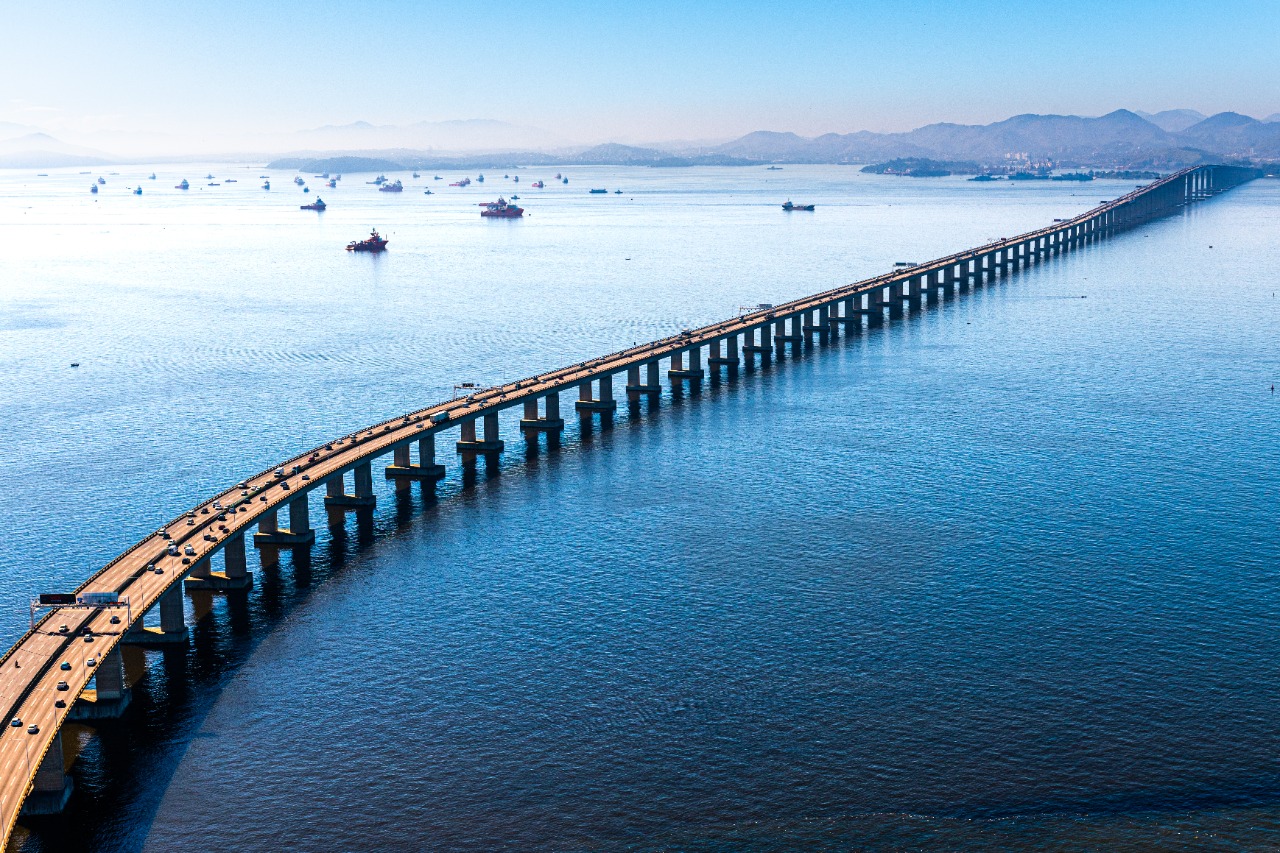
Between Rio and Niterói, a crossing of 13.29 km brings together a central span of 300 meters and a structural solution that still appears as a record in technical cuts, while different international classifications generate distinct readings.
Rio-Niterói Bridge and the Record of the 300 Meter Span
The Rio-Niterói Bridge, officially called Presidente Costa e Silva Bridge, continues to be mentioned in institutional materials and technical publications as a reference in engineering due to its central span of 300 meters in a continuous straight beam arrangement.
Inaugurated on March 4, 1974, the connection between Rio de Janeiro and Niterói is one of the main road corridors in the state and registers, in estimates released by agencies and the operator of the stretch, daily traffic in the range of 150 thousand vehicles.
With a length of 13.29 kilometers and a maximum height point of around 72 meters, the bridge connects the fluminense capital to Niterói and concentrates a significant part of the movement between the Metropolitan Region and the Leste Fluminense, as well as catering to tourism flows and freight transport.
-
Goodbye iron: new technology from Xiaomi promises to revolutionize the way we iron clothes with 500 kPa steam, continuous flow of 120 g/min, heating in 65 seconds, and six smart modes for different fabrics.

-
Rio Pardo, the most mysterious city in Rio Grande do Sul: untouched Pampas castle, the missing treasure of the Devil Boy, bride’s saint, invisible tunnels, and a 200-year curse today.

-
China retires the J-7 fighter after years of military protection and can now transform military items into drones, following more than 60 years of operation of the J-7, derived from the MiG-21, with thousands of units produced and strategic use in the PLAAF and PLANAF.

-
Volunteers are sought to live in the mountains for a month: a study pays people to stay at 2,500 meters, with 24-hour monitoring of sleep, metabolism, and blood pressure.


How the Central Span and the Continuous Beam Appear in Technical Publications
The element most associated with the bridge in engineering texts is the 300 meter span.
In this type of description, “span” refers to the main section without intermediate supports, sized to allow the passage of vessels under the structure without the need for moving parts.
In the adopted design, the crossing is presented as a system based on a continuous beam supported on pillars, without main suspension cables and without exposed metal trusses as the predominant solution in that section.

In technical materials, this arrangement is often described as part of the set that enabled compatibility between navigation in Guanabara Bay and road traffic.
The choice of a continuous structure appears, in these same records, associated with stability requirements under wind, the constant presence of sea spray, and intense traffic.
In sector evaluations, these are factors that typically influence the sizing and control of deformations in large crossings.
Why the Bridge is Called a Record Holder and Where There is Divergence of Criteria
The bridge is presented in institutional communications and promotional texts as holding the largest central span in this specific type of continuous straight beam.
This technical focus is what sustains the claim of a record in part of the material about the work.
Other compilations, however, treat “box beam” and variations of this typology more broadly, and therefore list bridges built later with equal or greater main spans in different categories.
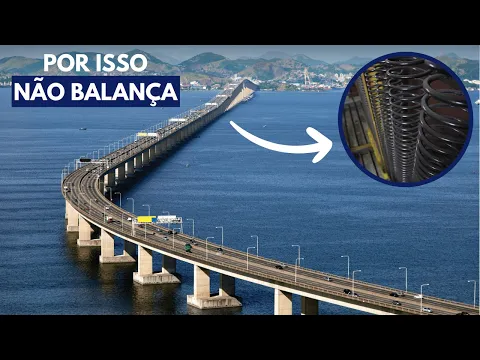

The divergence usually arises when lists do not adopt the same classification criteria for the structural system of the central section of the Rio-Niterói.
<p.In light of this, the assertion that “no one has surpassed” depends on the framework used in the comparison.
When the focus is on the continuous straight span released for the central section, the Rio-Niterói is cited as the record holder.
In broader taxonomic surveys, however, the position may vary.
Work Begun in the Late 1960s and Delivered in 1974
The construction began in the late 1960s and delivery occurred in 1974.
Historical reports and technical materials about the work describe the complexity of executing foundations, erecting pillars, and launching large structural segments in a maritime environment, with logistics based on operations over water and the use of large pieces.
In records about the project, there is also mention of the mobilization of thousands of workers and equipment that were then unusual in the country for assembly and movement tasks of structures.
The crossing has consolidated itself as a recurring case study in engineering by combining scale, execution in a coastal environment, and integration with a dense urban area.
Daily Traffic, Urban Mobility and Freight Transport
In the daily life of Rio, the bridge concentrates part of the movement of those working or studying between Niterói, São Gonçalo, and other surrounding cities and the capital.
Moreover, it functions as a strategic route for services, logistics, and movements towards the interior and the Lakes Region, depending on the route.

Traffic estimates released by institutional sources and used in reports indicate daily circulation in the range of 150 thousand vehicles, with variations by day of the week, holidays, and events.
Operationally, this volume tends to amplify impacts when there are accidents, closures, or maintenance, as congestion spreads to access roads.
The operation of the system involves user support and flow monitoring, according to descriptions from the stretch administrator.
Among the measures typically associated with this type of infrastructure are monitoring by cameras, support for occurrences, and organizing interventions to reduce traffic impacts.
Maintenance of the Bridge and Monitoring in a Sea Spray Environment
The preservation of the bridge depends on periodic inspections and interventions due to the marine environment and wear associated with constant traffic.
In technical publications, the topic appears linked, for example, to inspection practices, corrosion control, and planning works over time, focusing on maintaining safety and operational standards.
When treating the bridge as a reference, sector documents often highlight the set of design and execution solutions for the central span and the need to maintain structural performance compatible with usage intensity.









-

-

-

8 pessoas reagiram a isso.