





 Portuguese
  English
  Spanish
  4 min of reading
  8 comments


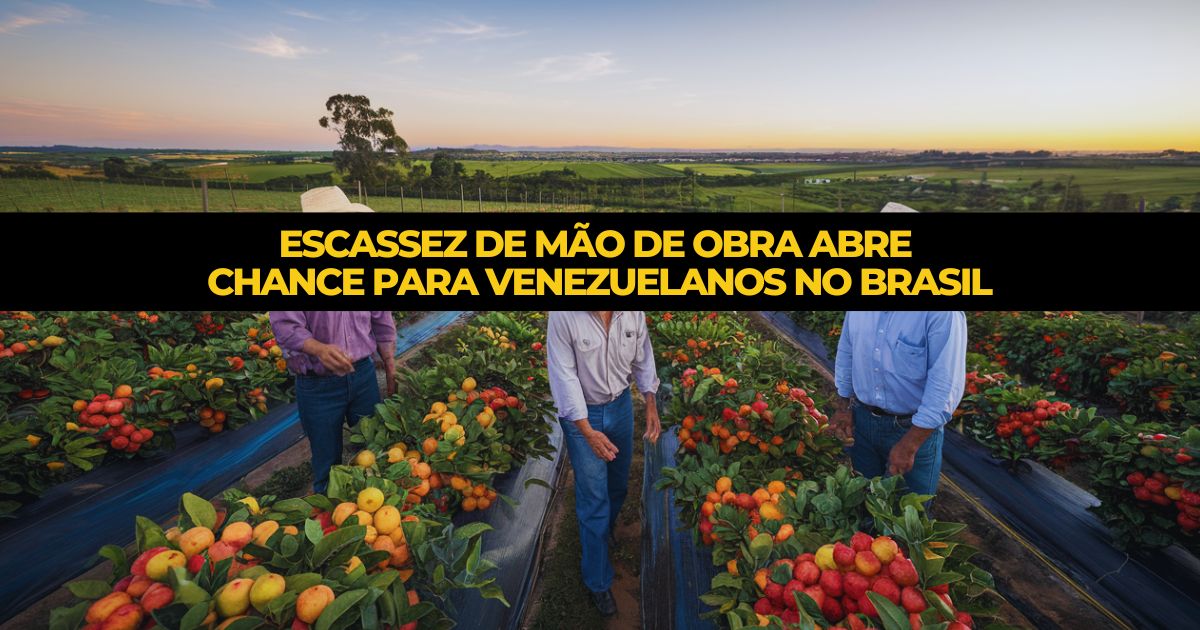


The Lack of Workers in the Agricultural Sector of Brazil Led Companies to Hire Venezuelans. The Recently Signed “National Decent Work Pact” Aims to Improve Conditions in the Field and Promote Social Dialogue.
An unusual scenario challenges the job market in Brazil: one of the country’s most prosperous agricultural regions is facing an unprecedented crisis.
The shortage of local labor has not only raised alarms but has also led companies to seek unusual alternatives to meet their demands.
What seemed to be an opportunity for Brazilians has ended up involving foreign workers in a solution that could profoundly impact the agricultural sector.
-
The U.S. Embassy in Rio de Janeiro opens a job vacancy for Electrician with a salary of R$ 70,032 per year; find out how to apply by April 9.

-
The Port of Santos has 120 openings for quality inspectors, and to apply, you just need to have completed high school, have basic computer skills, and go to Poupatempo to obtain the referral letter before the positions are filled.

-
Fiocruz has opened a selection process with vacancies for nurses, dentists, and psychologists, with salaries that can reach nearly R$ 8,000 including the preceptorship grant.

-
Work at Vale! The company is recruiting individuals with high school, technical, and higher education in areas such as maintenance, operations, and technology, with 400 immediate openings in 6 states, salaries of up to R$ 10,000, and 100% online applications.


Yesterday (13), in Petrolina (PE), a historic agreement for the sector was signed: the “National Decent Work Pact in Rural Areas”.
The ceremony included representatives from the federal government, unions, and business leaders.
Among the highlights was the Secretary of Agriculture of Bahia, Wallison Tum, who revealed that companies in Western Bahia have already begun hiring Venezuelans due to the shortage of local workers, as reported by journalist Carlos Brito.
The Pact and Its Promises
The Terms of Adhesion to the National Decent Work Pact in Rural Areas aim to combat degrading labor practices and promote fair conditions in the field.
Signed by the Ministers of Agriculture and Labor, Carlos Fávaro and Luiz Marinho, the pact focuses on formalizing employment, combating discrimination, and eradicating child labor.
The Brazilian Association of Producers and Exporters of Fruits and Derivatives (Abrafrutas), federations of workers, and employer unions also endorsed the commitment, which aims not only for better conditions for workers but also for greater sustainability in agricultural production.
According to Wallison Tum, the agreement represents a “milestone for the São Francisco Valley,” a region that has suffered for years from the lack of workers to meet the growing demand for irrigated fruit farming.
Tum emphasized that dialogue between governments and employers is essential to address these challenges and ensure the region’s economic development.
Hiring Venezuelans
The shortage of local labor has led companies to seek workers from outside the country.
According to Wallison Tum, there are already reports of Venezuelans being hired in Western Bahia, an emergency solution to maintain the competitiveness of the agricultural sector.
This reality reflects not only a labor supply problem but also the need for public policies that encourage the retention of Brazilian workers in the field.
Minister Luiz Marinho emphasized that the signed pact is “against degrading work” and in favor of good practices and dialogue between capital and labor.
National Dialogue Table
In addition to the pact, the National Fruit Farming Dialogue Table was established, an initiative aimed at creating joint solutions among employers, workers, and the government.
The table will initially be implemented in Pernambuco and Bahia, critical regions for irrigated fruit farming, and will focus on strengthening collective bargaining and social dialogue.
For Minister Carlos Fávaro, the commitment made is “an important evolution in the relationship between capital and labor.” He highlighted that the federal government seeks to develop the country economically while promoting social inclusion and reducing inequalities.
The Role of Employers and Unions
The union between employers and unions has been pointed out as essential for the success of this pact. The president of Abrafrutas, Guilherme Coelho, believes that collaborative work will not only improve workers’ conditions but also address the labor shortage in the sector.
“We need to ensure job security and unite efforts for the sector to continue growing,” Coelho stated during the event.
Although the pact and the Dialogue Table are important advancements, the challenge of attracting and retaining Brazilian workers in the field still persists.
The hiring of Venezuelans demonstrates that, without structural incentives, the agricultural sector may increasingly rely on external alternatives.
The labor crisis in Brazil exposes structural challenges that go beyond irrigated fruit farming. The reliance on foreign workers may be a temporary solution but raises questions about the future of national agriculture.
Will the signed pact be sufficient to attract Brazilians back to the fields? Or will the sector continue to seek international solutions to a local problem?









É só pagar bem que tem mão de obra pra trabalhar, querem ganhar competitividade em cima do trabalhador, querem pagar uma mixaria e ainda tirar o couro do cara, aí é melhor viver de auxilio governamental
Se pagar bem com bom salário e com Tofo direito legal , e boas condições de trabalho quem não quer , não precisa de mão de obras de outros países ,
E só , pagar bem. Com registro com condições de trabalhos legais ,