Portuguese
 Spanish


A 299 kWp installation has started operating in Provence to assess water savings, maintenance costs and future photovoltaic canopies.
A solar installation over a water conveyance canal has started operating in southern France, with a length of 71 meters and a capacity of 299 kilowatt-peak (kWp). Located in Saint-Maximin-la-Sainte-Baume, in the Provence region, the project uses a metal canopy with photovoltaic panels suspended above the Canal de Provence, a water conveyance canal. It is expected to produce approximately 404 megawatt-hours (MWh) of electricity per year, without requiring new land for the panels.
A report published by pv magazine Brasil on November 23, 2026, said the structure was developed by Société du Canal de Provence (SCP) in partnership with the regional government of Provence-Alpes-Côte d’Azur. The installation was officially presented during a site visit on November 10 and will be used to assess whether the technology can be expanded to other sections of the water network.
France installs 299 kWp of solar panels over canal without taking up new land
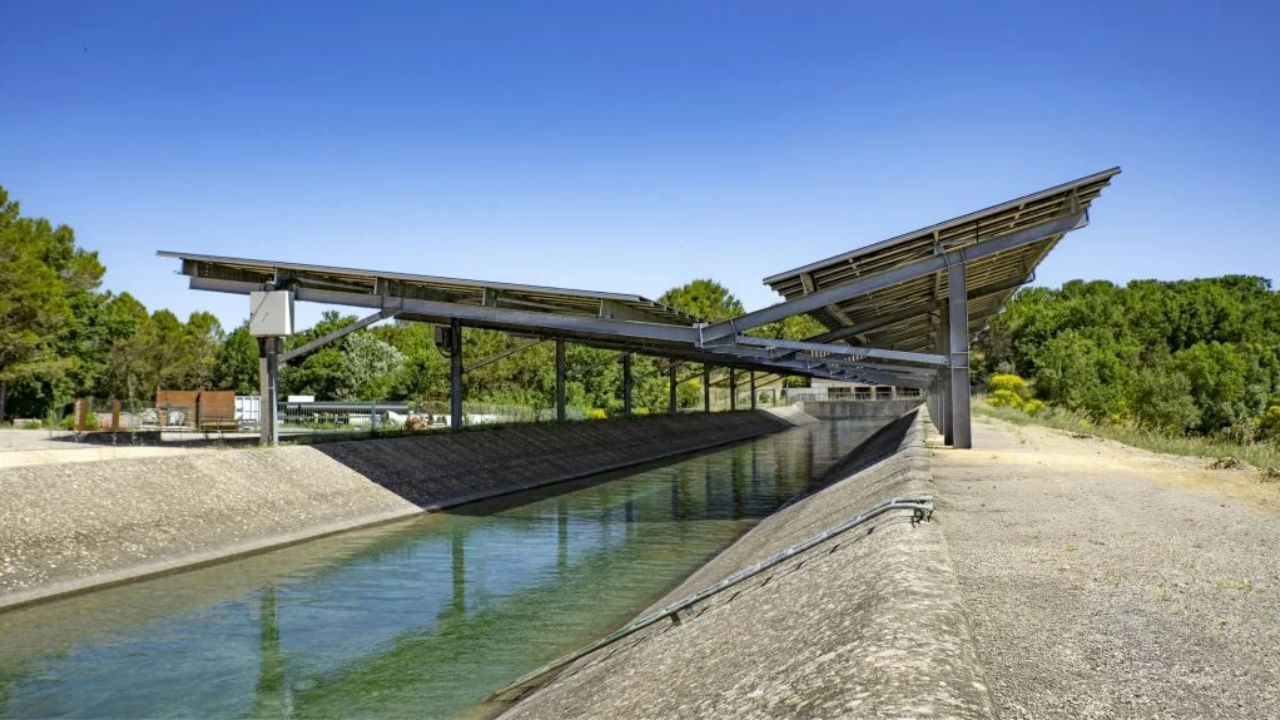
The organizations involved describe the Saint-Maximin-la-Sainte-Baume installation as France’s first large-scale photovoltaic canopy project over a canal. The structure was built specifically to follow the canal’s route while preserving the flow of water.
-
Apple signs power deal with 16-turbine, 99.2-MW wind farm inaugurated in Romania
-
PRIO closes volunteer program after 11 Brazilian nonprofits raise more than R$10 million, exceeding R$1.5 million target in 2026
-
Power grids across five continents exhibit mysterious oscillations every 60 seconds, explained by automated battery tests
-
Original Batmobile from ‘Batman Returns’ featuring Chevrolet V8 engine and flame exhaust to be auctioned for up to R$37 million with street usage restrictions
At 71 meters long, the canopy extends beyond the width of the water conveyance structure and reaches part of its banks. The panels rest on a raised metal frame, allowing water to continue flowing beneath the equipment.
The installed capacity of 299 kWp represents the modules’ rated output under standardized test conditions. The estimated annual generation of 404 MWh may vary depending on solar irradiance, temperature and equipment availability.
The projected output is equivalent to approximately 404,000 kilowatt-hours per year. Project officials say that amount corresponds to the annual electricity consumption of about 200 residents or approximately 1% of SCP’s energy demand.
The solution makes use of existing infrastructure, avoiding the need to set aside additional land for photovoltaic panels. The project also preserves the canal’s original purpose: transporting water in the region.
Solar canopy could reduce evaporation and algae growth in canal
Positioning the panels above the water offers an advantage not found at every conventional solar installation: the panels cast shade directly over the canal’s surface.
Reduced exposure to solar radiation may help limit evaporation, especially during hot periods. The canopy also reduces the amount of light reaching the water, a condition that may limit the growth of certain algae.
According to the Société du Canal de Provence, the technology will be evaluated for its effects on water temperature and environmental conditions in the canal.
These benefits still need to be measured specifically at the French installation. In its November statement, the company did not disclose a percentage reduction in evaporation or consolidated results from water-quality monitoring.
The photovoltaic canopy must also preserve access for workers responsible for cleaning, maintaining and inspecting the hydraulic structure. Any expansion will need to account for these requirements, since installing the panels cannot compromise water conveyance.
Similar projects have already been developed outside Europe. In the United States, for example, solar power projects over canals have been studied as a way to generate electricity and reduce the water’s exposure to the sun.
Canal de Provence has nearly 70 kilometers of open channels and potential exceeding 50 MW

The French project was designed as an experimental installation, but the operator has already studied its use at other points in the network.
Canal de Provence has approximately 70 kilometers of open-air stretches, representing potential sites for new photovoltaic structures. However, not all sections of the canal are suitable for equipment.
The SCP says only 5% to 10% of the canals’ length could be considered for future installations because of technical and regulatory constraints.
The company’s analyses indicate photovoltaic capacity potential of more than 50 megawatt-peak (MWp) across the opportunities studied. Annual output could reach approximately 70 gigawatt-hours (GWh) if the projects deemed viable were built.
These figures are expansion projections, not capacity already built. The only installation presented at this stage is the 299 kWp photovoltaic canopy in Saint-Maximin-la-Sainte-Baume.
The estimated potential also represents a different scale from the experimental installation. While the demonstrator was designed to produce 404 MWh annually, the expansion under study could reach 70,000 MWh per year, depending on whether new systems are built.
Project combines hydraulic engineering and electricity generation for the operator’s own use
Electricity produced by the photovoltaic canopy will be used under Société du Canal de Provence’s self-consumption model. This means the generation is expected to help meet part of the operator’s own energy needs.
The company manages water conveyance and distribution infrastructure, an activity that requires technical facilities and consumes energy. By generating electricity on its own structures, SCP aims to control some of the costs associated with this service.
The initiative is part of the company’s energy planning, which calls for it to produce more renewable energy than it consumes in the future. According to official documentation released in November, the annual demand considered in this strategy is approximately 40 GWh.
The company already uses hydropower in its operations and is developing photovoltaic projects in different formats. These include systems installed on rooftops, on the ground, over bodies of water and on agricultural structures.
The French project adds to other ways of using spaces already occupied by infrastructure. CPG, for example, reported on a solar installation built on railway tracks, a Swiss project that uses a transportation corridor to generate electricity.
Another report covered the installation of solar panels on a commercial rooftop in Palmas, where the electricity is used by the facility itself.
Steel structure designed to allow canal operations and maintenance
Building the canopy required balancing the conditions needed for solar generation with the characteristics of an operating water infrastructure system.
The panels were placed above the water on a metal structure supported along the sides of the canal. The design keeps the water flowing and creates space beneath the canopy for operational activities.
According to SCP’s technical release, the project involved several specialized companies. INEO Provence et Côte d’Azur worked on the metal structure, foundations and utility networks; SCAE was responsible for the electrical work.
Eurovia handled earthworks, while Bourrelly took part in vegetation clearing and landscaping.
The involvement of several teams shows that the project was not simply a matter of placing panels over the water. The structure had to support the modules, accommodate electrical equipment and preserve the canal’s operating conditions.
Those responsible for the project will also need to monitor how the materials perform and how easily the structure can be maintained before deciding whether to build additional installations. The release does not disclose the project’s total cost or the investment’s payback period.
Upcoming measurements will determine where the technology can be expanded
The system in Saint-Maximin-la-Sainte-Baume began operating as a demonstration project, a stage intended to assess a solution’s performance under real-world conditions before any potential larger-scale deployment.
SCP plans to use the data to assess energy output, maintenance needs and the canopy’s environmental effects. The analysis will also consider safety requirements and canal operations.
The plan calls for selective expansion, limited to sections deemed suitable. The company has not yet announced a construction schedule for future canopies or confirmed which sections will host the next projects.
In the meantime, the 299 kWp installation will make it possible to compare actual output with the estimated 404 MWh a year and determine whether shade from the modules helps reduce water losses.