






 Portuguese
  Spanish


A property surrounded by a new highway in China has reignited the discussion about compensations, public works, and the resistance of owners who refuse to leave their homes even when large urban projects advance around them.
The image seems like a montage, but it has become one of the strongest portraits of accelerated urbanization in China. In Jinxi, in Jiangxi province, a residence was isolated between lanes of the G206 after the owner refused a compensation agreement and the works advanced around the property.
According to the South China Morning Post, the house was nicknamed the “Eye of Jinxi” because, seen from above, it resembles an eye surrounded by asphalt. The case drew attention not only for its visual impact but for what it reveals about a phenomenon known in the country as “nail houses,” houses that remain standing while everything around them is demolished or transformed.
The owner, identified in different reports as Huang Ping, allegedly refused an offer of 1.6 million yuan, about US$ 220,000. The construction continued anyway, with the road bypassing the residence and a special access route to keep the family connected to the outside.
-
Celtic trumpet with animal head sounds again after 2,000 years and reveals musical mystery of the Iron Age

-
Archaeologists finally explain why faceless knights appear tiny in decorated tombs in Japan, while horses gain impressive details and reveal an ancient collective ritual to guide the dead in Kyushu.
-
King Charles III opens the gardens of his royal residence for the first time for a historic flower exhibition, arrives by carriage with Camilla, and is surprised by a toilet transformed into a sustainable planter.
-
Balcony immortalized by Michael Jackson in Pelourinho may change for good after 17 years, as merchant receives order to leave and the fate of the famous tourist spot remains surrounded by doubts.


What are Chinese “nail houses”
The term “nail house,” known in Chinese as dingzihu, describes properties that resist demolition after a disagreement between residents, authorities, or developers. The Guardian defines this type of house as a property whose owner rejects the compensation offered to leave the location.
The image is strong because it transforms an administrative dispute into an almost surreal urban scene. Instead of disappearing with the advancement of the construction, the house remains as an isolated point, surrounded by excavations, construction sites, demolished buildings, overpasses, or new roads.
Reuters also uses the term to explain properties that remain like “nails” difficult to remove within areas already cleared for new developments. In the case of Jinxi, the visual effect became even more striking because the highway was built around the house, creating a scene that quickly went viral.
Jinxi case gained strength after the highway opened
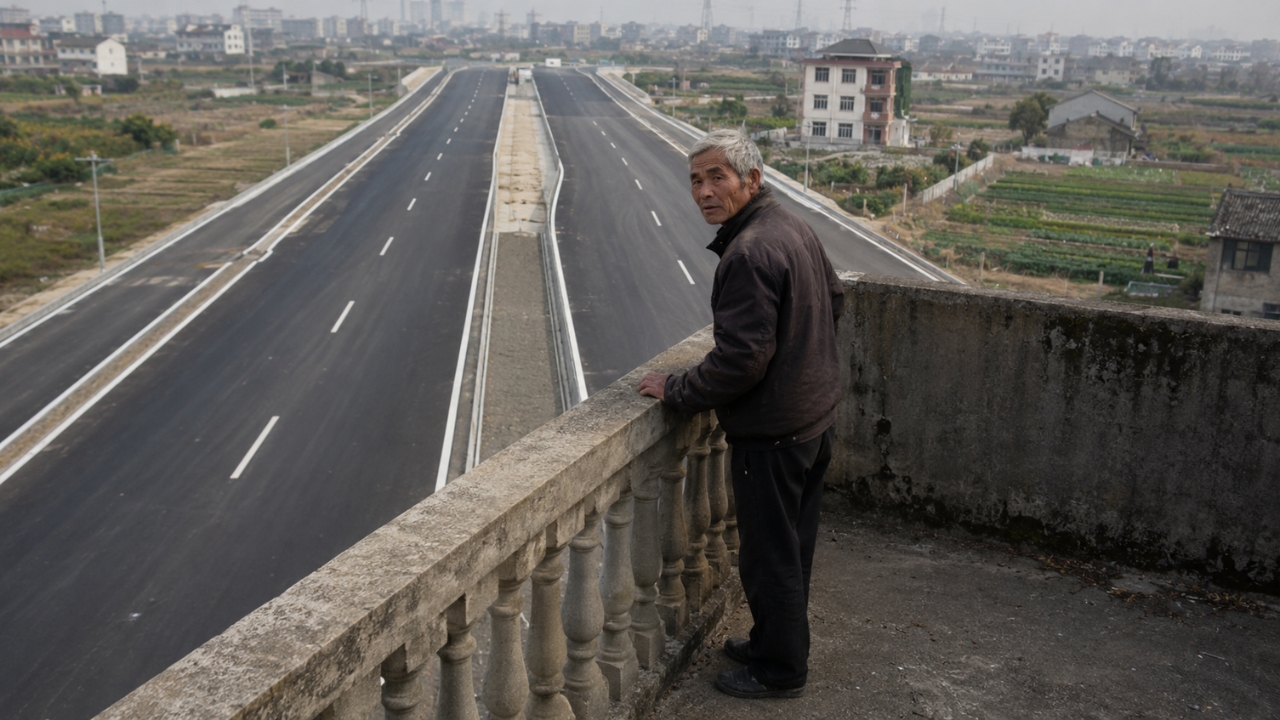
The Jinxi case did not end when the asphalt was completed. Reports from Oddity Central and Cadena SER pointed out that the family eventually left the property after the road went into operation, due to the noise, vibration, and constant traffic.
This turn gave another weight to the story. The house that once symbolized resistance also began to show the practical cost of remaining surrounded by a large construction. Even with access created by the construction team, daily life inside the residence changed completely.
The power of the image helped the case circulate around the world, but the discussion goes beyond visual curiosity. It involves compensation, the right to remain, urban pressure, and the boundary between a public work and the life of those in the project’s path.
Wenling became one of the most famous cases in 2012
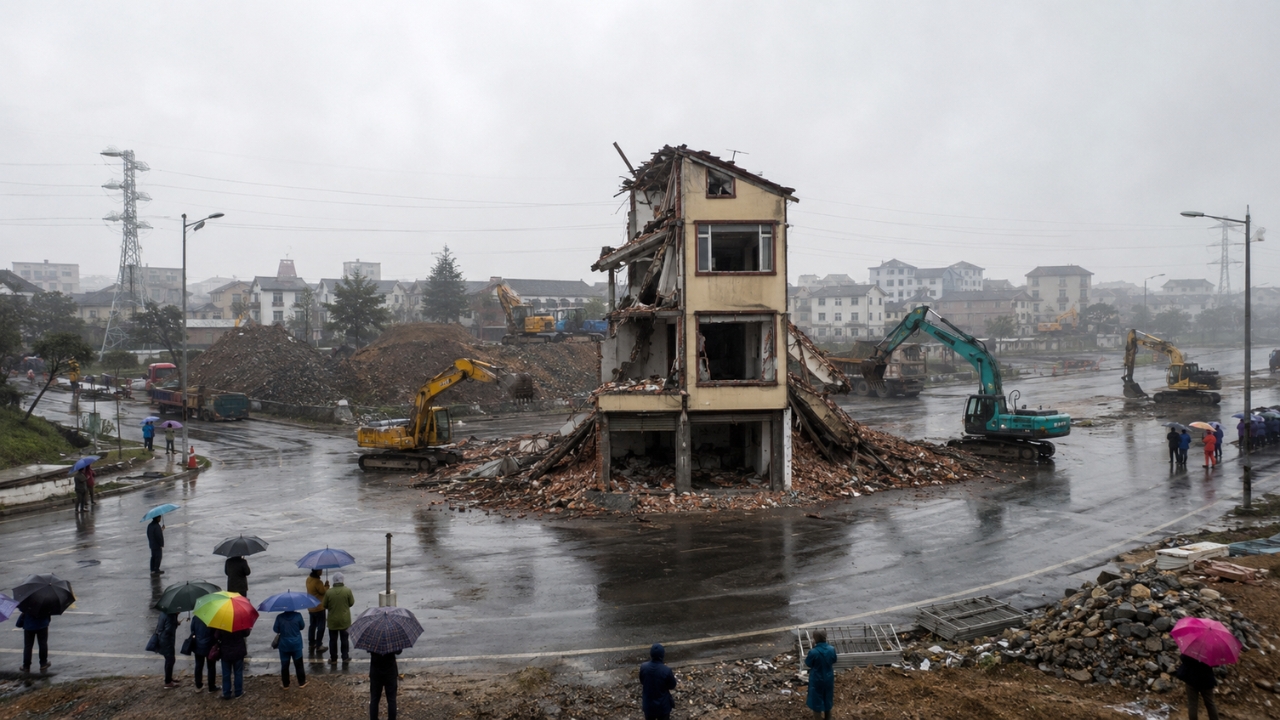
Before Jinxi, one of the most well-known episodes occurred in Wenling, in Zhejiang province, in 2012. Luo Baogen, a 67-year-old duck farmer, and his wife remained as the last residents of an area demolished to open a road to a railway station.
According to China Daily, more than 500 families began leaving the region starting in 2008. Luo, however, considered the compensation insufficient to build another house in the village. The amount cited was 260,000 yuan, about US$ 41,700 at the time.
CBS/AP reported that Luo claimed to have spent about 600,000 yuan, approximately US$ 95,000, to build the house. The initial offer was said to be 220,000 yuan and then increased to 260,000 yuan. The road was already completed but had not yet been opened to traffic.
The outcome came on December 1, 2012. Reuters reported that the house was demolished after Luo accepted a deal, following talks with the local government and family members. The Guardian also reported the demolition after the acceptance of compensation.
Overpass in Guangzhou also bypassed residents
Another striking example appeared in Guangzhou, in Guangdong province. In 2015, ABC News showed an old residential building surrounded by a newly constructed circular overpass. Some residents had refused to leave a block marked for demolition since 2008.
The solution found was to build the large road around the building. Once again, the result drew attention because the construction did not erase the resistance, it merely framed it within the new infrastructure.
According to ABC News, many residents of “nail houses” refuse to leave because they believe the compensation offered is not sufficient. This point appears in different cases, from Wenling to Jinxi, always with the same backdrop: the dispute between large urban projects and residents who do not accept the terms of removal.
The dispute behind the viral image
“Nail houses” are not just architectural curiosities. They reveal a deeper social tension in a country that has undergone intense urban transformations and large-scale projects.
China Daily quoted Professor Shen Kui from Peking University, explaining that residents had the legal right to remain until they received what they were seeking, although the government also had the duty to carry out public works. The same expert pointed out low compensation standards on collective lands as one of the roots of the problem.
Reuters recalled that the 2007 Chinese Property Law sought to strengthen the protection of private property and curb illegal expropriations, although without fully privatizing collective rural lands. Amnesty International warned in 2012 that forced evictions continued to be a significant source of conflict in China, with compensations often below the real market value.
The isolated house between lanes, therefore, draws attention not only because it seems impossible. It shows how an ordinary property can become a symbol when the city advances faster than the agreement between builders and residents.
In the end, the case of Jinxi goes beyond a residence surrounded by asphalt. It sums up, in a single image, the clash between urban progress, refused compensation, and permanence, showing that even a solitary house can force a major project to change its form.


This house must be demolished to save the residence danger of motorists.
This can never happen in Nigeria
In 9ja your property will be demolished, no compensation and you will still be beating to pulp and got jailed. 9ja no get government.
China building ” Highway” and road for in general used by it citizens and visitors alike .. grace 🙏🏾 please