





 Portuguese
  English
  Spanish
  3 min of reading
  1 comment


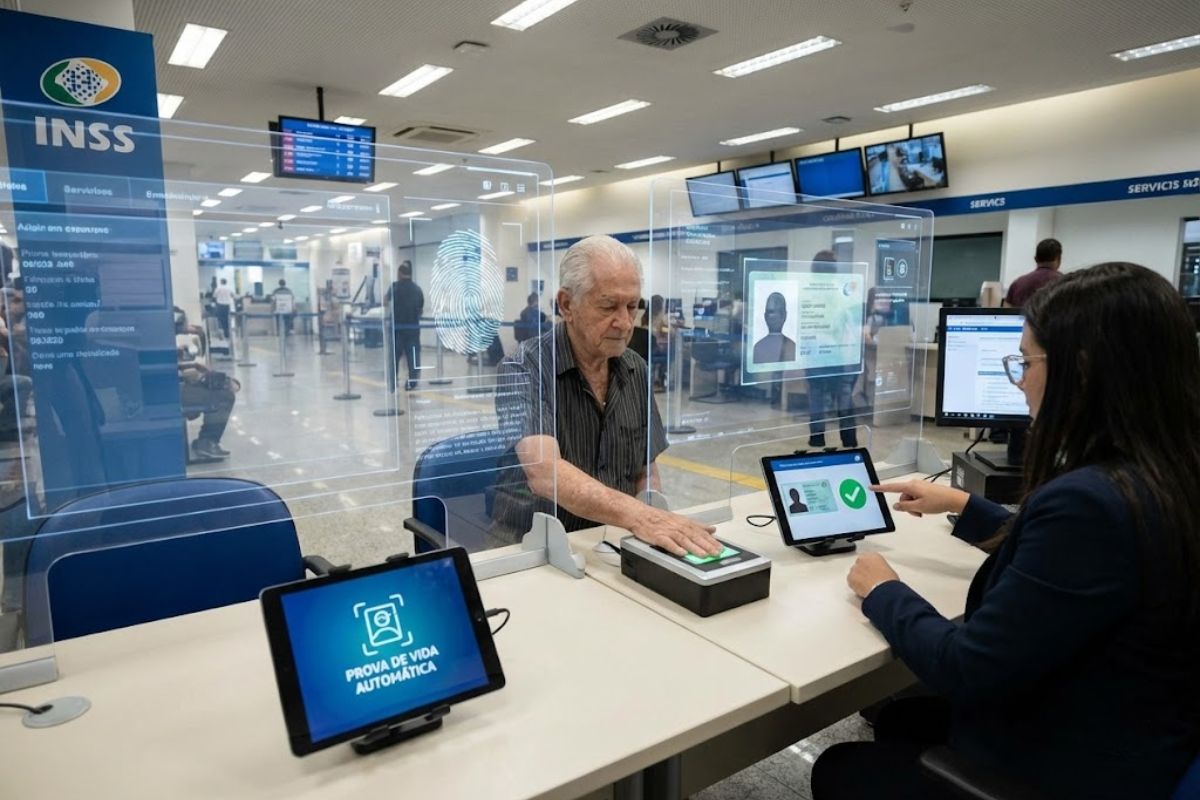


Proof Of Life In 2026 Becomes The Responsibility Of The INSS, Which Crosses Data From Multiple Sources To Confirm Beneficiaries And Reduce In-Person Requirement.
If the system does not validate the insured person’s status, a notification is sent. Regularization can be done via Meu INSS, banks, agency or gov.br. The proof of life in 2026 remains an annual requirement for retirees, pensioners, and long-term beneficiaries.
The procedure changes in practice.
The verification will primarily be done by an automated system of the INSS.
-
“No one will make us change the Pix,” says Lula after the US report.

-
Lula responds directly to Trump and says that Pix is from Brazil and will not change under pressure from anyone, after a report from the United States pointed out the Brazilian payment system as an American trade barrier.

-
Amazon has just announced a new fee on all deliveries, and your online purchases will become more expensive starting April 17, including for those buying from the United States here in Brazil.

-
He sold his share for R$ 4 thousand, saw the company become a giant worth R$ 19 trillion, and missed the opportunity of a lifetime.


The system uses data cross-referencing with official databases to automatically confirm who is alive.
The goal is to reduce the need for physical presence.
The measure seeks to ensure the continuity of benefits with less travel.
In 2026, the INSS will cross data from various official sources.
These include interactions in the Meu INSS app.
Information from banks is also included.
Health records and other official systems are part of the verification.
When the system cannot automatically verify the living status, the institute sends a notification.
The notice requests regularization.
The INSS warns that, without confirmation within the defined timeframe, payments may be blocked.
How Proof Of Life Works In 2026 With Automated Verification
The proof of life in 2026 is primarily conducted by the INSS.
The institute takes on the responsibility of validating most beneficiaries.
This occurs through data cross-referencing.
The model reduces the need for travel.
It also decreases the requirement for in-person attendance.
Even with automation, the requirement remains mandatory.
It applies to long-term benefits.
These include pensions and retirements.
The difference lies in the action trigger.
The insured person only needs to act when the system does not automatically certify the status.
What Happens When The INSS Does Not Confirm The Status Of The Insured
If the proof of life in 2026 is not confirmed by the cross-referencing, the INSS sends a notification.
The notice requests regularization.
It functions as a preventive alert.
The aim is to avoid payment blocks.
From this notification, the beneficiary must follow the indicated guidelines.
Regularization must be done within the deadline.
This confirmation is what prevents the interruption of the benefit.
Channels To Regularize Proof Of Life In 2026
Regularization of the proof of life in 2026 can be done through different channels.
The model combines digital platforms and in-person services.
The use of each channel depends on the insured person’s situation.
Options include the Meu INSS app.
In this case, steps such as facial recognition may be required.
It is also possible to use digital services from banks.
This depends on the paying institution of the benefit.
Another alternative is attending a bank agency.
It is necessary to present an official photo ID.
There is also the use of the gov.br app.
In this channel, proof of life can be done through facial recognition.
Requirements For Digital Proof Of Life On gov.br
To perform the proof of life in 2026 through gov.br, it is necessary to have a driver’s license.
Another possibility is having biometric data registered with the Superior Electoral Court.
These records allow for digital identity validation.
The process eliminates the need for an in-person visit.
Why Proof Of Life In 2026 Is Maintained
The proof of life in 2026 is regarded as a fundamental control mechanism.
It helps prevent fraud.
It also ensures that only legitimate beneficiaries receive payments.
Even with automation and reduced in-person requirements, the procedure remains mandatory.
The validation is directly linked to the continuity of the benefit.
In your opinion, has the proof of life in 2026 become simpler with automation and facial recognition, or does it still create insecurity due to the risk of blocking when the system does not confirm the data?









Mais seguro