Tunnel manager Meng Defeng and his China Railway 14th Bureau crews pushed the Jianghai tunnel boring machine 7.46 km under the Yangtze River, a record continuous drive that brought the 16.64-metre machine ashore in Taicang on November 26.
The machine crossed the levee on the river’s south bank at about 9 a.m. on Thursday, Science and Technology Daily and CCTV reported, and arrived in Taicang, in China’s Jiangsu Province, after roughly 14 months under the river.
The crossing completes the under-river stretch of the first bore, the right-hand line, of the Haitai Yangtze River Tunnel, which Chinese media describe as the world’s longest underwater highway tunnel dug with a shield machine.
A machine built in China for a 16-metre tube
Jianghai is a domestically developed 16-metre-class shield machine with a maximum excavation diameter of 16.64 metres. The tunnel lining rings it installs have an outer diameter of 16 metres, according to the reports.
-
Sheikh Hamdan bin Mohammed says Dubai has awarded Dh56.5 billion in new Al Maktoum airport contracts, enough to raise the steel roofs of two concourses and build two 132/11 kV substations for a hub planned for 260 million passengers a year

-
Certifier Laszlo Lepp handed a Passivhaus certificate to a 136.8-metre student complex in London’s Canary Wharf with 1,672 beds for UCL, making its 46-storey tower the tallest fully certified Passivhaus building in the world
-
São José dos Campos prepares R$272 million project spanning 8.3 km, with viaducts and a new alternative to the President Dutra Highway

-
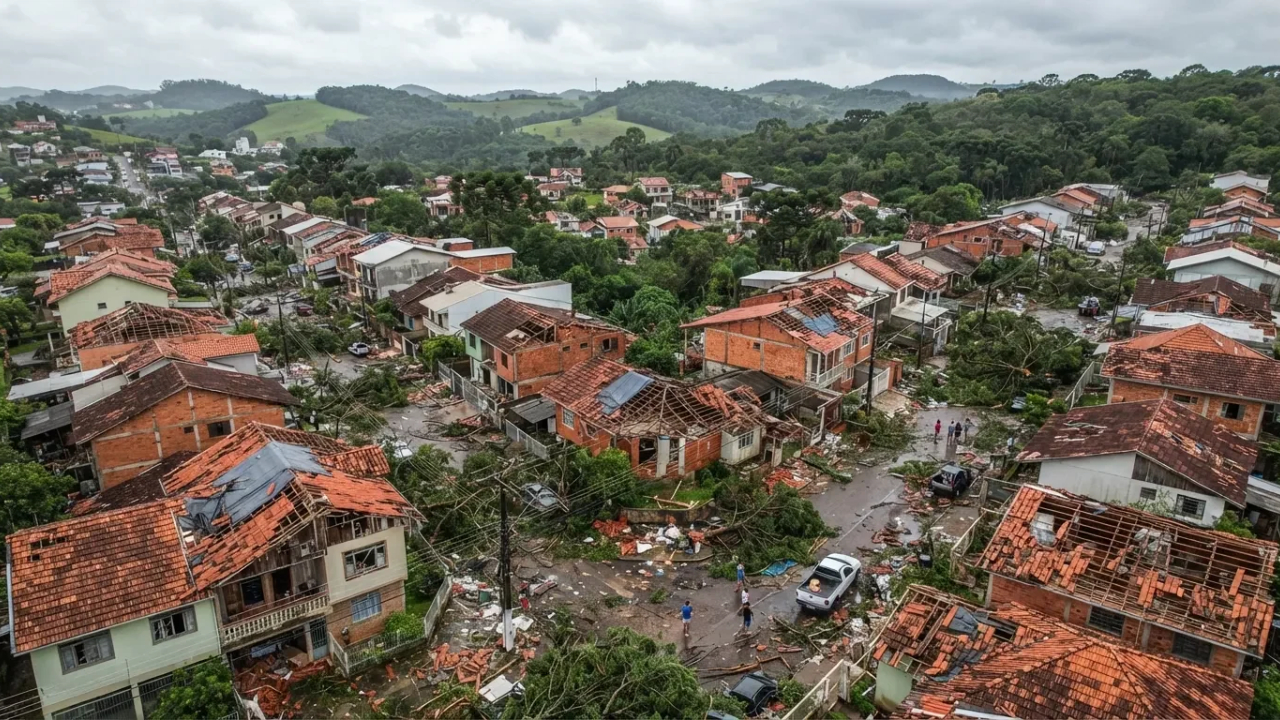
Rio Grande do Sul city receives approval for R$3.8 million in recovery funding after storm damages 8,000 homes

The Global Times put the machine’s weight at more than 5,000 tons. The reports call Haitai the largest-diameter tunnel now being built under the Yangtze, and Chinese outlets have nicknamed it the new “first tunnel on the Yangtze.”

A 39-km expressway with 11 km under the river
The whole Haitai project runs 39.07 kilometres, linking Haimen, in Nantong, on the north bank with Taicang, in Suzhou, on the south bank. The Global Times also lists Changshu on the southern side.
It is designed as a two-way, six-lane expressway with a design speed of 100 km per hour. The section that passes under the river is 11.185 km long and combines open-cut work with shield tunnelling.
China Railway 14th Bureau Group is building the right-hand line’s shield section, which measures 9,315 metres in total. Jianghai is the single machine assigned to dig that entire stretch.
Fourteen months from launch to the south bank
The machine was launched in April 2025 from Haimen, on the north bank. After finishing the land section on that side, it entered the river stretch in September 2025, the reports said.
It reached its lowest point in May 2026, about 75 metres down, and left the river section in November. Across the crossing it advanced at an average of about 20 metres a day.
Science and Technology Daily described three phases: a steady entry into the Yangtze, a long downhill drive to the deepest point, and a climb back up with changes in the machine’s attitude to exit the riverbed.
Two records along the way
According to the newspaper, the run set a record for continuous tunnelling under the Yangtze, at 7.46 km, and a record for monthly progress, with a best month of 664 metres.
The reports present the crossing as a test passed by Chinese-built 16-metre-class shield equipment and by the tunnelling methods used under the river, after a drive that combined great length, great diameter, high water pressure and deep cover.
Soft ground that sinks under load
Meng Defeng, the shield manager on China Railway 14th Bureau’s Haitai project, said that once under the river the tunnel had to pass through compound soft soil layers that are loose, highly permeable and prone to settlement under pressure.
He added that the very long single-heading drive kept Jianghai working under heavy load for a long time, since the machine was advancing from one side only, with no second machine coming the other way.
Pressure equal to 51 cars on each square metre
At the lowest point, Meng said, the face of the machine was under 7.5 bar of water and earth pressure, which he compared to the weight of 51 cars pressing on every square metre.
A machine of that diameter disturbs a lot of ground as it digs, he said, which raises the risk of water and sand bursting in, leaks at the tail of the shield and collapse of the excavation face.
The rise and fall of the route added another problem. The deep early section put heavy strain on the equipment, while the later climb meant thinner cover above the tunnel and shifting water pressure, demanding very precise steering.

How the crew kept the drive under control
Before entering the river, the team carried out a full maintenance and condition check on the machine. During the drive, a “digital shield” platform tracked tunnelling parameters, equipment status and ground changes 24 hours a day.
For the deepest stretch, the project set up a three-level support system linking academicians and outside experts, technical staff at headquarters and the crews at the face, Science and Technology Daily reported.
The crews used cutter changes at atmospheric pressure, a telescopic main drive and advance geological forecasting, along with fourth-generation synchronous two-component grouting to control the quality of the finished tunnel.
On the climb out, the team adjusted tunnelling parameters in real time as cover depth and water pressure changed, correcting the machine’s attitude until it reached the south bank.
What is left before the first bore is through
Leaving the river ends the hardest part of the right-hand line, according to the newspaper. The team will now continue with the remaining land section on the south bank and push toward full breakthrough of that bore.
The reports did not give a date for that breakthrough, for the second bore, or for the opening of the expressway, and they did not mention the cost of the project.
What the crossing changes for drivers
Once finished, the tunnel is expected to greatly shorten travel between Nantong and southern Jiangsu and Shanghai, supporting what officials call a “one-hour economic circle” in the core of the Yangtze River Delta.
The Global Times reported that it should also ease pressure on the existing Sutong Bridge, which links Suzhou and Nantong across the river. The reports did not put a number on the time saved.
The project is listed in the Yangtze trunk crossing layout plan for 2020 to 2035 and in Jiangsu’s transport corridor plan for the Yangtze River Economic Belt, according to the CCTV report carried by Sdenews.
Part of a wave of giant river tunnels
Large shield machines are now digging under rivers on several continents. In the United States, a second boring machine recently started on the Hudson Tunnel’s two new rail tubes.
China has already faced the risks of deep drives before, as when engineers sent a second 5,000-ton machine from the opposite side to reach a stuck one.
At Haitai, a single machine of more than 5,000 tons has now crossed the full width of the river on its own, a feat Chinese media describe as a first test passed by home-built 16-metre-class equipment.
Would drivers in the Yangtze River Delta trade the Sutong Bridge for a 39-km expressway running deep under the river?