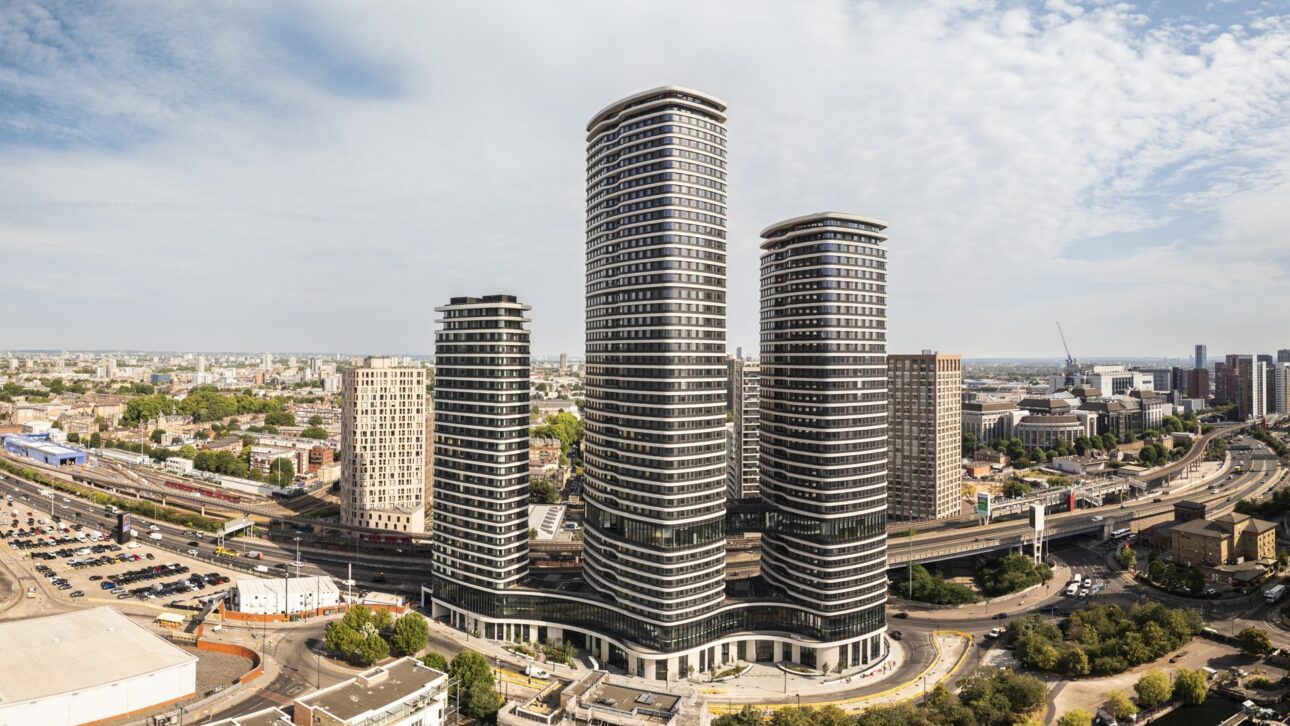

Certifier Laszlo Lepp of the Passivhaus Institute handed over the paperwork on November 24 that makes a 136.8-metre student complex in Canary Wharf the tallest Passivhaus building in the world, with 1,672 beds for University College London students.
The scheme is urbanest Canary Wharf, three towers of 46, 36 and 28 storeys on the Isle of Dogs in east London. The developer announced the certification on November 25 in a statement also published by e-architect and BDC Magazine.
According to urbanest, the certificate gives the project two global records: the world’s tallest fully Passivhaus-certified building and the world’s largest Passivhaus-certified building for residential use.
The company also claims two national titles. The complex is described as the UK’s largest certified single Passivhaus building of any type and the country’s tallest purpose-built student accommodation building, standing 136.8 metres from ground to roof.
-
São José dos Campos prepares R$272 million project spanning 8.3 km, with viaducts and a new alternative to the President Dutra Highway

-
Rio Grande do Sul city receives approval for R$3.8 million in recovery funding after storm damages 8,000 homes
-
Transport minister Chen Shih-kai says Taoyuan Airport’s Terminal 3 is 91% built and will open on Christmas Day 2027, with all 95,000 cloud-shaped ceiling panels in place and room for 45 million more passengers a year

-
Santos Begins Demolishing 170-ton Walkway Damaged by Storm Surge, Plans 56-Meter Replacement





A ceremony on site, a certificate from Austria
The achievement was formally celebrated at the building on November 24, when representatives of the project team received the official certificate from the Passivhaus Institute, the developer said in its statement.
Lepp, managing director of the Passivhaus Institute in Austria and certifier of the project, tied the record to the people living inside. “Certifying the largest Passivhaus project worldwide proves that sustainability and social responsibility belong together,” he said.
“For me, Passivhaus means giving students a healthy, comfortable and affordable home, because sustainable living should never be a privilege,” Lepp added in the same statement.
What the label actually demands
Passivhaus is a performance standard. Its core limits, as summarized in the Wikipedia entry on the standard, include annual space heating demand of no more than 15 kWh per square metre, or a peak heat load of no more than 10 watts per square metre.
The building envelope also has to pass a blower-door test, with airtightness of no more than 0.6 air changes per hour at 50 pascals, and use mechanical ventilation with heat recovery, typically at 75% efficiency or better.
urbanest describes five principles behind the label on its own website: very high insulation, triple-glazed windows, construction free of thermal bridges, an airtight envelope and ventilation with highly efficient heat recovery.
How the towers passed the tests
According to the developer, the Canary Wharf scheme met the standard “following rigorous testing” through high levels of insulation, airtight construction, high-performance glazing and heat-recovery ventilation across all three towers.
The company said the building also achieved an air permeability result that significantly outperformed the level the industry considers excellent. The statement did not publish the measured figure, so the margin over the Passivhaus limit is not known.
Henriksen Studio handled both the façade engineering and the Passivhaus consultancy. Its founder, Thomas Henriksen, said the project “shows that Passivhaus can be delivered at scale on a complex, mixed-use city scheme.”
“From the outset, urbanest set a clear ambition for comfort, health and low operational energy, and that commitment carried through design, construction and commissioning,” Henriksen said.
What changes for the 1,672 students inside
The development opened in September 2026 under a full nominations agreement with UCL, meaning the university fills the rooms. Besides the 1,672 student bedspaces, it holds 80 residential units with one, two and three bedrooms.
For residents, urbanest says the design means comfortable temperatures throughout the year and a continuous supply of fresh, filtered air, along with substantially lower operational energy demand than an average new building.
On its explainer page, the company says Passivhaus can cut heating consumption by up to 60-80%. It has not released a measured energy figure for the Canary Wharf towers since students moved in.
Shared spaces include a gym, a yoga studio, two cinema rooms, study spaces, games rooms and 70 sky gardens, which the developer says were included to support student wellbeing.

UCL’s accommodation chief on affordable rooms
Joe Lay, director of accommodation at University College London, said the scheme is located near the university’s School of Management and fits several priorities of UCL’s accommodation strategy.
“urbanest Canary Wharf has been designed with sustainability embedded, introduces a significant number of affordable rooms to our portfolio, and provides high-quality spaces where UCL students can feel at home,” Lay said. The statement did not give rent levels.
Shops, classrooms and a drive-thru at the base
The towers are not only housing. The development also provides 43,000 square feet of retail and flexible-use education and office space, of which two levels have planning consent for education use.
The ground floors also include a drive-thru McDonald’s restaurant, according to the statement published by urbanest, e-architect and BDC Magazine on the record-holding towers.
The team behind the three towers
The scheme was delivered in partnership with UCL. The wider project team listed by urbanest included JRL Group, Apt Architects, Henriksen Studio, Newmark, Walsh, Rider Levett Bucknall, MTT and LDA Design.
Anthony Mellalieu, chief operating officer at urbanest, credited the whole group. “Achieving this rigorously tested certification is a reflection of exceptional work from the entire project team,” he said.
From Battersea to a much larger record
This is not the developer’s first certified building. urbanest Battersea achieved the standard in 2024 and, at the time, became the UK’s largest Passivhaus building. The company says Canary Wharf repeats that work at a substantially larger scale.
Canary Wharf is urbanest’s tenth student community in central London and its second certified to the standard. The company describes itself as a central London real estate investment trust founded in 2008, with more than 6,000 beds across ten properties.
“Following the certification of urbanest Battersea in 2024, this latest achievement places urbanest at the forefront of sustainable student accommodation,” Mellalieu said in the statement.
How high the bar sat before
The Wikipedia article on the Passive House standard still names an 88-metre tower in Bilbao, Spain, completed in 2018, as the world’s tallest certified Passive House building. At 136.8 metres, the London scheme stands well above that figure.
Other tall residential projects are also chasing records for new building methods. In Sydney, a developer wants to stack factory-built steel modules 71 storeys high in Parramatta for 1,152 rental homes.
What is still missing from the record
The announcement leaves several numbers open. It gives no measured airtightness result, no heating demand per square metre for the towers and no figure for energy bills paid by residents after the first months of occupation.
The record claims come from urbanest and the certifier. No independent ranking of tall Passivhaus buildings was published alongside the announcement, and University College London’s own news page could not be accessed for this article.
Should tall student housing in big cities be required to meet the Passivhaus standard, even if it raises the initial construction cost?