Man received bank deposit by mistake in Zimbabwe, spent the amount and was convicted in a case that raised alerts about errors in digital transfers.
According to Allafrica, in a report dated November 12, 2025, Garikai Mtangandebvu, a worker at a wholesale store in Vengere, Rusape, in Zimbabwe, was convicted after mistakenly receiving US$ 1,885.45 and ZWL 238,638.90 in his bank accounts in July 2025. The money, according to the case reviewed by the court, was intended for another person with exactly the same name but ended up in the wrong accounts.
The episode gained attention because it was not limited to a simple banking error. According to Allafrica, Mtangandebvu realized the deposits were suspicious, did not notify the bank, nor did he attempt to locate the true recipient. Instead, he withdrew and used the amounts, which led the case to court and turned the story into a direct alert about wrongful deposit, digital transfers, and criminal liability.
Banking error in Zimbabwe occurred because two people had exactly the same name
The most unusual element of the case lies in the identity coincidence. There were two men named Garikai Mtangandebvu, and it was this duplication that caused the money to be sent to the wrong account. When the legitimate recipient realized the amounts had not been credited, he filed a formal complaint, and the company responsible for the transfer began an investigation.
-
At 92 years old, an elderly man refuses to retire, works every day in a restaurant for a reason that moves customers and colleagues, turns kindness into a life mission, and says he doesn’t plan to stop.

-
Octopus learns to play piano underwater after six months of training, receives an instrument with treats and surprises by producing notes and even a chord.

-
She traded the city for the Minas Gerais savanna and has been living since 2018 on a farm valued at over R$ 8 million. At 41, Paula Fernandes takes care of a vegetable garden, horses, chickens, and ducks, and says she returns ‘energized’ to her own roots in the Minas countryside.
-
Women had their faces and bodies forcibly tattooed by abusive partners, but free laser treatment in the Netherlands is erasing the marks of violence and restoring freedom to the victims.


The investigation showed that the system allowed the transfer to the wrong man despite the nominal coincidence. From there, the police were called, and the case proceeded to the Rusape Magistrates Court. The identification error helped explain the origin of the deposit, but did not absolve the responsibility of the person who received and decided to spend the money.
This distinction was central to the outcome. The initial error was with the transfer system, but the subsequent conduct of the recipient was what defined the criminal interpretation of the case.
Court understood that the accused knew the money was not his
According to Allafrica, the decisive point for the conviction was the fact that the accused himself acknowledged that the deposits seemed suspicious from the beginning. This weakened any argument that he might have believed he was dealing with a legitimate payment.
In practice, the court considered that there was not just a banking error followed by innocent spending. The judicial interpretation was that, upon noticing something unusual and still withdrawing and using the amount, Mtangandebvu consciously assumed the risk of appropriating funds that did not belong to him.
This interpretation completely changes the framing of the episode. Instead of simple financial confusion, the Justice treated the case as misappropriation of money received by mistake, which supported the conviction.
In Zimbabwe, spending money deposited by mistake can become a crime
According to Zimpricecheck, the legal position in Zimbabwe is clear: when money mistakenly enters an account, the person must notify the responsible financial institution. Withdrawing and spending an amount that they know, or reasonably should know, does not belong to them can result in criminal liability.
This understanding has become even more sensitive with the advancement of digital transfers in the country. The growing use of electronic payment platforms has increased the speed of operations, but it has not always been accompanied by the same level of identity verification and legal education for users.

This is precisely why the case drew so much attention. It showed that the digitization of the financial system does not eliminate human risk nor the legal obligation. On the contrary, it can make errors faster, quieter, and potentially more serious.
Sentence combined suspended prison, money return, and community service
The penalty imposed on Garikai Mtangandebvu was 36 months in prison, but the execution was divided into parts. According to the reported case, six months were suspended on condition of good behavior.
Another 15 months were suspended with the requirement of full restitution of the amount to the rightful recipient. The remaining 15 months were converted into 525 hours of community service, making this the most immediately executable part of the sentence.
This format shows how the Justice system tried to combine three objectives at the same time: punish the conduct, pressure for the return of the money, and avoid immediate total incarceration. Even so, the case remains heavy because the obligation of restitution can be extremely difficult to fulfill.
Money not recovered and restitution may become the hardest part of the penalty
According to the presented content, no amount was recovered. This detail makes the conviction even more difficult in practice, because part of the suspension of the sentence precisely depends on the full return of money that has already been spent.
For a wholesale worker in a low-income country, returning almost US$ 1,900, in addition to the equivalent in local currency, can become a long-term obligation and difficult to execute. This means that the financial part of the sentence can weigh as much as the criminal punishment.
In practice, community service tends to be the most executable portion of the penalty, while restitution remains the most complicated part, precisely because it depends on an economic capacity that the convicted apparently did not have.
Rusape case became warning about errors in digital transfers
The case of Garikai Mtangandebvu became a clear portrait of the legal risk involved in wrong bank deposits. What started as a transfer error, caused by the coincidence of names, ended in criminal conviction, obligation to return money, and fulfillment of community service.
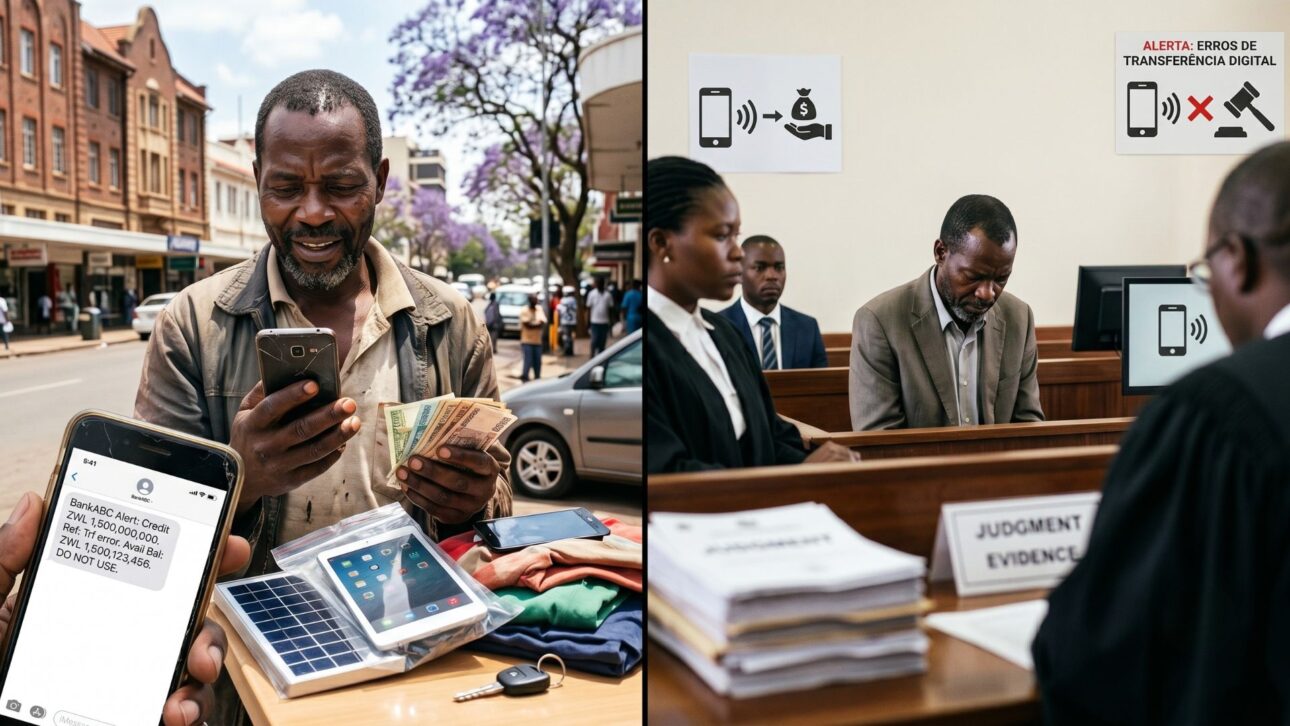
The coincidence of identity helped produce the error, but it was not enough to remove the responsibility of the person who received the funds. The court understood that the accused noticed the abnormality of the operation and still chose to withdraw and use the amount.
In the end, the lesson the case leaves is direct: money received by mistake does not become the property of the recipient just because it entered the account.
In an increasingly digital banking system, a technological failure may start the problem, but the decision to spend the amount is what can turn a financial error into a criminal conviction, even when the banking system fails, the deposit seems like an unexpected windfall, and the temptation to spend comes before prudence.