





 Portuguese
  English
  Spanish
  5 min of reading
  0 comments


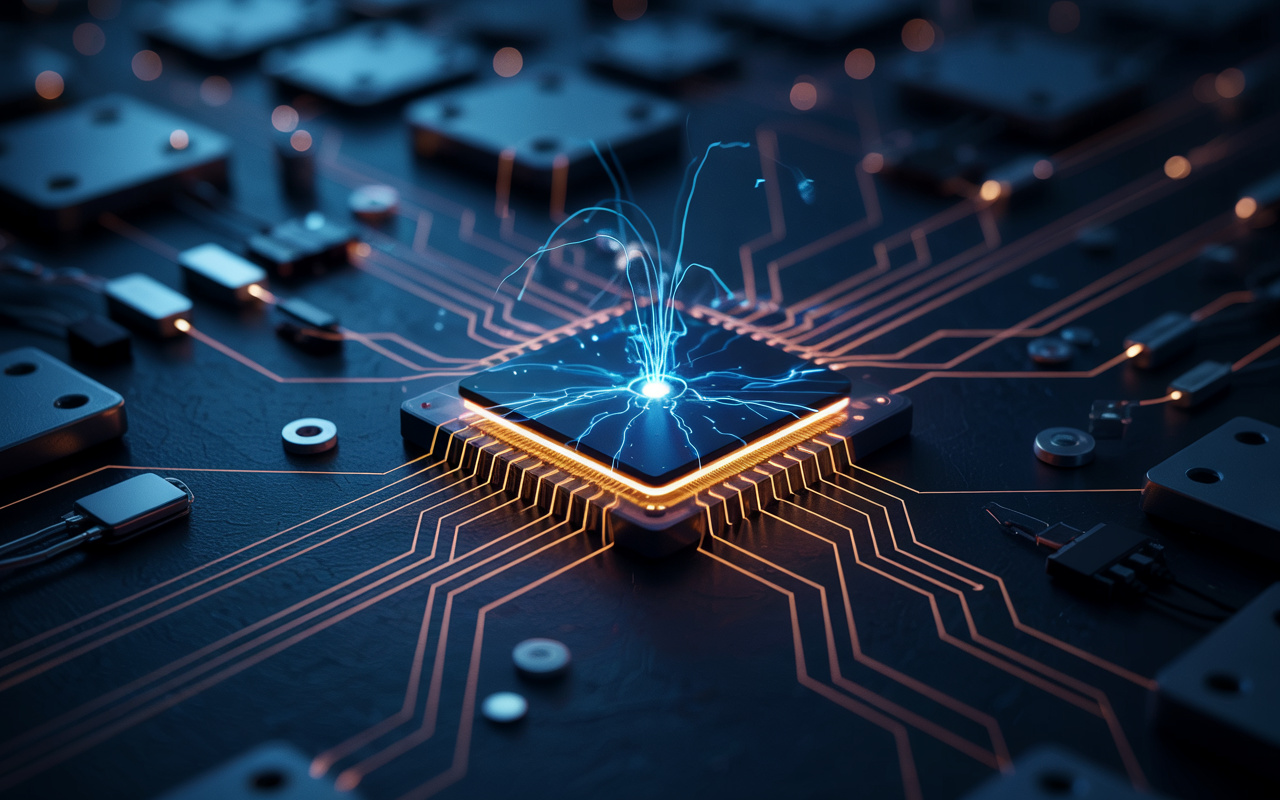
Understand How an Innovative Material Transitioning Between Conductor and Insulator Is Driving an Electronic Advancement That Can Make Technology Up to 1000 Times Faster, Shaping the Electronics of the Future.
Electronics is about to undergo a radical transformation with the discovery of a material that transitions from conductor to insulator, capable of accelerating devices by up to 1,000 times. This innovation, considered a true electronic advancement, promises to enhance the performance of devices we use daily and open doors to a faster and more efficient electronics future. In this article, we explain what makes this technology so revolutionary, how it works, and what impacts it may have on the market and society.
What Is the Material That Transitions from Conductor to Insulator? An Electronic Advancement That Can Transform Electronics
The concept of a material capable of alternating between conductive and insulating states is not completely new. This change is called metal-to-insulator transition (MIT). What differentiates this new material, however, is the speed and control with which this transition can be triggered.
Renowned researchers have been studying metallic oxides such as NdNiO₃, which exhibit a rapid transition between conductive and insulating states on the nanoscale, as demonstrated in recent experiments conducted by teams at MIT and Harvard. This response time is about 1,000 times faster than traditional semiconductor materials currently used in transistors and chips.
-
Super toxic red mineral found in the double burial of two women aged 1,900 years near the banks of the Dnieper River in Ukraine.

-
No one expected this under a common street: archaeologists find 3 intact oak barrels, buried about 400 years ago, with traces of lime and pieces related to 17th-century construction.

-
After decades of failed attempts, Brazil is once again looking to space with an orbital rocket measuring 12 meters, weighing 12 tons, costing R$ 189 million, and scheduled for launch in 2026, in a new race to finally achieve autonomous access to orbit.

-
The Earth will plunge into a few minutes of darkness in broad daylight in August 2026, when a total solar eclipse transforms the sky into one of the most impressive astronomical phenomena in recent years.


In addition to speed, this material exhibits high thermal stability and durability, essential aspects for use in consumer and industrial electronics. This represents a substantial electronic advancement, as it will allow for the creation of devices that operate far beyond current performance limitations.
Technology 1000 Times Faster: The Impact of the Transition Between Conductor and Insulator
The possibility of a material quickly alternating between conductor and insulator paves the way for an exponential increase in the speed of electronic devices. In transistors, which are the foundation of all integrated circuits, this change means operations can be performed at speeds never before achieved.
This acceleration brings several advantages:
- Faster Processing: computer chips and smartphones can perform complex calculations in a fraction of the current time, making software and applications much more agile.
- Reduction in Energy Consumption: the rapid and efficient switching reduces energy expenditure, increasing battery life and decreasing device heating.
- Miniaturization of Circuits: high efficiency allows for the manufacture of smaller components without performance loss, driving the development of more compact devices.
This advancement is a significant step towards the electronics of the future, where speed and energy efficiency are crucial.
Conductor Insulator: The Key Role of This Transition for the Electronics of the Future
The differential of the new material lies in its ability to be both a conductor and an insulator, depending on the applied stimulus. This creates unprecedented possibilities in the design of electronic circuits and systems.
In traditional electronics, the flow of electric current is controlled by semiconductors that have physical limitations that hinder radical accelerations. The rapid transition between conductor and insulator performed by the new material redefines these boundaries.
This behavior allows the development of:
- Ultrafast Transistors: capable of turning currents on and off at vastly superior speeds, enhancing the performance of CPUs and GPUs.
- Innovative Memories: devices that store data by alternating between conductive and insulating states, increasing the speed of reading and writing.
- Smart Sensors: that quickly respond to environmental changes, enhancing precision and response time in medical and industrial applications.
Therefore, the functionality of conductor insulator is one of the keys to the next generation of electronic devices, with applications ranging from everyday life to critical high-tech systems.
Recent Studies Confirm the Electronic Advancement with the New Material
Recent research shows that some materials, such as thin films of vanadium dioxide (VO₂), can perform the transition between conductive and insulating states on the order of nanoscale time, approximately 9 to 10 nanoseconds.
This time is about 1,000 times faster than the typical switching times observed in traditional semiconductors, which operate in microseconds.
Moreover, the thermal robustness of the material prevents degradation at high temperatures, a critical factor for use in mobile devices and industrial applications. These data indicate that the electronic advancement is not just theoretical but a concrete step towards the evolution of global electronics.
Technology 1000 Times Faster and Its Practical Impacts on the Market
The introduction of this revolutionary material has the potential to directly affect various sectors of the economy and technology:
- Computing: faster and more efficient processors, with lower energy consumption, can drive artificial intelligence and cloud computing.
- Communications: 5G networks and future generations could benefit from faster devices, increasing capacity and reducing latency.
- Consumer Electronics: smartphones, laptops, and wearable devices could become smaller, more powerful, and with greater autonomy.
- Industrial Sectors: automated machines, robotics, and sensors could operate with greater precision and speed.
The global semiconductor market already estimates that disruptive technologies like this could generate growth of up to 15% per year starting in 2026, amplifying the economic and social impact of electronics.
Challenges and the Path to Large-Scale Adoption of the Electronics of the Future
Despite the enormous potential, the development of the technology faces technical and economic challenges for mass commercialization.
- Large-Scale Production: it is necessary to adapt current manufacturing techniques to produce the material economically and consistently.
- Integration into Existing Systems: the new material needs to be compatible with the current electronic architecture, which requires innovation in circuit design.
- Long-Term Stability: ensuring that the switching between conductor and insulator occurs without degradation after millions of cycles.
- Industrial Standards: development of guidelines for the use of the material across different sectors.
Research is actively being conducted to overcome these barriers, with major companies in the sector already investing in partnerships with universities to accelerate the process.
Why the Material That Transitions from Conductor to Insulator Is a Game Changer in Electronics?
This material represents a true game changer because it combines high speed, energy efficiency, and versatility, characteristics that will drive the next generation of future electronics.
The ability to switch between conductor and insulator in record time is a solution that overcomes the physical limitations of conventional semiconductors and opens the door for innovation across multiple fronts.
The promise of a technology 1000 times faster not only improves device performance but also creates opportunities for new products and services, impacting industry, economy, and the daily lives of people.
From this discovery, we can expect a profound transformation that will reshape the way we interact with technology, with significant benefits in speed, consumption, and design.







Seja o primeiro a reagir!