





 Portuguese
  English
  Spanish
  5 min of reading
  2 comments


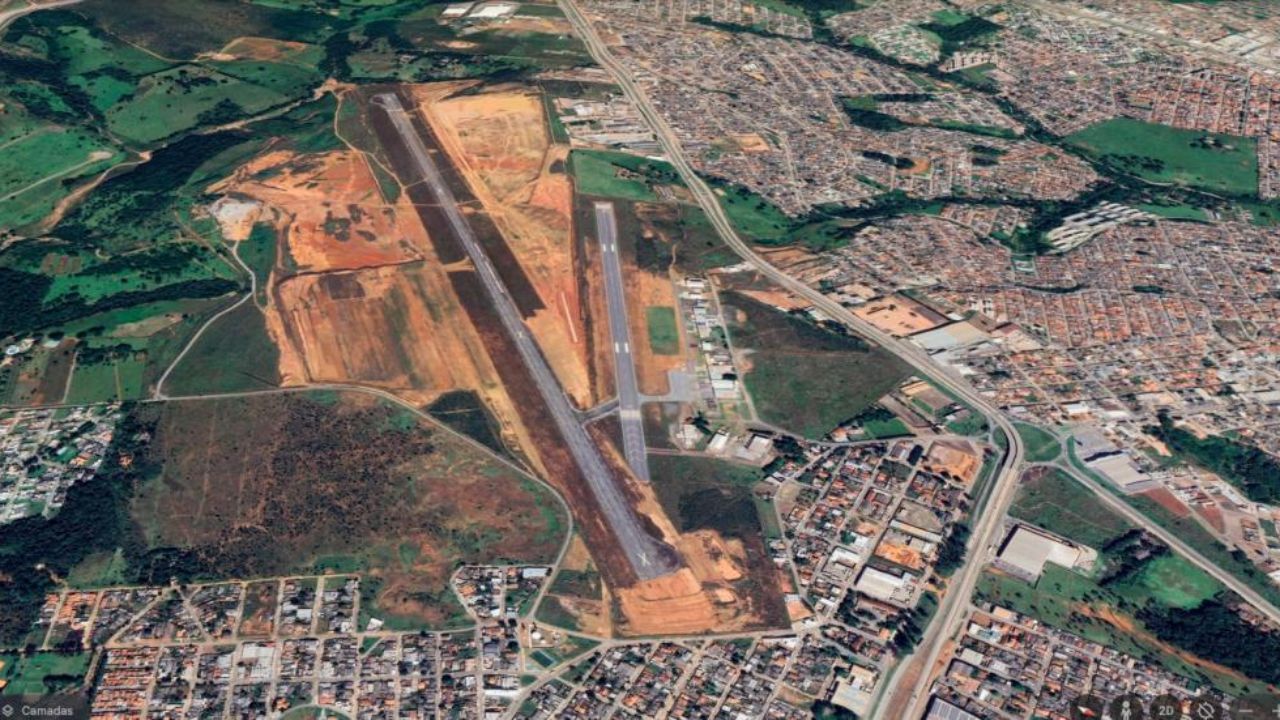


How The “Central Aerotropolis,” Grounded In Railways And Infraero Management, Is Becoming The Mega Airport And Logistics Center In The Midwest To Reorganize National Distribution.
A colossal infrastructure effort is underway to transform the Anápolis-Brasília axis into Brazil’s new logistical gravitational center. Capitalizing on Goiás’ geographic centrality, the Multimodal Logistics Platform (PLM-GO) project is coming to life, integrating high-capacity modes to create the mega airport and logistics center in the Midwest. This hub, already nicknamed “Central Aerotropolis” by the market, is not just a transport cluster; it is a strategic reengineering of the country’s logistical matrix.
The fundamental goal is to resolve historical distribution bottlenecks and reduce the “Brazil Cost”. The initiative aims for the synergistic integration of three pillars: rail, led by the Norte-Sul Railway (FNS); air, with the Anápolis Cargo Airport; and road, complemented by a cutting-edge customs infrastructure. Together, these modes are set to efficiently articulate the transport systems of the South and the emerging North, positioning the Midwest as the main distribution hub in the country.
The Legal Foundation: The “Aerotropolis” In The Master Plan
The concept of “Central Aerotropolis” is more than a market term; it is a project legally anchored in the territorial planning of the municipality. According to the Master Plan of Anápolis (SAPL), the development of the complex is formalized by the creation of the Economic Development Zone (ZDE) and the Linear Economic Development Zone (ZLDE). These zones provide the legal basis that allows and encourages orderly industrial and logistics occupation.
-
Neither the Pyramids nor the Great Wall of China, this gigantic construction in Spain is the human mark on planet Earth that intrigues the most when seen in images from space.
-
Surrounded by cliffs, mist, and chilling stories, the ancient Hotel del Salto has been reborn as a museum while still unable to shake off its reputation as a haunted place.

-
This star-shaped fortified construction, hidden near the border of Spain, may be the largest fortress on the planet.

-
Congonhas receives the monorail promised for the 2014 World Cup after more than a decade of delays and becomes the first airport in Brazil with integrated subway.

The ZDE is specifically designated for the establishment of logistics, industrial, and technological development activities, allowing business clusters to form around the new infrastructure. The ZLDE, in turn, follows the layout of the highways, intended for multifunctional activities. This legal structuring ensures that Anápolis’ urban and industrial growth occurs coherently with logistical planning, a crucial factor for the success of a distribution hub of this magnitude.
The Rail Pillar: R$ 2.8 Billion From FNS As A Catalyst
The most impactful vector in the volume movement of the platform is undoubtedly the rail network. The Norte-Sul Railway (FNS) was designed to be the backbone of national cargo transport. According to information from the Ministry of Transport (Gov.br), the auction of the FNS segment resulted in the concession to Rumo S.A., which committed to invest R$ 2.8 billion in the railway. This investment ensures the operational robustness of the complex.
The Central Segment of the FNS, connecting Palmas (TO) to Anápolis (GO), is already in operation, linking the Goiás platform to vast productive regions and, in the future, to northern ports. Anápolis is consolidating itself as the main junction of the Midwest, housing terminals that serve both the Norte-Sul Railway and the Centro Atlântico Railway (FCA). Through these tracks flow high-volume commodities like grains, minerals, and fertilizers, as well as higher value-added products such as sugar and proteins in reefer containers, with logistics costs and security far more efficient than the road modal.
The Air Pillar: The Challenge Of R$ 250 Million From The Airport

The component that justifies the name “Aerotropolis” is the Anápolis Cargo Airport (SWNS), whose development has been historically slow. However, a crucial step towards its operationalization was recently taken. According to Ordinance No. 344 (Infraero/SINEAA), the operation of the airport was granted to Empresa Brasileira de Infraestrutura Aeroportuária (Infraero) in July 2023. This transition provides greater technical capacity and mitigates management risks, integrating the terminal into the national Infraero network.
Despite the advancement in governance, the potential of the “Mega Airport” still faces a critical bottleneck. The existing runway is inadequate for operating large international cargo aircraft, such as the Boeing 747F. The full activation of the air modal depends on the construction of a new cargo runway, a mandatory investment estimated at R$ 250 million. The completion of this project is essential for the Anápolis hub to absorb traffic from saturated hubs like Guarulhos and Curitiba, especially to serve the Goiás Pharmaceutical Pole, the largest in Latin America.
The Road And Customs Gear
No logistical hub operates without an efficient customs and road distribution mechanism. In Anápolis, this function is anchored by the Dry Port Central-West (PSCO), which already demonstrates robust performance, accounting for 50% of the state’s imports. The PSCO acts as the customs “gate” of the Midwest, streamlining the bureaucracy of foreign trade and attracting companies that require efficient logistics management.
Road connectivity, vital for e-commerce and “last mile” logistics, is ensured by the BR-060 axis (Brasília-Anápolis-Goiânia). Complementary works, such as the resumption of the Anápolis Ring Road, are essential to allow cargo traffic to reach the Agroindustrial District (DAIA) and the multimodal platform without choking urban traffic. This infrastructure is complemented by specialized services, such as the postal unit at DAIA, focused on corporate clients and collection for the Goiânia-Anápolis axis, integrating e-commerce into the logistics hub.
The Macroeconomic Impact: 60 Thousand Jobs And The New Matrix
The socioeconomic impact of this mega airport and logistics center in the Midwest is already measurable. The strategy of the complex is based on two pillars: to support agribusiness (grains, meats) with volume transport via FNS, and to serve the high value-added industry (pharmaceutical, e-commerce) with speed, via air and road modalities. This diversification provides high economic resilience to the region.
The multiplying effect on employment is massive. The sum of the expansion of the Agroindustrial District of Anápolis (DAIA) with the establishment of Politec, the new municipal industrial district, has a projection of creating nearly 60 thousand new jobs. This growth proves that the “Central Aerotropolis” is not just an infrastructure project, but a complete reorganization of the national supply chain, with real potential to set new rules of competitiveness and development for Brazil.
Does this R$ 2.8 billion railway project, combined with the new Infraero airport, really have the power to shift Brazil’s logistical axis away from the South and Southeast? Do you agree with this change? Do you think it impacts the market you operate in? Leave your opinion in the comments, we want to hear from those who experience this in practice.







Esse empreendimento será um marco decisivo para a descentralização da LOGÍSTICA no Brasil. A localização geográfica no Centro do Brasil, associada ao âmago da produção de grãos e à proximidade do Centro do Poder, que é o DF. Torcemos para esse projeto virar realidade.
Boa notícia, parabéns! Infraestrutura quase toda pronta para crescer!
Parece que ainda haverá um gargalo aeroportuário em Anápolis. Era necessário que o aeroporto já construísse a pista básica de aeroporto internacional que é de 3.200 metros de comprimento, e não 3.000m, a fim de, receber grandes aeronaves de carga, similar a aeronave de 400 passageiros, ambas com aproximadamente 300 toneladas de peso, em voos de ULTRA LONGA DISTÂNCIA de 15.000 Km sem nenhuma restrição operacional, e assim, se tornar realmente um destino global de carga.
Alguns exemplos:
– Rio de Janeiro RJ, 3.200 x 47m
– Porto Alegre RS, 3.200 x 45m
– Porto Seguro BA, 3.200 x 45m em projeto
– Petrolina PE, 3.250 x 45m
– Brasília DF, 3.300 x 45m