





 Portuguese
  English
  Spanish
  7 min of reading
  0 comments


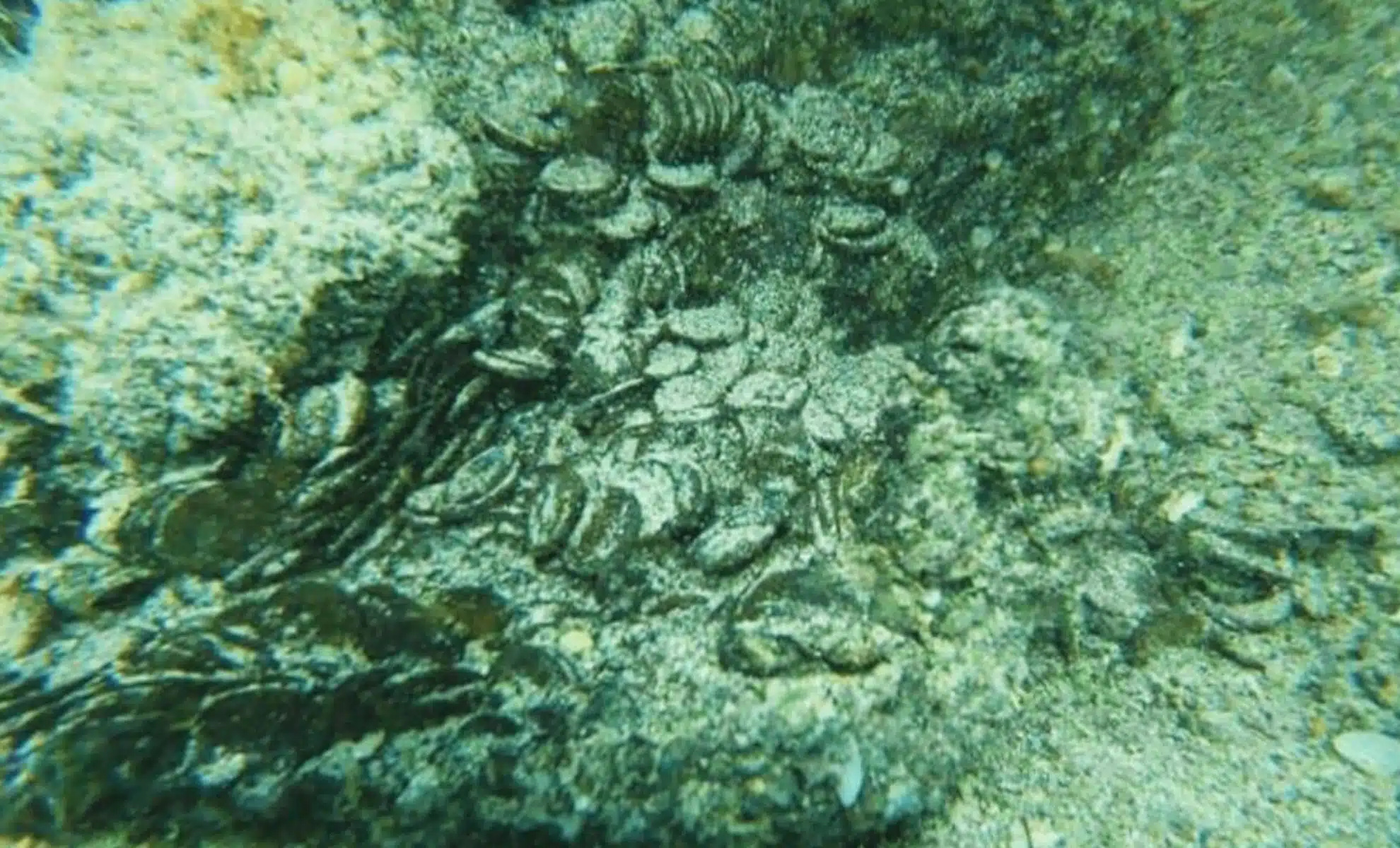
The Accidental Discovery in Sardinia Revealed Thousands of IV Century Bronze Nummi Preserved by Seagrass, Confirming a Unique Historical Deposit That Sheds Light on the Economy and the Trade Routes of the Roman Empire During the Constantinian Dynasty
Recovery of More Than 50,000 Roman Bronze Coins Dated Between 324 and 340 A.D. on the Northeastern Coast of Sardinia Confirms Maritime Deposit Preserved for 1,686 Years
A local amateur diver located over 50,000 Roman coins off the northeastern coast of Sardinia, revealing a IV-century deposit preserved for 1,686 years under marine sediments, as confirmed by the Italian government after recovery operations were completed in late 2025.
Discovery and Identification of the Roman Coins on the Italian Coast
The Italian Ministry of Culture confirmed the recovery of a vast archaeological treasure. The initial discovery occurred in late 2024, accidentally made by an amateur diver. Extraction operations extended through the last quarter of 2025.
-
The robust smartphone from Oukitel comes with a 20,000 mAh battery, satellite communication, walkie-talkie, and thermal camera to tackle mountains, deserts, offshore platforms, and disaster zones in a single device designed for extreme operations.

-
Wastewater from steel and cement industries can capture 30 million tons of CO2 per year in a discovery that transforms a common industrial waste into a low-cost climate weapon, with technology already available and direct application in factories.

-
Extinct for over 100 years and considered one of the rarest birds in Brazil, a legendary species reappears in the Northeast, resumes breeding in the wild, and surprises researchers in 2026.

-
7,000-year-old bonfire in southern Israel reveals a rare scene from the past and uncovers ostrich eggs prepared by nomads in the desert.

The exact location is situated off the northeastern coast of Sardinia. This area was previously known for wreckage but not for structured deposits of this type. The diver identified an anomalous concentration of bronze objects on the seabed.
State investigators documented that the concentration of objects exceeds 50,000 specimens. The mass of items was arranged in specific patterns on the seabed. These patterns suggest a rapid and permanent sealing of the site, contradicting the hypothesis of gradual dispersion.
No shipwreck structure was located in the area of the discovery. Despite the absence of the vessel, the presence of cargo was confirmed. Teams recovered fragments of ceramic transport amphorae along with the metals.
Iron nails and packaging residues were also found. The amount of nails and packaging materials is sufficient to confirm maritime transport. However, these elements are not enough to identify the type of vessel, its tonnage, or ownership.
The recovered fragments of containers are consistent with documented Roman amphora typologies. The reference used for this validation is the archive of the Classical Art Research Center at the University of Oxford. The containers would have been stacked in the hold of a ship.
The original arrangement of the amphorae would involve pointed bases secured in stowage or fitted into receptacles. The set of recovered artifacts consists almost entirely of Roman coins made of bronze. These coins are technically classified as nummi.
Numismatic Details and Dating of the Load
The Italian agency for historical heritage classified this deposit as the largest treasure of Roman coins recovered in the Mediterranean. The find is also considered one of the best-preserved in Europe. The absence of corrosion on the metals is a technical highlight.
The load was originally minted between the years 324 and 340 A.D. This timeframe corresponds to a specific period of the Constantinian dynasty. The minting marks present on the bronze discs allowed for this precise dating.
Officials from the Ministry of Culture reported that the Roman coins exhibit consistent iconography. The images follow the standard emission series of the IV century. Among the identified motifs are the Sol Invictus and imperial fortifications.
Other visible motifs include the Chi-Rho christogram and victory symbols. The marks from the mint indicate production facilities located in Gaul. There are also indications of production in the Eastern Mediterranean.
This geographical diversity in mint marks suggests an aggregation of values. The load likely aggregated fiscal transfers from various distinct provincial treasures. The nummus was the denomination introduced by Diocletian’s monetary reorganization in 294 A.D.
This coin was minted in large quantities during the Constantinian dynasty. The treasure from Sardinia represents the mature phase of this monetary experience. The base material is bronze, whose face value was maintained by imperial decree.
The Role of Posidonia Oceanica in Archaeological Conservation
The state of preservation of the Roman coins is a central point of scientific analysis. The nummi from the IV century had only unstable superficial treatments in silver. A metallurgical analysis from 2019 confirmed the fragility of these treatments.
The study, published in the journal Heritage Science, indicated that such coins degrade in a few decades under normal conditions. However, the specimens from Sardinia maintain their surfaces intact. The explanation lies in the biological environment of the deposit.
Researchers from the Italian authority determined the location of the deposit within a meadow of Posidonia oceanica. This species of seagrass has a specific sedimentary dynamics. The plant functions as a preservation agent for submerged cultural heritage.
An article from 2018, published in the journal Ambio, details this phenomenon. The text is accessible through the archives of the National Institutes of Medicine. The authors of the study called these meadows “safes.”
The root layer of Posidonia oceanica retains sediments and elevates the seabed. This process maintains an anoxic condition in the environment. The lack of oxygen inhibits the electrolytic corrosion of non-ferrous metals, such as bronze.
The report notes specific sediment accumulation rates in these meadows. The recorded variation is from 0.6 to 5 millimeters annually. Based on these technical parameters, it is possible to estimate the time of sealing of the treasure.
The deposit of Roman coins in Sardinia would have been completely sealed within two to three decades after deposition. The coins were not only preserved by the environment. They were effectively buried by marine vegetation.
Comparative Analysis with British Terrestrial Deposits
Terrestrial treasures of comparable periods offer an important analytical contrast. The Seaton Down Treasure is the main point of comparison. This treasure was discovered in Devon, England, in 2013.
The English material was analyzed by the Royal Albert Memorial Museum. The find contained 22,888 nummi. The coins were buried in a single leather pouch, near a Roman way station.
A detailed examination of the Seaton Down Treasure was published in 2017. The study confirmed that the last coins dated to 348 A.D. Thomas Cadbury, assistant curator of the museum, provided data on the purchasing power of the time.
The lowest-paid agricultural worker earned about one nummus per day. Two nummi bought a jug of the worst-quality Roman wine. A better-quality wine cost eight nummi.
The Seaton Down coins had diverse geographic origins. They were produced in mints in Syria, Egypt, and Turkey. However, the majority originated in Gaul, similarly to the find in Sardinia.
The location of the English treasure suggested to investigators that it represented accumulated wages. It could also have been reserves of goods. The burial coincided with a period of political instability in Britain under Emperor Constantius II.
The emperor sent the notary Paulus Catena to hunt down supporters of the usurper Magnentius. A commentator on the museum’s analysis suggested that the treasure belonged to one of these supporters. The owner likely did not survive the purge carried out by Catena.
The treasure of Roman coins from Sardinia differs in fundamental contextual aspects. It is a maritime deposit, not terrestrial. It has double the size of the Seaton Down British treasure.
Additionally, it shows no evidence of the owner’s intent to retrieve it. The find in Sardinia lacks the political specificity associated with the British deposit. It represents an accidental loss in transit, not deliberate concealment.
Economic and Inflationary Context of Roman Coins
The nummus was originally conceived as an economic solution. Diocletian, who ruled from 284 to 305 A.D., inherited an empire with devalued currency. The silver coin had been rejected by the market.
Historian Ralph W. Mathisen conducted a comprehensive analysis of Diocletian’s reforms. The emperor attempted to deal with rampant inflation and economic decline. Measures such as the Edict of Maximum Prices were implemented.
Mathisen records that these efforts produced mixed results. The edict failed to achieve its main objectives. The reintroduced gold and silver emissions could not be sustained on a large scale.
What survived was the nummus made of bronze. By around 340 A.D., confidence in the currency had deteriorated significantly. Reconstructions by economic historians point to a change in methods of state remuneration.
Soldiers and public officials received increasing portions of payment in kind. Grains, oil, and textiles were delivered through the anona system. The face value of the currency was not guaranteed by its metallic content.
The deposit of Roman coins in Sardinia was minted a generation after Diocletian’s abdication. It may represent an attempt to convert one form of state obligation into another. Authorities consider two main possibilities for the load.
The vessel could have been transporting fiscal revenues to distribution points. Alternatively, it could have been carrying coins already rejected by the recipient populations. These populations might have preferred payments in goods.
The Italian Ministry of Culture classified the entire treasure as property of the State. The decision follows national cultural heritage laws. Legal details are available on the official portal of the Ministry.
No private claims on the treasure have been registered. Conservation and attribution work continues in national laboratories. Selected pieces are expected to be transferred to regional museums after 2026.








-

-

-

3 pessoas reagiram a isso.