Astronomer Wouter Vlemmings and his team at Chalmers used the ALMA telescope to watch the red giant Mira, 330 light-years away, for nearly 10 years and caught a record eruption that threw out a loop of gas reaching as far as Saturn sits from the Sun.
The images of Mira, presented on November 23 in a release from Chalmers University of Technology in Sweden and featured the same day as the Picture of the Week of the European Southern Observatory (ESO), suggest that a basic idea about old stars needs to change.
For decades, astronomers explained the winds of stars like Mira as a gentle push from starlight on grains of dust. The new results point to something far more violent: magnetic storms on the star’s surface that fling material out into space.
A loop of gas as wide as the path to Saturn
Mira is a red giant in the constellation Cetus, the Whale, about 330 light-years from Earth. It is cooler than the Sun but much older, bigger and brighter, and it has long been a favourite target for astronomers.
-
Xiaomi launches motor that transforms ordinary roller blinds into automated ones, featuring a 4,600 mAh rechargeable battery, 4 kg capacity, 7 cm/s speed, and IP44 protection, at a price of 349 yuan, approximately R$265

-
BYD uses 536-hp Denza Bao 5 hybrid SUV to tow 180-ton Boeing 747 for 1,600 meters, ending on two wheels with 4,500 kg of ballast
-
Paleontologist Àngel Galobart and his team lifted a 7-metre titanosaur neck, sealed in a block of more than 15 tonnes, out of a site in Catalonia, a 70-million-year-old giant that may be bigger than Europe’s previous record holder

-
Starlink offers Mini kit to new customers in Brazil for R$49, with Residential Max plan at R$174.30/month until Nov. 30



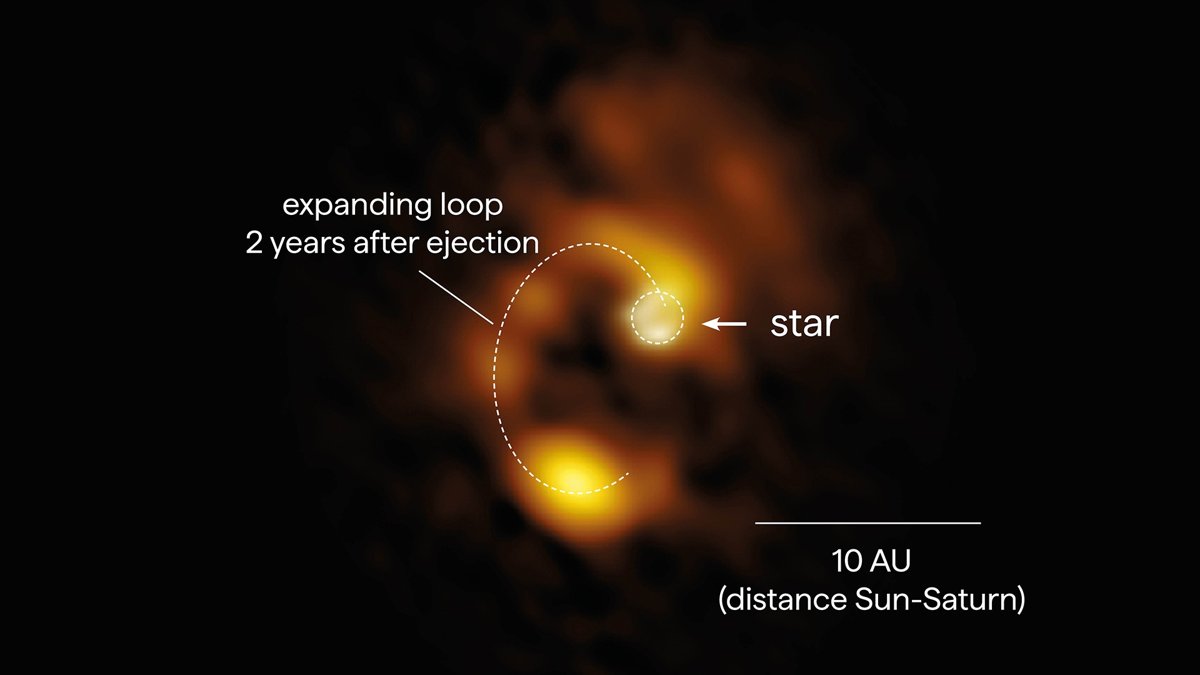
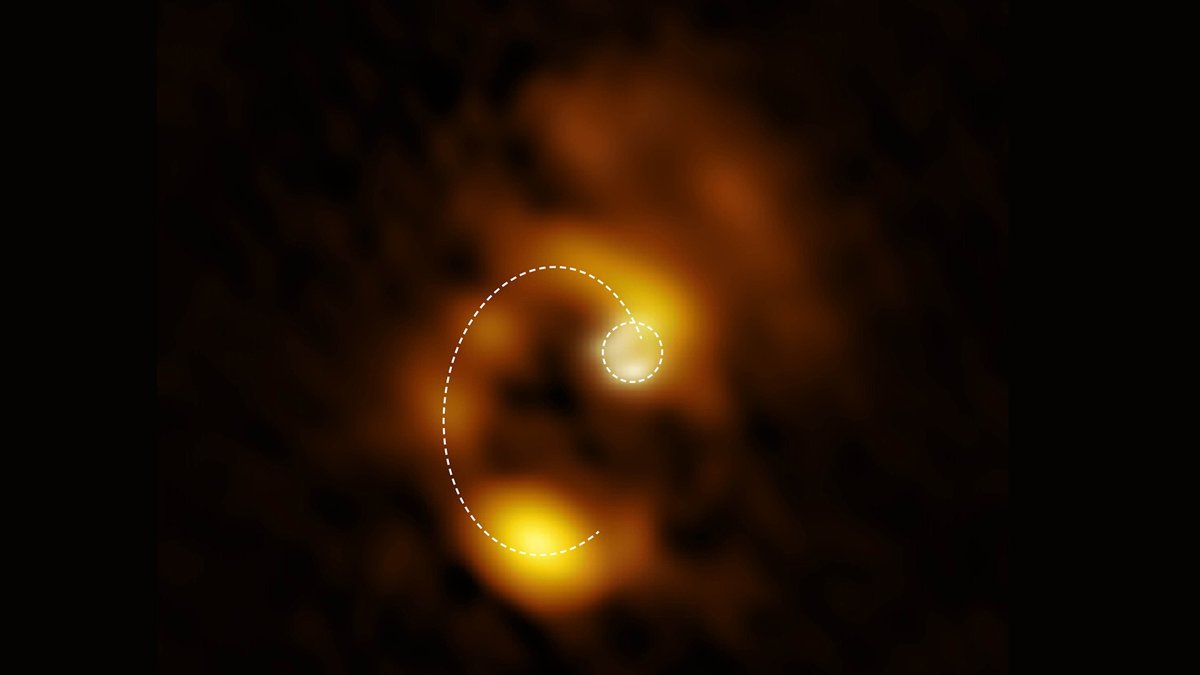
According to ESO, the image captured by the Atacama Large Millimeter/submillimeter Array (ALMA) in Chile shows a loop of material ejected from the star and now reaching up to 10 astronomical units from its surface, roughly the distance from the Sun to Saturn.
ESO compared it to a coronal mass ejection from our own Sun, “only far larger,” and said it carries more energy than the strongest stellar flares on record.
The longest look yet at another star’s surface
The team, led by Vlemmings and postdoctoral researcher Miora Andriantsaralaza, both of Chalmers, used ALMA to produce what the university calls the most detailed images ever made of Mira’s surface.
The observations run from 2017 to 2025. Chalmers describes them as the longest study yet of the surface of a star other than the Sun, and they show that the star changed dramatically in less than ten years.
“We were astonished to see how the star’s surface is constantly changing. The brightest areas were different every time we looked, and the brightest patches are amazingly bright. We realised that star is flaring, releasing vast amounts of energy each time,” Andriantsaralaza said.
The team estimates that the brightest of Mira’s flares are brighter than any flare yet observed from any comparable star.
The 2023 flare that kept growing for two years
One of those flares, seen in 2023, did not stop at the surface. Doctoral student Behzad Bojnordi Arbab, part of the research team, described what happened next.
“In 2023, we saw one of these flares appear on the star’s surface, but it didn’t stop there. Over the next two years, this eruption on the surface created a vast, expanding loop of gas around the star, which we captured in an image in 2025,” he said.
“The loop was much bigger than the star, extending as far out as the distance of Saturn from the Sun. We hadn’t seen anything like that before,” Bojnordi Arbab added.
ESO noted that eruptions like this are expected on other stars too, but stars are so distant that astronomers usually catch only a brief flicker of brightness. In Mira’s case, the shape of the eruption can be made out directly.
Magnetism, not starlight, behind the wind
The loop turned out to be the key to the discovery. ESO said an eruption this strong cannot be driven by gentle stellar winds, and that the team confirmed the role of the magnetic field thanks to ALMA’s ability to study polarised light.
“In the loop, there’s a strong magnetic field, which must also influence the star’s wind. That showed us a connection between the flare and the loop, and reminded us also of phenomena we can see on our Sun,” Vlemmings said.
“For decades, astronomers have believed that the winds from stars like this must be powered by starlight. Light from the star shines on grains of dust in the star’s outer atmosphere, and that gives them a push. But this star is showing us something different,” he said.
ESO added that the loop can be traced back to a bright hot spot seen on Mira’s surface two years earlier, and that such hot spots come and go repeatedly, which suggests that magnetic outbursts drive most of the mass the star loses.
Why it matters for carbon, oxygen and nitrogen
The elements of life as we know it, such as carbon, oxygen and nitrogen, are made in stars like the Sun. When those stars grow old, they blow off their outer layers in dense winds, and that material goes on to form new generations of stars and planets.
If magnetic storms, and not only starlight, launch that material into space, models of how these elements spread through the Milky Way need to take magnetic fields into account, the Chalmers team said.
“Now we see that magnetic storms on Mira’s surface are continually creating bright flares. Even more surprisingly, each of these is strong enough to lift parts of the star’s outer layers and launch them into interstellar space,” Andriantsaralaza said.
“Our study has consequences for our understanding of the whole of the galaxy’s ecosystem. Perhaps, Earth wouldn’t be here if it wasn’t for magnetic storms on a red giant star, billions of years ago before the Sun was born,” Vlemmings said.
A preview of the Sun’s distant future
Because Mira is much older than the Sun, the researchers say it offers a glimpse of what our own star will become. In a few billion years, the Sun will be like Mira, a cool and windy star.
ALMA has looked closely at other giant stars before. The same array produced images of the bubbling surface of Betelgeuse, a far more massive red supergiant.
Astronomers in the 1600s named the star Mira, Latin for “the wonderful one.” In ESO’s words, now that it can be seen even closer, “this is truer than ever.”
Two papers and a team across four countries
The results are published in two papers in the journal Astronomy & Astrophysics. One, led by Vlemmings, describes a giant magnetic eruption from Mira A. The other, led by Andriantsaralaza, covers the periodic activity on the star’s surface.
Authors of the Vlemmings paper are affiliated with Chalmers in Sweden, the University of Oslo in Norway, ESO in Germany and Masaryk University in Czechia, according to the Chalmers release.
If magnetic storms on old stars helped scatter the atoms we are made of, what else have astronomers been getting wrong about dying stars?