Portuguese
 Spanish


Denza, BYD’s luxury brand, released footage Wednesday, November 18, 2026, of the Bao 5 towing a Boeing 747-400 in Dunsfold, England, in three runs: on four, three and two wheels, using electric power only with the gasoline engine off
BYD used the Denza Bao 5 plug-in hybrid SUV to tow a Boeing 747-400 weighing about 180 metric tons in Dunsfold, England. The test was released Wednesday, November 18, 2026.
New Atlas detailed the tow on November 21 in an article by Simon Heptinstall. On November 18, Electrek, autoevolution, AM Online and Top Gear also published Denza’s footage.
The vehicle used in the test is the same model Denza sells in Brazil as the B5.
-
Paleontologist Àngel Galobart and his team lifted a 7-metre titanosaur neck, sealed in a block of more than 15 tonnes, out of a site in Catalonia, a 70-million-year-old giant that may be bigger than Europe’s previous record holder

-
Starlink offers Mini kit to new customers in Brazil for R$49, with Residential Max plan at R$174.30/month until Nov. 30

-
KTM launches 2027 Macina Gran 830 e-bike with 120 Nm Bosch Performance Line CX motor, 800 Wh PowerTube battery, 10-speed Shimano Cues drivetrain, weighing 26.9 kg and priced around €3,330
-
Daikin EcoSwing Gold: The Most Energy-Efficient 9,000-BTU Inverter Air Conditioner on Inmetro’s Label



The SUV debuted in Brazil at the São Paulo Auto Show in November 2025, priced at R$436,000, according to O Povo.
The Brazilian B5 has the same type of powertrain as the vehicle in the test. It has one electric motor on each axle, differential locks and DiSus-P active suspension, according to CNN Brasil and Olhar Digital.
How the tow went with four, three and two wheels
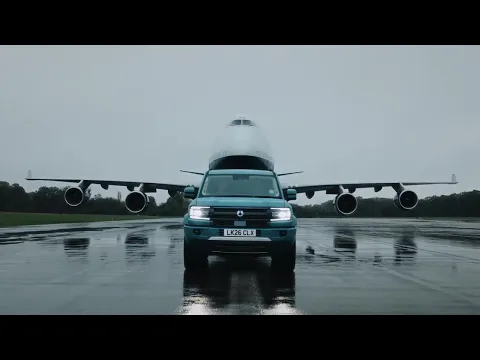
Denza made three runs on the track. For the first, the Bao 5 had all four wheels. Before the second, technicians removed one wheel. Before the third, they removed another.
The three runs covered a total of 1,600 meters. The driver was Mark Gallifant, a senior BYD technician in the United Kingdom.
Gallifant had previously towed a fully loaded double-decker bus, according to autoevolution.
The two removed wheels were on the right side of the vehicle. In the final run, the SUV pulled the aircraft while resting only on its two left-side wheels.
There was heavy rain that day. The team waited for the asphalt to dry before the final attempts, autoevolution reports. The official video, however, describes the track as wet.
The aircraft: a retired 180-ton 747-400
The aircraft used was a Boeing 747-400 retired in 2020. It was not loaned by an airline and still has its engines and complete interior, which is why it still weighs about 180 metric tons.
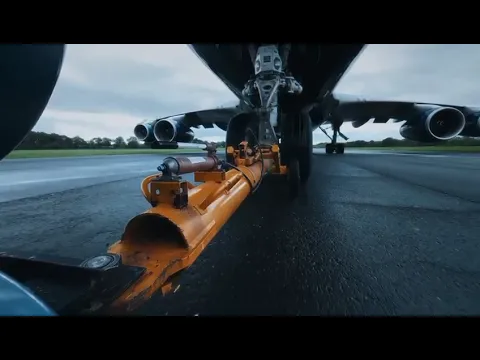
A custom-made hitch connected the SUV to the aircraft’s nose wheel. Apart from that hitch, the Bao 5’s mechanical components were stock, according to autoevolution.
Why the gasoline engine stayed off
The Bao 5 towed the 747 using only its electric motors. The 1.5-liter turbocharged gasoline engine was never started, New Atlas reports.
BYD posted the test on X on November 19. The official account’s post, in English, says Denza removed one wheel from the Bao 5 and then a second.
With the vehicle in pure electric mode, the SUV pulled the full load first on three wheels and then on two.
BYD writes that this is equivalent to 90,000 kg, or 198,000 pounds, per wheel. The post credits the result to the DMO platform.
2,000 kg and 4,500 kg of ballast in the cabin
To provide traction and balance, the team removed the passenger seats and filled the cabin with ballast. They used 2,000 kg for the run on three wheels and 4,500 kg for the run on two wheels.
AM Online and Top Gear report the ballast weights for each run. New Atlas and Electrek cite the 4,500 kg used in the final stage.
Small stabilizer rollers were attached to the axles. They kept the SUV from tipping onto its brake discs after the wheels were removed, New Atlas explains.
The Bao 5’s electric powertrain
The Bao 5 uses BYD’s DMO plug-in hybrid architecture, short for Dual Mode Off-road. It combines three electric motors with a 1.5-liter turbocharged gasoline engine.
One of the three electric motors is on the front axle, another on the rear axle, and the third acts as a generator. Electrek reports combined output of 536 hp, or 544 PS, and 760 Nm of torque.
The battery is a 31.8-kWh BYD Blade unit. Under the European WLTP test cycle, all-electric range reaches 90 km, and the SUV accelerates from 0 to 100 km/h in 4.8 seconds.
The vehicle has a body-on-frame chassis and electronic differential locks at the front and rear, which respond in milliseconds. Its official towing capacity is 2,500 kg.
What the DiSus-P did in the test
DiSus-P is BYD’s hydraulic system for controlling the body and adjusting the vehicle’s ride height. It belongs to the same technology family used in the Yangwang U9, New Atlas notes.
Top Gear says the test was intended to showcase this self-leveling suspension. The British magazine adds that, in an earlier test, it found the Bao 5 uncomfortable on potholed streets.
Denza UK posted the official 61-second video on YouTube on November 18. Its English description reads: “180 tonnes. A Boeing 747. A rain-soaked runway. Half the grip”.
The description says the challenge began with three driven wheels and ended with two, on a wet runway and in pure electric mode.
Denza credits the result to the DMO platform, DiSus-P and BYD’s 120,000 engineers.

Inspection after the runs
Denza says inspections after each run found no signs of strain on the powertrain, chassis or tires. AM Online and Electrek also report this finding.
Autoevolution notes that the SUV appeared intact, although the tires seem to be under considerable strain in the video.
Earlier records and what Denza claims
Denza says the Bao 5 is the first production car to tow an airplane on two wheels.
The brand also says it was the first to move a Boeing 747 using electricity alone.
New Atlas notes that the feat does not qualify for an official Guinness World Records title for all-electric towing. The reasons are its plug-in hybrid powertrain and the ballast.
The 180 metric tons also falls short of the record involving the Airbus A380.
That record belongs to a Porsche Cayenne S Diesel. In April 2017, in Paris, it pulled a 284-metric-ton Air France A380 for 42 meters.
In 2006, a Volkswagen Touareg V10 TDI towed a 155-metric-ton Boeing 747-200 at Dunsfold.
In May 2018, a Tesla Model X P100D pulled a 130-metric-ton Boeing 787-9 for nearly 300 meters in Melbourne.
The CarNewsChina channel posted a 61-second video of the test on November 18.
The English description says the B5 repeated the Touareg’s feat, with one exception: it traveled on the two wheels on its left side.
The Denza B5 in Brazil
The B5 was Denza’s first model in Brazil. It was launched at the 31st São Paulo International Auto Show, at the Anhembi District, in November 2025.
The launch price was announced at R$436,000, O Povo reported.
The Brazilian specifications published by Olhar Digital on November 19, 2025, list 677 metric horsepower and 76.6 kgf·m of torque.
The battery capacity is 31.8 kWh, and the 0-to-100 km/h time is 4.8 seconds.
The 677 metric horsepower figure announced in Brazil differs from the 544 PS listed for the UK version used in the test.
Both sets of specifications list the same 31.8-kWh battery and the same 0-to-100 km/h time.
O Povo reported that the vehicle has 4×4 drive and three differential locks. Its combined range reaches 1,200 km on China’s CLTC test cycle, while its all-electric range is between 90 and 100 km.
The B5 sold in Brazil has a towing capacity of up to 2,500 kg, the same figure Denza lists in the UK.
Denza will have its own dealership network in Brazil. The brand is considering building models at BYD’s industrial complex in Camaçari, Bahia, with no timeline set, O Povo reported.
UK pricing and deliveries
In the UK, the Bao 5 starts at £69,500 for the Elegance trim. The Ultimate trim used for the towing test costs £78,880, according to AM Online.
Orders are open, and the first deliveries to UK customers are expected in early 2027. Denza made its official debut in the country at the 2026 Goodwood Festival of Speed.
The brand was established in 2010 as a partnership between BYD and Daimler and is now controlled by BYD. In the UK, the Bao 5 joins the Z9GT and D9.
In Brazil, building the B5 in Camaçari remains under consideration, with no timeline or production volume set.