





 Portuguese
  English
  Spanish
  3 min of reading
  0 comments


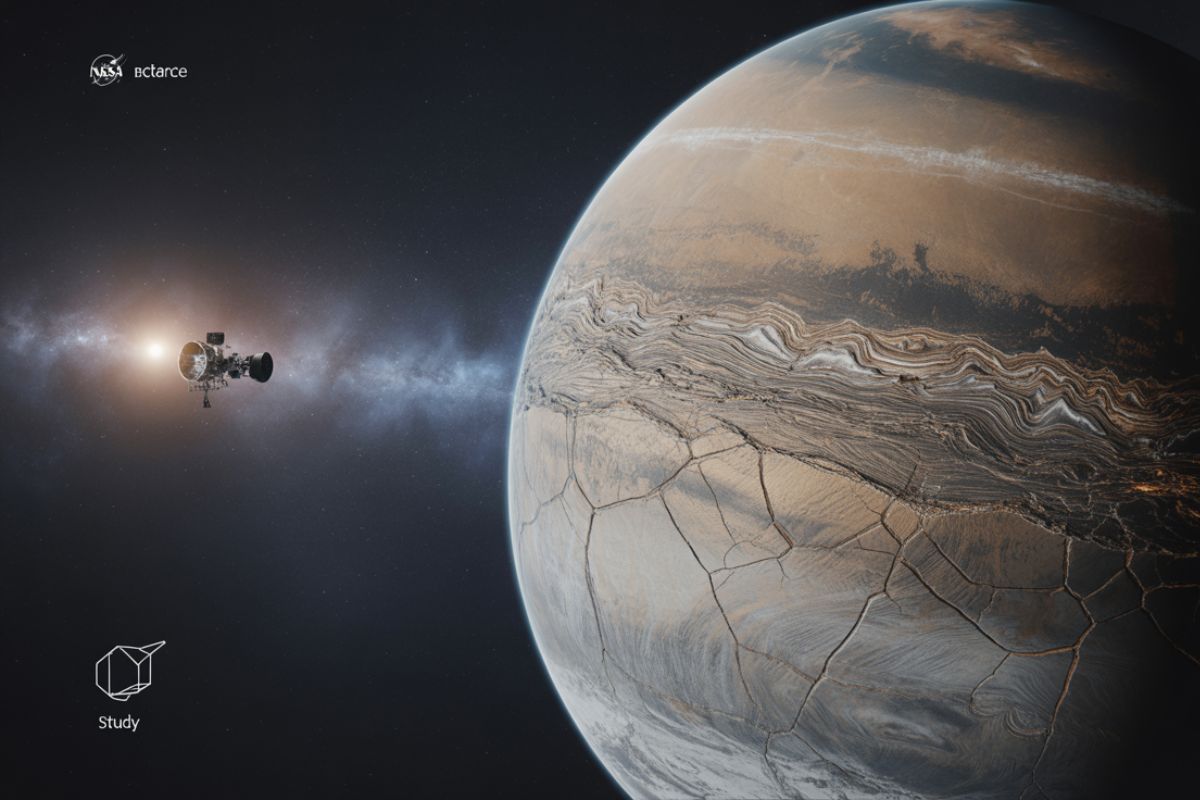
Meet Exoplanet TOI 1227 b, a “Cosmic Baby” That Is Being Bombarded by Radiation and Losing Its Atmosphere at an Alarming Rate.
According to a study released by NASA’s Chandra space observatory, astronomers have observed a planet that is literally shrinking. The exoplanet, named TOI 1227 b, has a size similar to Jupiter and is being bombarded by such an intense dose of high-energy radiation that its atmosphere is evaporating into space.
The phenomenon, which occurs at an impressive speed, offers scientists a rare opportunity to observe the evolution of a planet in its early stages. The discovery, led by researchers from the Rochester Institute of Technology, presents a dramatic scenario and a bleak future for this young world.
What Is TOI 1227 b, the Planet That Is Shrinking?
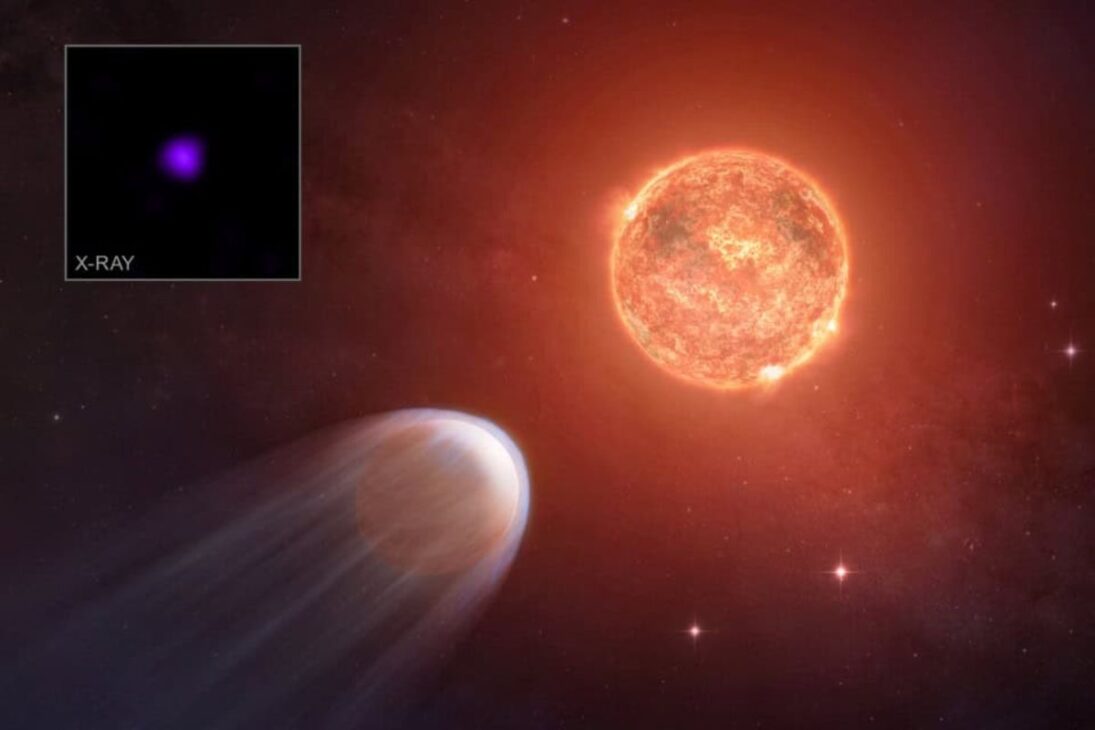
TOI 1227 b is considered a “baby” in cosmic terms, at only 8 million years old — a tiny fraction compared to Earth’s 4.5 billion years. It orbits its parent star at an extremely close distance, approximately 13 million kilometers.
-
New semi-autonomous legged robot technology challenges the limitations of space exploration by operating almost without human intervention on the Moon.

-
Super toxic red mineral found in the double burial of two women aged 1,900 years near the banks of the Dnieper River in Ukraine.

-
No one expected this under a common street: archaeologists find 3 intact oak barrels, buried about 400 years ago, with traces of lime and pieces related to 17th-century construction.

-
After decades of failed attempts, Brazil is once again looking to space with an orbital rocket measuring 12 meters, weighing 12 tons, costing R$ 189 million, and scheduled for launch in 2026, in a new race to finally achieve autonomous access to orbit.


This proximity is key to understanding why NASA observes a planet that is literally shrinking. The star, although it has only 10% of the mass of our Sun, is much brighter in X-rays, bombarding the young planet with violent radiation.
Why Is This Planet Losing Its Atmosphere?
Continuous exposure to high-energy radiation is “blowing” the outer layers of TOI 1227 b’s atmosphere into space. “The planet’s atmosphere simply cannot withstand the high dose of X-rays it is receiving,” stated Attila Varga, the study leader.
This atmospheric loss process is known as photoevaporation, and in the case of TOI 1227 b, it occurs at an extremely accelerated rate due to its young age and proximity to its star.
The Scale of Shrinking: The Equivalent of Earth’s Atmosphere Every Two Centuries
The rate at which the planet is losing its atmosphere is impressive. Scientists estimate that every two centuries, TOI 1227 b loses a gas mass equivalent to the entire atmosphere of our planet.
Over time, this ongoing process of “wear” is expected to reduce the planet to a rocky, barren core. Currently, TOI 1227 b has a mass about 17 times greater than that of Earth, but computer models indicate it could end up losing the equivalent of two Earths in total mass.
A Rare and “Puffy” Case in the Galaxy
The study also highlighted that TOI 1227 b is a rare case among the young exoplanets already discovered. Among planets less than 50 million years old, it has the longest year (lasting 28 Earth days) and orbits the star with the lowest mass ever recorded.
Interestingly, researchers state that the planet is “puffy,” meaning it has dimensions larger than it would naturally have. “We believe this puffiness is largely the result of the continuous assault from the star’s X-rays,” explained Joel Kastner, co-author of the study.
The Dark Future of the “Baby Planet”
The team of scientists used the Chandra telescope to measure the intensity of radiation and applied simulation models to predict the planet’s future. The calculations showed that, in about 1 billion years, TOI 1227 b will have completely lost its atmosphere.
“The future of this baby planet does not look promising,” summarized Alexander Binks, another author of the study. NASA observes a planet that is literally shrinking and that, in the future, could end up only a tenth of its current size, a cruel fate for such a young world.
What did you think about this NASA discovery? Leave your opinion in the comments!






Seja o primeiro a reagir!