Portuguese
  Spanish


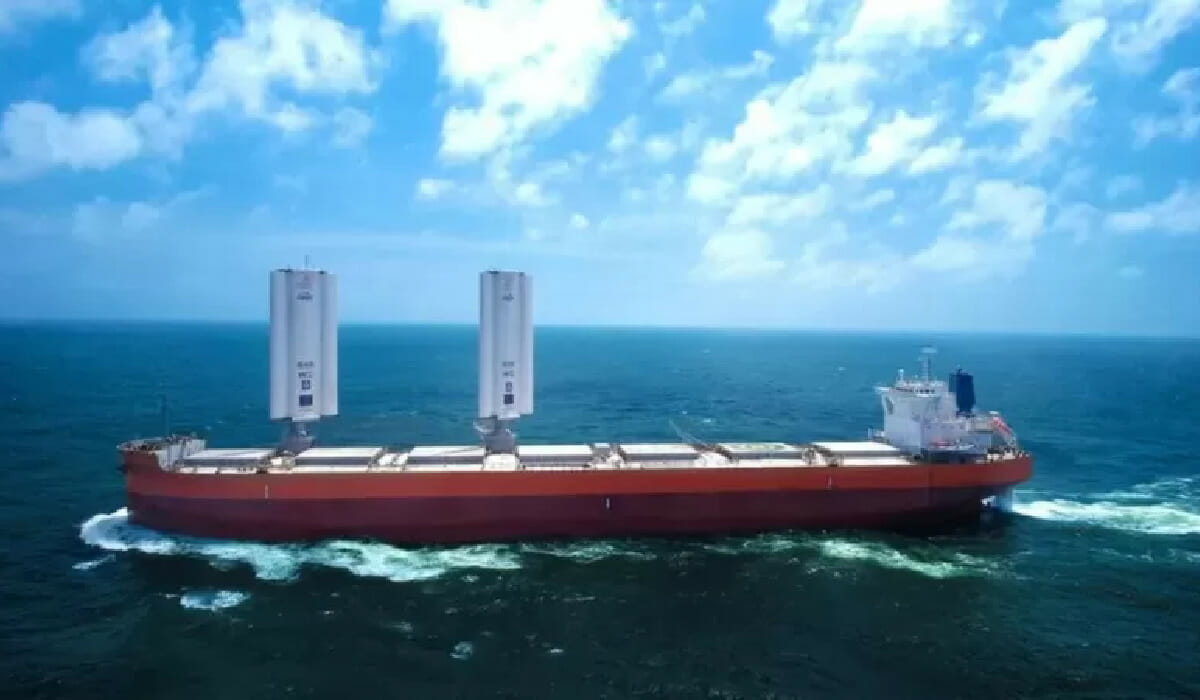

The New Cargo Ship with Wind Sails Marks a Giant Turn Toward Maritime Sustainability
The maritime transport company Cargill is leading an innovative initiative in the sector by embarking on its maiden journey with a cargo ship equipped with giant special sails powered by wind energy. The ship Pyxis Ocean, chartered by Cargill, is being propelled by large sails known as WindWings, designed in the United Kingdom. According to BBC Brasil, this technology aims to reduce the ship’s fuel consumption and consequently decrease the carbon footprint associated with maritime transport, a crucial step toward a more sustainable and eco-friendly future.
The shipping industry is responsible for approximately 2.1% of global carbon dioxide (CO2) emissions, making the search for innovative solutions to reduce its environmental impact essential. The WindWings sails, standing at 37.5 meters tall and built with the same material as wind turbines, are a promising response to this challenge. When opened after departure, these sails indicate a significant reduction in CO2 emissions, with forecasts suggesting they can decrease fuel consumption by up to 30% for a cargo ship.
Wind Sails Provide a Sea of Change Toward Emission Reduction
The ship Pyxis Ocean is making its first journey from China to Brazil, as a real test of the effectiveness of this technology. Developed by the British company BAR Technologies, the technology of the new wind sails originated from the team of British sailor Ben Ainslie during the 2017 America’s Cup, also known as the “Formula 1 of the seas.” The voyage will take about six weeks to reach Brazil, where the real impacts of this innovation will be assessed.
-
Why can the crane operator only obey the correct signalman on the construction site: among dozens of workers, a hand raised by the wrong person can confuse the maneuver and turn a load of tons into an immediate risk.

-
What changes with the new public transportation rules that can reduce pressure on fares and pave the way for zero fare in Brazil?
-
Three Chinese companies manufacture more than 96% of the world’s dry cargo containers and 100% of refrigerated ones, in a dominance built over 40 years that has made it almost impossible for the West to compete in this market.

-
Argentina confirms Belgian giant to lead strategic Paraná River waterway and promises to reduce logistical costs on one of South America’s most important routes



Future Perspectives and Challenges of Wind Propulsion
The maritime industry is undergoing a remarkable transformation, driven by technologies such as wind sails. John Cooper, head of the BAR Technologies team, believes that by 2025 half of new ships will be ordered with wind propulsion. However, experts point out that the journey toward maritime sustainability is not a linear path.
The implementation of wind technologies on ships must be balanced with other strategies, such as the use of zero-carbon fuel, modernization of existing vessels, and optimization of operations. Nevertheless, the innovation of WindWings highlights the maritime industry’s power to embrace significant changes toward a cleaner and more environmentally responsible future.