





 Portuguese
  English
  Spanish
  3 min of reading
  0 comments


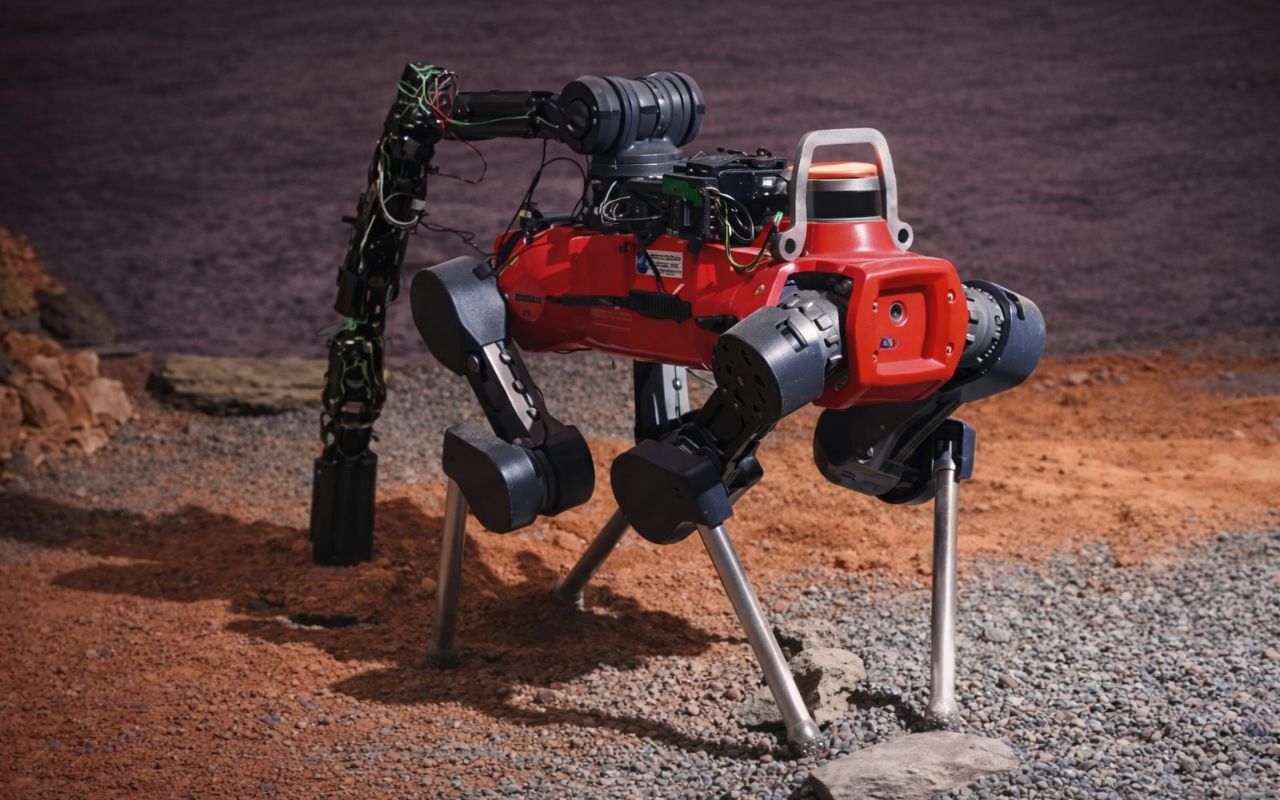
New technology with legged robot could transform moon missions by increasing autonomy and efficiency in space exploration.
A new technology based on a semi-autonomous legged robot could transform the way missions explore the Moon and other celestial bodies, according to a study published in the journal Frontiers in Space Technologies on Monday (30).
Developed by researchers in the space field, the system was designed to operate with greater autonomy, reducing the dependence on commands sent from Earth.
The proposal arises in response to the limitations currently faced by exploratory vehicles, which must deal with communication delays, low speed, and energy constraints.
-
Super toxic red mineral found in the double burial of two women aged 1,900 years near the banks of the Dnieper River in Ukraine.

-
No one expected this under a common street: archaeologists find 3 intact oak barrels, buried about 400 years ago, with traces of lime and pieces related to 17th-century construction.

-
After decades of failed attempts, Brazil is once again looking to space with an orbital rocket measuring 12 meters, weighing 12 tons, costing R$ 189 million, and scheduled for launch in 2026, in a new race to finally achieve autonomous access to orbit.

-
The Earth will plunge into a few minutes of darkness in broad daylight in August 2026, when a total solar eclipse transforms the sky into one of the most impressive astronomical phenomena in recent years.


Thus, the new approach aims to expand the explored area and accelerate the collection of scientific data.
New technology faces current challenges of space exploration
Today, missions on planets like Mars face significant operational difficulties. The communication time between Earth and the robots can vary between four and 22 minutes.
This forces scientists to plan each movement in advance. Additionally, it limits real-time responsiveness.
As a consequence, robots move slowly and explore reduced areas. On average, they cover only a few hundred meters per day.
The new technology proposes the use of a legged robot capable of operating semi-autonomously. Unlike traditional models, it can move between different points of interest without constant supervision.
Meanwhile, the system analyzes multiple targets sequentially. This allows for time optimization and expands the reach of missions.
According to the researchers, this approach accelerates the search for resources and biosignatures. These elements are indirect indicators of the existence of life.
New technology tested with ANYmal legged robot
To validate the concept, scientists used the quadruped robot ANYmal. The equipment was adapted with a robotic arm and compact scientific instruments.
Among them were a microscopic imaging system and a portable Raman spectrometer. This type of equipment allows for the analysis of the chemical composition of materials.
The tests were conducted in a controlled environment. The location simulated conditions similar to those found on the Moon, including soil and lighting.

Legged robot identifies important materials on the Moon
During the experiments, the legged robot demonstrated the ability to operate independently. It approached targets, positioned instruments, and collected data.
The system identified different types of rocks, such as gypsum, carbonates, basalt, dunite, and anorthosite. These materials are considered strategic for future missions.
For example, anorthosite is associated with the lunar crust. Dunite, on the other hand, may indicate the presence of valuable minerals.
The researchers compared two modes of operation: one with human supervision and another semi-autonomous. The results showed significant efficiency gains.
Autonomous missions were completed in 12 to 23 minutes. In contrast, directly controlled operations took about 41 minutes.
Even with greater speed, scientific accuracy was maintained. In one of the tests, all targets were correctly identified.
New technology could redefine moon missions
The ability to operate with less human intervention represents an important change. This is because it reduces dependence on commands sent from Earth.
Additionally, it allows for the exploration of larger areas in less time. This factor is crucial for increasing the scientific return of missions.
Another advantage is the reduction of operational costs. More efficient systems require fewer resources throughout the missions.
Legged robot could be key for future space missions
With the advancement of planned missions to the Moon and other destinations, the new technology gains relevance. Legged robots offer superior mobility in uneven terrain.
While traditional vehicles face limitations, these systems can adapt better to the environment. This expands exploration possibilities.
Finally, the researchers highlight that agile robots could act as initial explorers. They would identify priority areas for more in-depth studies.
Thus, the combination of autonomy, mobility, and precision could mark a new phase in the exploration of the Moon and beyond.






Seja o primeiro a reagir!