





 Portuguese
  English
  Spanish
  4 min of reading
  0 comments


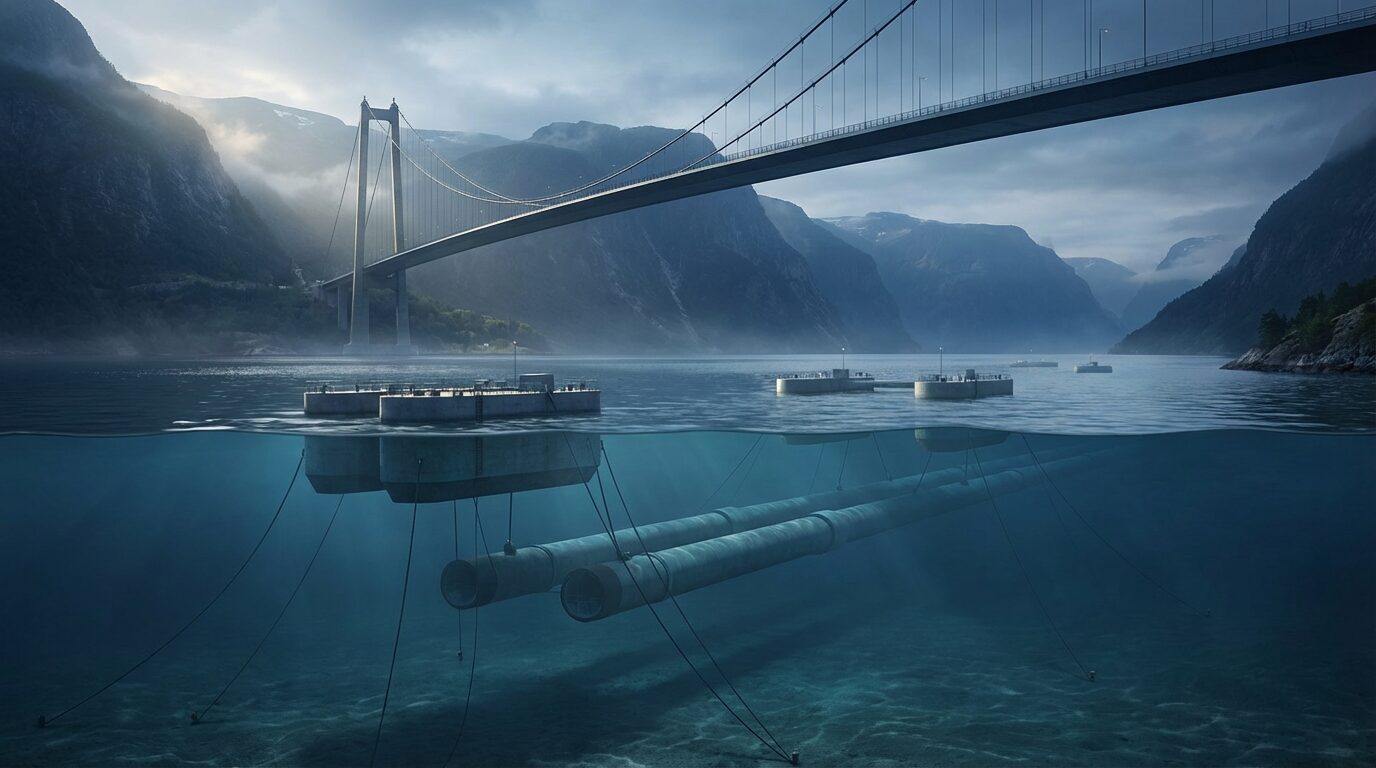
With An Investment Of US$ 40 Billion, Norway Plans To Transform The E39 Into 1,100 Kilometers Without Ferries. Floating Submerged Tunnels And Record-Breaking Bridges Promise The Largest Continuous Coastal Route In The World.
Norway has started one of the most ambitious engineering undertakings to conquer its fjords and the harsh Arctic climate. The plan is to eliminate the reliance on ferries along the E39, creating an uninterrupted roadway corridor along the country’s west coast. The project combines unprecedented solutions, such as floating submerged tunnels and large-span bridges.
Today, the journey between the south and north of the country requires seven ferry crossings, making travel slow and vulnerable to bad weather. Transforming the E39 into a continuous expressway of 1,100 kilometers aims to halve the total travel time and stabilize the transport of people and goods. The projected investment is US$ 40 billion, an amount that reflects the complexity of the works.
The Norwegian strategy combines cutting-edge technology with environmental preservation, avoiding structures that harm the landscape or navigation. At the same time, the proposed solutions must withstand currents, winds, and extreme tidal variations. The result is a rare challenge that combines innovation, scale, and resilience.
-
These are the drivers who may stop paying tolls on highways in a project that promises to reduce costs for those who live from transportation in Brazil.

-
(Video): Italian pilot lands plane on moving train at 120 km/h and achieves unprecedented feat in aviation, even with a narrow runway and without direct visual contact.
-
It seems to have come out of a science fiction movie: A Brazilian city where it rains almost every day, recording over 4,000 mm per year, driven by climatic factors — a direct result of its strategic location in the Amazon.
-
The water crisis that could change everything this year has already begun; it’s not just about the climate, it affects technology, raises product prices, and can halt entire companies without warning.

Floating Submerged Tunnel Technology Allows For Conquering Deep Fjords Without Blocking Navigation
The major innovation of the route is the use of floating submerged tunnels in fjords so deep that excavated tunnels would be unfeasible. In this technique, concrete tubes sit below wave level and are supported by floating pontoons at the surface, ensuring stability and safety.
The solution preserves the view and keeps the channels open for the passage of large ships.
The system is monitored by high-precision sensors capable of detecting current variations, impacts, and structural deformations. This continuous monitoring is vital to ensure the integrity of the works, reduce environmental risks, and maintain operations without significant interruptions.
Record-Breaking Suspension Bridges And High-Precision Sensors Focus On Safety And Environmental Preservation
Not all sections will require submerged tunnels; part of the fjords will be crossed by record-breaking suspension bridges designed for large spans and strong winds. The combination of technologies allows for choosing the ideal solution for each geography, always focusing on performance and sustainability. The goal is to reduce impacts while delivering capacity and reliability.
By keeping the tunnels below the wave line and the bridges with high spans, the project avoids interference with the landscape and coastal navigation. The guideline is to reconcile mobility with the protection of local ecosystems. This includes attention to marine currents, fauna, and water quality.
The high-precision sensors function as real-time auditing tools, allowing for quick responses to any anomalies. Continuous data reading guides maintenance and fine-tuning, enhancing operational safety. This approach is central to a logistical corridor that will face adverse conditions and high demand.
The expected result is an infrastructure with redundancy and expanded safety margins, prepared for storms, tides, and ice. It represents an engineering standard that anticipates critical scenarios, minimizes risks, and supports the reliability of the route.
Economic And Tourist Impact With Time Reduction From 21 To 11 Hours And Easier Access To Remote Villages
The completion of the coastal axis promises direct gains for the economy and tourism. According to the portal Visit Norway, the reduction of travel time from 21 hours to 11 hours will make the E39 a more predictable logistical corridor, reducing costs and delays. This should stabilize the flow of goods between northern ports and other regions of the country.
For tourism, the continuous route is expected to become one of the most scenic drives in the world. The journey along the fjords, with new bridges and tunnels, is likely to boost visitation and shorten distances to points of interest. Redesigning access to remote areas could change the travel landscape in the country.
Visit Norway also highlights the easier access to northern lights observation peaks, an attraction that heavily depends on weather windows and efficient transportation. With faster and more stable roads, visitors and residents gain agility to take advantage of the best visibility conditions.
There is an expectation of real estate appreciation in areas currently isolated by fjords, a common movement when infrastructure reduces travel times. The arrival of services, investments, and tourism tends to strengthen local income and job creation, diversifying the coastal economy.
In addition to the time savings, ending ferries on critical stretches reduces dependence on weather, a key element in Northern Europe. This predictability is crucial for supply chains sensitive to deadlines and for planning tourist seasons.
Timeline Until Mid-2050 And Already Inaugurated Sections Show Scale And Uniqueness Of The Project
The official timeline foresees total completion by around mid-2050, due to the technical complexity of each stage. In the meantime, several sections are already being inaugurated, providing a glimpse of what will be the largest coastal infrastructure on the planet and building progressive benefits for drivers and cargo.
To illustrate the project, the Construction Time channel—which has over 371,000 subscribers—details the challenges of Norwegian engineering. A technical comparison based on costs and complexity indicates that the investment is a unique case of innovation, both for the geography faced and the solutions applied.
What do you think about Norway challenging fjords and weather with floating submerged tunnels and giant bridges? Should this billion-dollar model inspire other countries, like Brazil, or are the risks and costs too high? Leave your comment and join the debate on mobility, the environment, and large public works.






-

-

2 pessoas reagiram a isso.