





 Português
  Inglês
  Espanhol
  3 min de leitura
  0 comentários


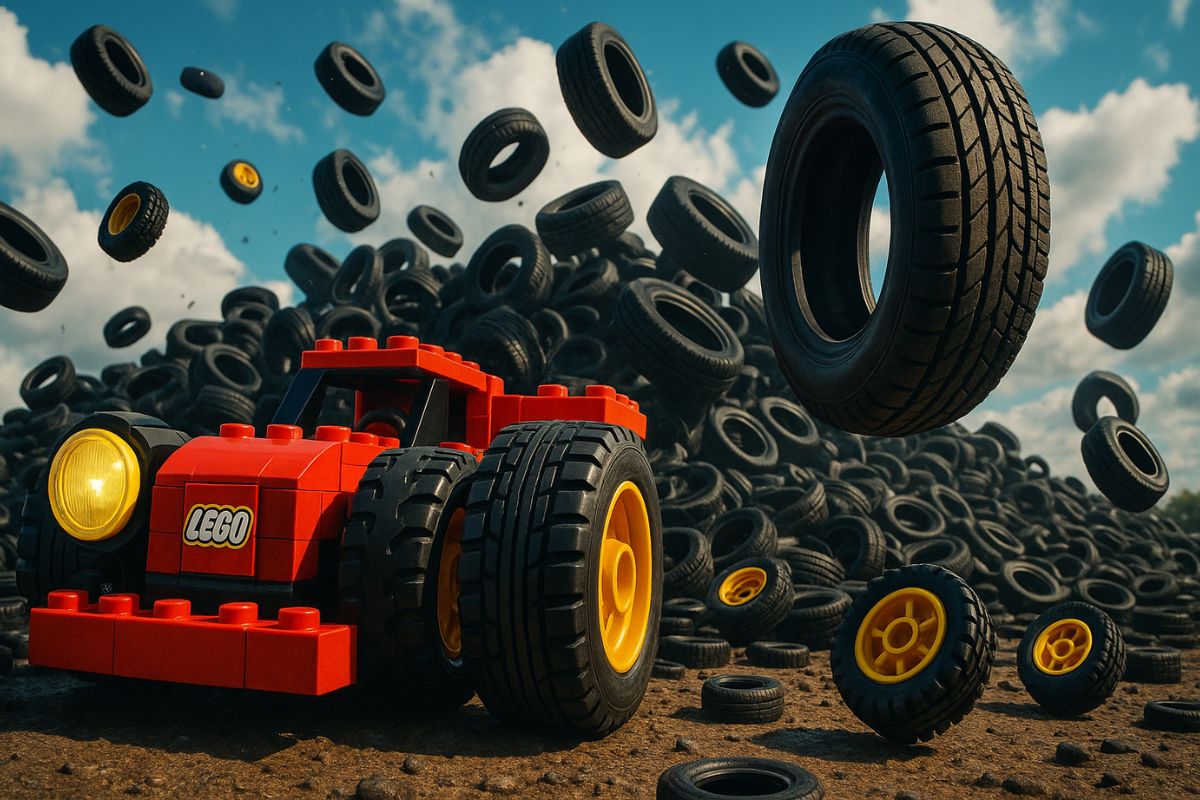
LEGO, Famous For Its Colored Bricks, Is Officially The Largest Tire Manufacturer In The World In Terms Of Units, Producing Hundreds Of Millions A Year And Surpassing Giants Like Michelin And Bridgestone
It may seem unlikely, but the largest tire manufacturer in the world does not belong to the automotive industry. The title goes to LEGO, the Danish company known for its building toys. The brand produces hundreds of millions of tires each year, surpassing traditional names in the industry such as Michelin, Bridgestone, and Goodyear.
The Guinness World Records confirmed the feat: in 2010, LEGO manufactured 381 million tires, setting the world record. Even with annual fluctuations, the company continues to produce, on average, between 306 and 318 million units per year, a volume that exceeds that of any real tire manufacturer.
Why LEGO Is Considered A Tire Manufacturer

The count includes all tires produced for the brand’s sets, from small cars and tractors to complex vehicles from the Technic and City lines.
-
With an unusual prize, Japan transforms office chairs into a resistance race on the streets, ISU-1 Grand Prix grows, fills stages, and pays 90 kilograms of rice.

-
House in England with a 7.6-meter shark embedded in the roof attracts attention worldwide and becomes a curious attraction in Oxford.

-
Masterpiece in Spain, under construction since 1882, receives 4.8 million visits in a year and impresses with its gigantism and architecture.

-
Attracting around 250,000 people a year, a lighthouse 200 meters from the sea, on a 60-meter high cliff, on the North Sea coast in Denmark, becomes one of the most impressive examples of how nature can threaten historical buildings.


Although the tires are tiny, Guinness acknowledges that, for statistical purposes, each unit is a complete tire, regardless of size.
This difference in scale explains the record.
While companies like Michelin and Bridgestone produce large, high-cost tires, LEGO manufactures a massive quantity of small, simple tires made of solid rubber.
What matters in this case is the number of units, not the weight, value, or use.
The Engineering Behind Toy Tires
Even though it is a toy product, LEGO tires are designed with technical rigor and precision.
The rubber compound used is formulated to resist deformation and maintain grip on miniatures, ensuring that the pieces fit perfectly, a typical requirement of the brand’s engineering.
In recent years, LEGO has also started investing in sustainable materials, developing bio-based polymers to gradually replace plastic and petroleum-derived rubber.
The goal is that by 2030, all of the brand’s pieces, including tires, will be made from 100% renewable materials.
Comparative With The Giants Of The Automotive Industry
The scale of LEGO’s production is impressive when compared to the industry leaders.
In terms of units produced, the numbers are revealing:
| Manufacturer | Estimated Annual Production (Units) | Type Of Tire |
|---|---|---|
| LEGO | 306 to 381 million | Solid Rubber Tires for Toys |
| Michelin | 190 million | Automotive and Industrial Tires |
| Bridgestone | 190 million | Automotive and Aircraft Tires |
| Goodyear | 166 million | Automotive and Heavy-Duty Tires |
LEGO surpasses all competitors in volume, but not in economic value.
Automotive tires involve complex processes, high-tech compounds, and safety certifications, while toy tires are simple, lightweight, and mass-produced.
When Curiosity Transforms Into A Lesson On Scale
This curiosity reveals how industrial metrics can be misleading when taken out of context.
LEGO has no stake in the automotive market, but the fact that it leads in units produced shows the power of scale of a company focused on entertainment and mass production.
In 2024, the brand maintained its position as the largest tire manufacturer in the world by units, reinforcing a fact that, while curious, is real and officially recorded.
While Bridgestone and Michelin compete in the global vehicle market, LEGO reigns supreme in the world of toys and miniature tires.
LEGO has turned a simple toy piece into a symbol of innovation and industrial precision.
The world record for tires demonstrates the consistency of the company’s production model and its mastery in molding engineering, something that keeps it relevant for over 90 years.
And you, did you already imagine that the largest tire manufacturer in the world was a toy company? Do you think the record should take size or number of units into account? Leave your opinion in the comments; we want to know how you view this industrial curiosity.









-

Uma pessoa reagiu a isso.