





 Portuguese
  English
  Spanish
  5 min of reading
  4 comments


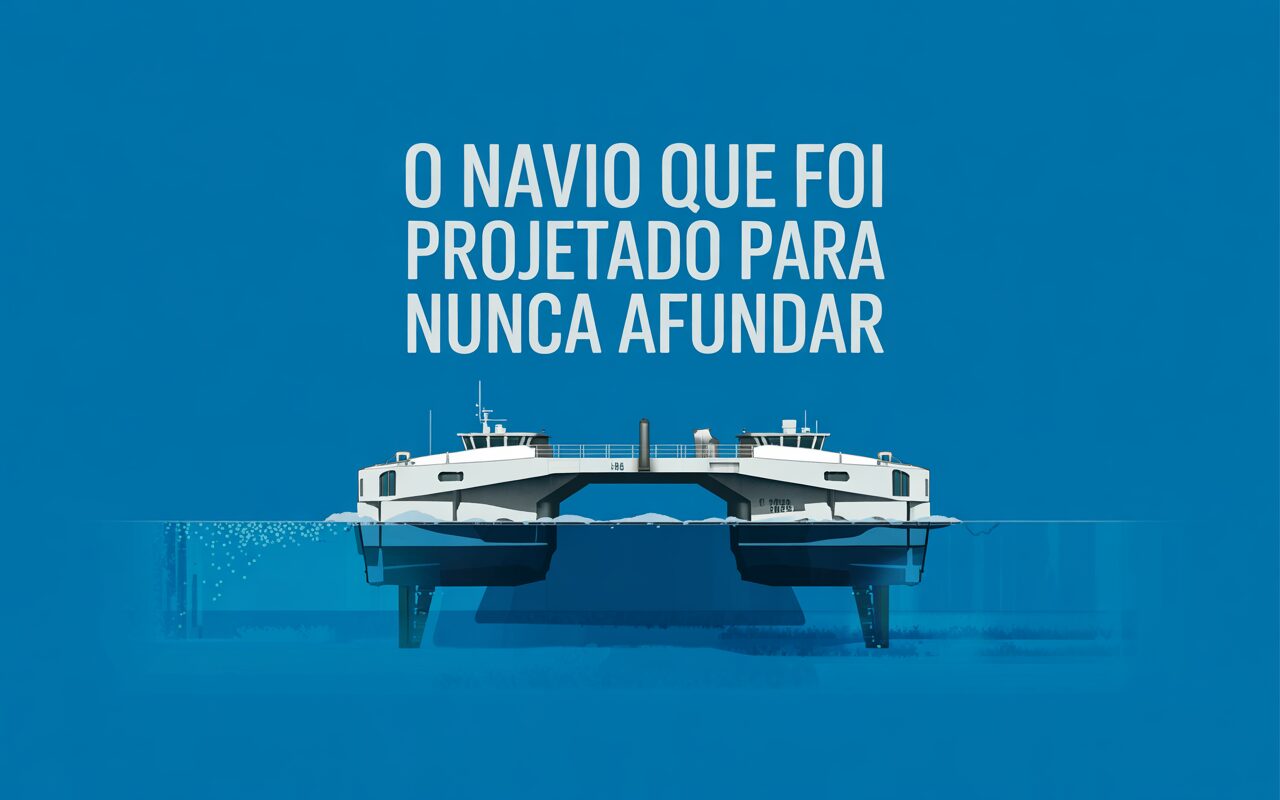

With Submerged Hulls and Unmatched Stability, the SWATH Ship Is Designed to Face the Sea Like No Other. Used by Navies and Research Centers, It Has Become Synonymous with Safety and Efficiency — and Fuels the Belief That It May Never Sink.
In a universe where giant waves and storms can turn massive vessels upside down, naval engineering has had to innovate to ensure greater stability and safety. It was in this context that the concept of SWATH (Small Waterplane Area Twin Hull) emerged — a type of twin-hull ship specifically designed to minimize contact with waves and maximize stability in rough seas. The acronym SWATH literally means, “Small Waterplane Area Twin Hull.” This revolutionary technology completely alters the behavior of the vessel on the water. Unlike conventional ships that float with a large part of their volume above the waterline, SWATHs have their main hulls fully submerged, connected to the upper structure by slender towers.
The result? A vessel almost immune to the effects of waves, with minimal movement even in open sea. This is why many experts consider the SWATH the ship designed to never sink.
How Does a SWATH Ship Work?
The secret to the extreme stability of SWATH ships lies in physics. By positioning its support hulls below the wave line, the vessel suffers much less from the impacts of the sea. The slender towers that connect the submerged hulls to the upper platform minimize the area of contact with the surface, drastically reducing the force of the waves that disturb conventional ships.
-
The village where two rivers run side by side without mixing in Santarém and Alter do Chão reveals some of the most beautiful freshwater beaches on the planet.

-
Brazil’s nuclear submarine with a speed 5 times greater than normal advances after nearly 50 years and R$ 40 billion spent.
-
A Brazilian island charges R$ 0.50 to receive visitors and prohibits any new residents.
-
Why was the Great Wall of China built? The truth that many are unaware of!


This design offers:
- Unmatched Stability, even in severe weather conditions;
- Reduced Rolling and Pitching (lateral and longitudinal movements);
- Greater Precision for Delicate Operations, such as scientific launches or military maneuvers.
For these reasons, SWATH ships have become preferred in missions that require extreme precision and safety, such as floating ocean laboratories, military reconnaissance vessels, and maritime telecommunications platforms.
Military Applications: Why Are SWATH Ships Considered Legends Among Naval Forces?
The U.S. Navy, Japan, Germany, Australia, and other countries use SWATH vessels in strategic operations. For example, the USNS Impeccable, from the U.S. Navy, is a SWATH ship operated for underwater surveillance and acoustic monitoring on the ocean floor.


These ships are ideal for:
- Installing and maintaining underwater communication cables;
- Launching and recovering sensitive equipment;
- Serving as radar and surveillance platforms;
- Supporting submarines and naval drones.
The impression of “ship that never sinks” comes precisely from its ability to remain stable even under 8 to 10-meter waves, which has been tested in open sea during actual military exercises.
This stability makes onboard operations safer, even in highly turbulent regions, such as the North Sea or South Pacific.
Scientific Use: The Laboratory That Floats in Extreme Seas
In addition to military use, SWATH ships are widely employed by scientific institutions and ocean research centers, mainly where extreme stability is needed for sensitive equipment.
Some examples include:
- The RV Triton, from the UK, operated by the Royal Navy and the Ministry of Defense, used as a scientific testing platform.
- The Fugro Gauss, a German ship used for high-precision maritime mapping and environmental studies.
- The Kilo Moana, from Hawaii, operated by the University of Hawaii for advanced oceanographic research.
These vessels can perform tasks such as underwater data collection, sensor deployment, geological tracking, and engineering testing with a stability that conventional ships simply do not offer.
A Project That Challenged Traditional Design
The design of a SWATH ship represents a complete break from the traditional model of vessels. Instead of a large single hull, the ship relies on two submerged cylinders, which requires complex structural calculations and more resistant materials.
This design presents some disadvantages, such as:
- Higher construction costs, compared to conventional ships of the same size.
- More demanding technical maintenance, due to hydraulic systems and pressure on the support towers.
- Lower total cargo capacity, as much of the structure is below the waterline.
However, these challenges are offset by operational benefits. Modern naval engineering considers the SWATH an extreme example of hydrodynamic efficiency, where form follows function — with impressive results.
Is There a SWATH Ship in Brazil?
Although Brazil does not operate large SWATH ships in the Navy or in ocean scientific research, there are records of small vessels with similar technology used by universities and engineering companies.
For example, modular floating laboratories and environmental monitoring platforms have already been built in the SWATH model for use in lakes, reservoirs, and coastal areas. Additionally, national shipyards are already studying its application in offshore operations, especially in the pre-salt, where stability is critical for drilling and testing.
Can a SWATH Really Never Sink?
Technically, no ship is 100% unsinkable. The Titanic itself, in 1912, was considered “unsinkable” — until it collided with an iceberg.
However, the SWATH comes very close to that ideal. The engineering behind this type of vessel minimizes the main risks of capsizing, instability, and structural failure caused by waves. Additionally, many models feature:
- Automatic Buoyancy Control Systems;
- Redundancy in Buoyancy Compartments;
- Coatings That Withstand Extreme Pressure Variations.
Therefore, in practical terms, the SWATH is considered one of the safest vessels in naval history. Even in catastrophic simulations, its center of gravity and low waterplane area prevent capsizing, sudden sinking, or hull breakage.
A Silent Revolution on the Seas
Although not popular among the general public, SWATH ships are gaining traction among engineers, strategists, and researchers. In a world where climate change creates more violent and unpredictable seas, vessels like these represent the next generation of ocean navigation.
Maritime technology companies are already studying how to adapt the SWATH concept for:
- Automated Transport Ships, such as ocean drones;
- Support Fleets for Offshore Wind Turbines;
- Mobile Platforms for Launching Maritime Satellites.
The idea of a “ship that never sinks” moves from fantasy to reality with the advancement of this innovative project.
The SWATH ship is not just an invention — it is a revolution in the way we challenge the sea. Its futuristic design, unmatched stability, and ability to withstand monstrous waves make it a true legend among military personnel, scientists, and engineers.
While many ships seek to resist the waters, the SWATH simply ignores the impact of the waves. Its existence proves that it is possible to combine technology, physics, and purpose into a single floating body — and that makes it one of the greatest milestones in contemporary naval engineering.







É como um catamarã com tecnologia avançada para utilização em mares abertos.
Podiam servir também para os Cruzeiros!
Titanic também dizia que não afundava,e Vários navios ou iates, está no fundos do mar falou mesmas, até submarino afunda nunca fala nunca na natureza.