





 Portuguese
  English
  Spanish
  9 min of reading
  0 comments


The Largest Mormon Temple on the Planet Is Literally Being Unearthed in Salt Lake City to Receive 98 Seismic Isolators Weighing 8 Tons, 423 km of Post-Tensioned Cables, and Reopen in 2027, Prepared for the Wasatch Fault
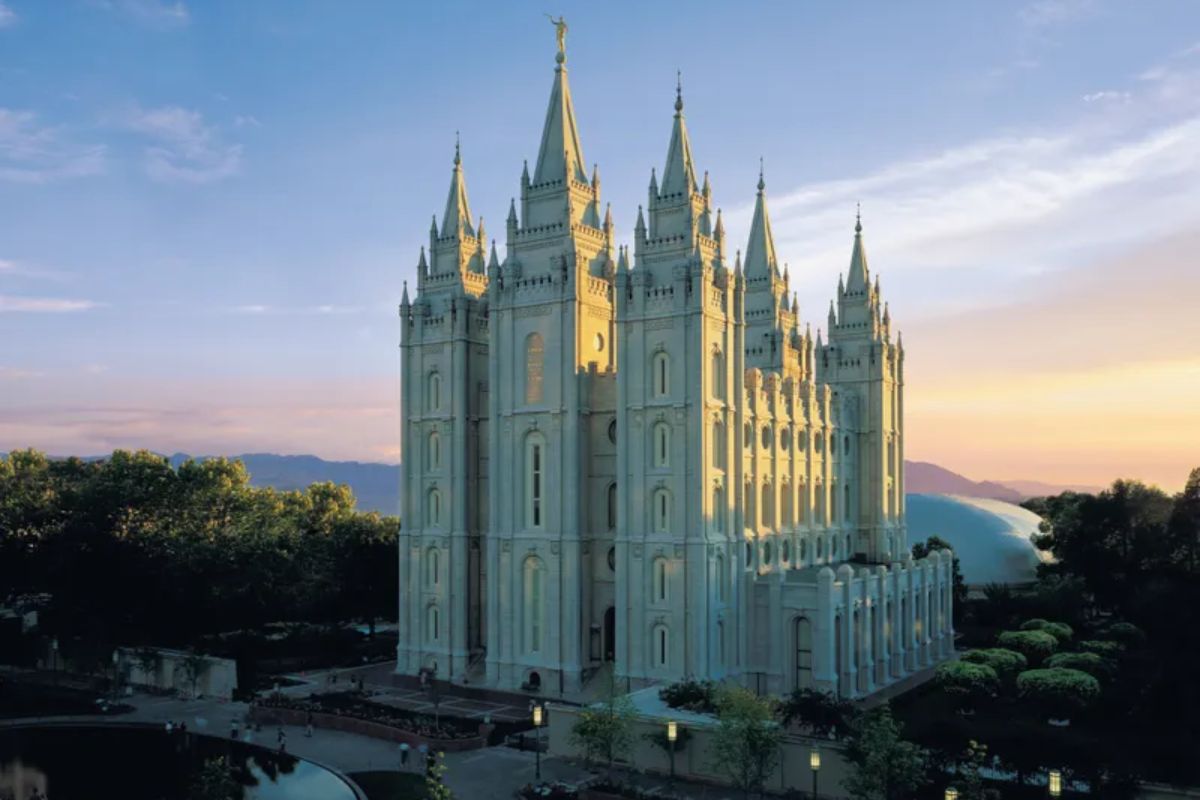
The Salt Lake Temple is at the center of one of the most ambitious seismic engineering projects ever undertaken on a historic building. An icon of The Church of Jesus Christ of Latter-day Saints and the largest Mormon temple in the world, the building is undergoing a modernization operation valued at around US$ 2 billion to meet the real risk of major earthquakes in the region. The idea is simple to explain and complex to execute: allowing the Salt Lake Temple to move with the ground during a tremor, rather than breaking along with it.
At the same time that engineers deal with stone foundations over 130 years old, excavations more than 10 meters deep, and concrete pieces weighing thousands of kilos, they also preserve wood, masonry, stained glass, sculptures, and religious symbolism that has existed since the 19th century. When the work is completed, expected to be finished in 2026 with the temple reopening in 2027, the promise is that the Salt Lake Temple will become one of the most earthquake-resistant historic structures on the planet.
A Monumental Temple at Seismic Risk

The Salt Lake Temple has dominated the Salt Lake City skyline for over a century. The construction took more than 40 years, was completed over 130 years ago, and was made with granite and quartz monzonite extracted from Little Cottonwood Canyon, dozens of miles away.
-
China completes the most critical section under the Yangtze River with the intelligent tunneling machine Linghang, excavating 11.32 continuous kilometers at depths of up to 89 meters and transforming the Chongming-Taicang tunnel into a landmark that redefines the scale of high-speed rail engineering in the 21st century.
-
The government of São Paulo surprises South America with a plan to transform the famous Ibirapuera with underground shops, air conditioning, and a 25-year concession in a billion-dollar project that expands the audience, alters a protected area, and provokes an immediate reaction.
-
With a lifespan of up to 60 years and a cost up to 30% higher than conventional concrete, self-healing concrete is already being used in Brazil to eliminate leaks, reduce maintenance, and is changing the real cost of construction projects.
-
Engineered wood CLT challenges steel and concrete and promises construction that is up to 2x faster with a lower environmental impact in modern civil engineering.

The walls are up to 3 meters thick in some places, the complex occupies about 11.4 acres of land, and houses approximately 170 rooms. Everything in this building was designed to impress with its scale, symbolism, and physical presence.
What was not considered at the time was earthquakes. The Wasatch Fault runs through the Salt Lake Valley, and geologists estimate that an earthquake of magnitude 7 or greater occurs approximately once every thousand years on this fault. More importantly for those living today is the short-term statistics.
There is around a 57% chance that an earthquake of magnitude 6 or greater will hit the region in the next 50 years, something comparable to events that have already changed building codes in other countries.
A tremor of this magnitude could cause severe damage to the Salt Lake Temple, requiring lengthy repairs or even putting irreparable parts of the historic structure at risk.
The Warning That Came From New Zealand
To understand what could happen to the Salt Lake Temple in a disaster scenario, one need only look at Christchurch, New Zealand. On February 22, 2011, the city was struck by an earthquake of magnitude 6.3.
The iconic Christchurch Cathedral suffered severe structural damage, with the collapse of the tower and part of the structure, and ended up being partially demolished before undergoing a process of reconstruction and seismic reinforcement.
The message to Salt Lake City was clear: waiting for the earthquake to hit could mean the difference between restoring and losing a symbol.
Instead of waiting for a destructive event, The Church of Jesus Christ of Latter-day Saints decided to act preventively.
The project for the Salt Lake Temple seeks to apply lessons learned from recent disasters before a similar event occurs in the Salt Lake Valley.
This explains the scale of the investment, the long construction timeline, and the level of intervention in the foundations of a 19th-century building.
How the Base Isolation of the Salt Lake Temple Works
The heart of the modernization of the Salt Lake Temple is the so-called base isolation. In simple terms, it is a system that decouples the structure from the direct movement of the ground during an earthquake.
Instead of the temple feeling all the energy of the tremor, it begins to move in a controlled manner over a kind of giant “rolling.”
The goal is to drastically reduce the forces that the building feels during a strong tremor and, with that, protect both the structure and the people inside it.
In the case of the Salt Lake Temple, the system is designed to allow for up to about 1.5 meters of horizontal movement in any direction during a major earthquake. This is what helps preserve ornamental elements of stone, masonry, towers, and historic interiors.
The key lies in the 98 base isolators being installed beneath the temple, each weighing approximately 8 tons.
The isolators function as large bearings between a new concrete foundation and the structure that carries the weight of the stone walls, allowing this structural “raft” to slide when the ground moves.
98 Isolators, 423 km of Cables, and a Monumental Excavation


Getting the Salt Lake Temple to “float” on top of seismic isolators required a nearly surgical engineering operation.
First, the teams excavated around the original foundations to about 10.6 meters deep, creating a new lower level where the isolators would be installed. In this process, the challenges were obvious.
It was necessary to remove earth and manipulate the base of a stone building weighing millions of kilos without allowing it to move a centimeter out of place.
For this, various shoring and stabilization techniques were used. Micropiles, secant piles, anchor rods, tensioned rods, manually built support columns, and cement grout injections helped keep the temple stable while the soil was removed.
With the excavation completed, a new concrete foundation was built, specifically designed to withstand earthquakes, with transfer beams and reinforced concrete beams around the perimeter and inside the structure, redistributing the weight of the temple.
This base is complemented by more than 423 kilometers of post-tensioned cables passing through the foundation. These cables connect the Salt Lake Temple to the new foundation in a way that controls load transfer, especially during seismic movement.
In practice, the structural stack is organized in layers: ancient stone foundations on top, transfer beams just below, base isolators, and finally, the new concrete foundation.
When all the weight of the Salt Lake Temple is transferred to the isolators, the soil beneath them will be removed, allowing the building to literally “float” over this system during an earthquake.
The isolator system is rigid vertically, supporting permanent loads and wind loads, but flexible horizontally, which is exactly what is sought in base isolation.
All this work occurs alongside additional reinforcements to walls, towers, and other architectural elements, as isolation alone does not guarantee zero damage in an extreme scenario.
More Than Seismic Safety, A Use Update
The modernization of the Salt Lake Temple is not limited to the structural aspect. The work is also creating more space for ritual baptisms, expanding the number of seats in classrooms, and adding a new annex to the north, with a sealing wing, where weddings are held.
The seismic intervention serves as an opportunity to update the use of the Salt Lake Temple to meet the current needs of the community, without compromising its historical and symbolic character.
This balance between structural reinforcement, preservation of original details, and functional adaptation is one of the reasons why the project extends over so many years. Initially, the expectation was to complete the work in 2025, but the deadline was adjusted to 2026, with reopening to the public in 2027.
In a building of this age and complexity, any surprises encountered during excavations or reinforcements require custom solutions, and this takes time.
The History of the Salt Lake Temple and the City That Grew Around It

To understand why so much effort and money are being invested, it is necessary to look at the origin of the Salt Lake Temple and Salt Lake City itself. In 1847, led by Brigham Young, about 148 Mormons arrived in the Salt Lake Valley in search of an isolated place, away from religious persecution.
Mormonism was a new religion, surrounded by controversy, and the founder of the church, Joseph Smith, had been murdered a few years earlier.
In the midst of an arid and isolated environment, the temple was envisioned as a symbol and an urban axis, something capable of anchoring a new society.
The formal construction of the Salt Lake Temple began in 1853, with initial foundations made of sandstone. By the late 1850s, with American troops marching toward Utah and the region on the brink of conflict, workers buried the foundations to protect them and halted the work.
Years later, when the project was resumed, the decision was made to rebuild the foundations in granite, using stone extracted from Little Cottonwood Canyon, about 32 kilometers away.
Without heavy machinery, granite blocks were detonated with dynamite, shaped by hand, and transported in wagons pulled by teams of oxen through rough terrain.
Each trip could take up to four days. The stones were carefully hewn to create gigantic walls up to 3 meters thick.
Architect Truman O. Angell combined Gothic and Romanesque elements with rich symbolism, including stars, suns, and the statue of the angel Moroni, transforming the Salt Lake Temple into a kind of “stone sermon” visible from afar.
Throughout the 1870s and 1880s, the temple towers rose, steam tools began to be used, but most of the work continued to be manual.
Craftsmen shaped the stone by hand, wood was cut locally, and metal was produced in small workshops.
At the same time, the settlement around the temple grew, ceasing to be a remote outpost and transforming into a city.
The Plan of Zion and the Hidden Architecture of Salt Lake City
Salt Lake City did not grow haphazardly. It was deliberately designed based on the so-called Plan of Zion, an urban model conceived years earlier.
Just days after the arrival of the first settlers, surveyors were already marking the streets in a nearly perfect grid, aligned with the cardinal points.
At the center of this grid, a block of 11 acres was reserved for the Salt Lake Temple, the most important building in the community.
While cities like New York were organized into blocks of approximately 80 by 200 meters, Salt Lake City adopted giant blocks of 200 by 200 meters, the largest of any American city at the time. The streets were also disproportionately wide, over 40 meters wide, well above the 18 to 30 meters typical in other cities.
The result was a city where the Salt Lake Temple became the true physical and symbolic center of the urban mesh.
Each block was about 10 acres and was divided into only eight large lots, creating small “micro-farms” within the city itself.
Families farmed on their land, the streets served as irrigation channels during dry periods, and the large blocks acted as firebreaks, as well as ideal corridors for infrastructure installation.
In the long run, this scale ultimately made pedestrian mobility and downtown density more difficult, but facilitated the arrival of the automobile, large highways, and, more recently, the TRAX light rail system.
Preserve the Past to Build the Future
Throughout the 20th century, Salt Lake City expanded far beyond this original structure, and the rise in land values and real estate pressure led to the demolition of many historic buildings.
In this context, investing over US$ 2 billion to save one of the city’s oldest and most emblematic buildings sends a strong message.
The Salt Lake Temple project acts as a manifesto in favor of preservation, showing that it is possible to update the safety of an old structure without erasing its history.
The expectation is that this effort will have a multiplying effect, inspiring new preservation initiatives in other historic buildings in Salt Lake City and other cities facing similar dilemmas between development and memory.
Thanks to the work of engineers, architects, and construction teams who literally unearthed and supported the temple on a new system of isolators, the Salt Lake Temple should no longer be at risk in the event of a major earthquake and become a reference for seismic engineering applied to historical heritage.
And you, do you think projects like the Salt Lake Temple are worth a billion-dollar investment to preserve history even in high seismic risk areas?







-

2 pessoas reagiram a isso.