Portuguese
  Spanish


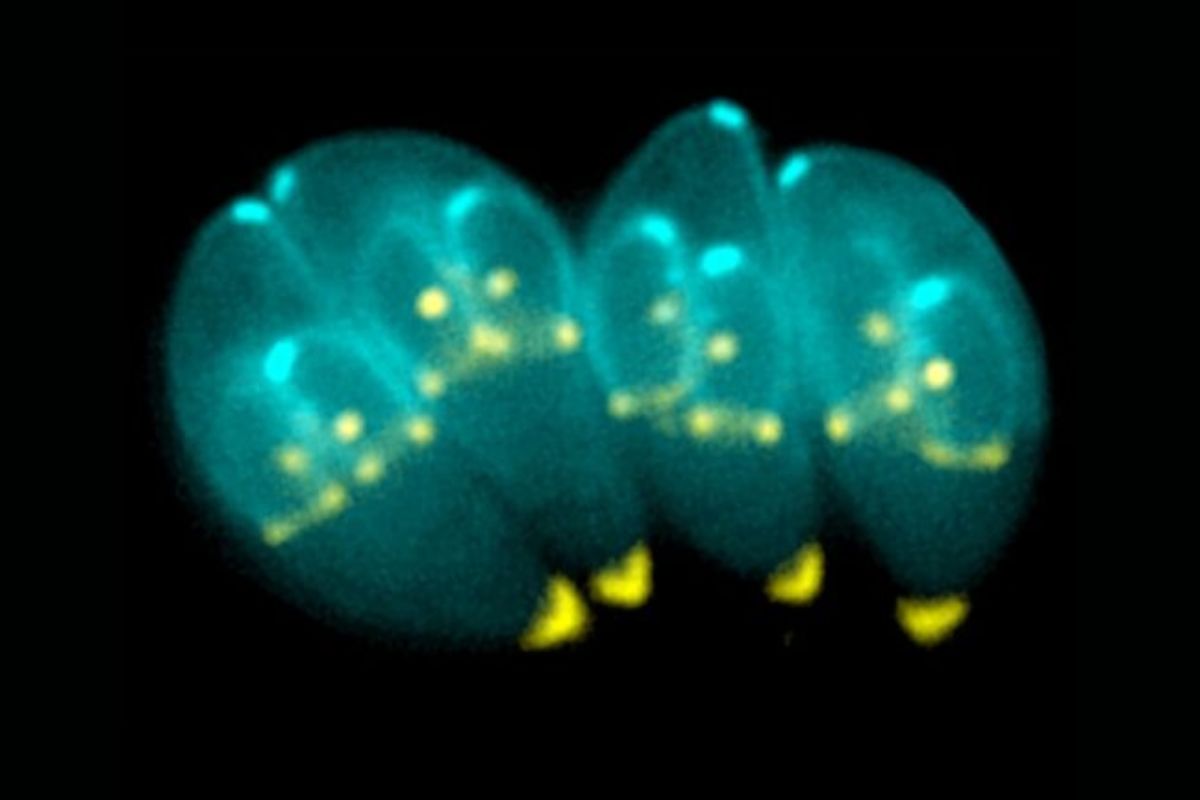


University of California Study, Published in Nature Communications, Suggests That the Toxoplasmosis Parasite, Present in About One Third of the Population, Maintains Active and Organized Cysts in the Brain and Muscles. Within Them, Subtypes Divide: Some Sustain the Chronic Phase, Others Prepare for Reactivation Just When Immunity Drops.
What seemed like a “silence” inside the body may actually be a mode of operation. The parasite that causes toxoplasmosis manages to persist for a lifetime, and the new reading is uncomfortable: the parasite not only “stays there” but organizes itself to continue existing.
This persistence occurs even when the initial phase goes by without symptoms. In many cases, the immune system contains the beginning of the infection but does not eliminate the parasite completely. It lodges in microscopic cysts, mainly in the brain and muscles, where conventional therapies cannot effectively reach.
How the Parasite Enters, Establishes Itself, and Becomes a Long-Term Problem
Contamination usually occurs through well-known pathways: consumption of undercooked meat or contact with soil and feces of cats carrying the parasite. What changes from person to person is what happens afterward and, mainly, how well the immunity can “push” the parasite into a more controlled phase.
-
$12 Billion Invested in AI Data Centers in Semi-Desert Mexican State, But 17 of 18 Municipalities Now Face Water Shortages, Residents Receive Water Only 3 Days a Week

-
How Much Does Starlink Satellite Internet Cost for Cars, Trucks, and RVs? Prices for Antenna, Accessories, and Plans

-
Scientists Convert Food Waste into Aviation Fuel, Successfully Test 50% Blend with Conventional Kerosene to Cut Emissions and Promote Sustainable Flights
-
OnePlus N6 Smartphone to Launch in India with 8,000mAh Battery and 45W SuperVOOC Charging, Lasting Up to Three Days




Over time, the parasite forms cysts: structures wrapped in a protective layer and capable of harboring hundreds of bradyzoites, the form associated with the chronic phase. These cysts can reach 80 micrometers and frequently appear in neurons, as well as in skeletal and cardiac muscles.
This is where the story stops being about a “past infection” and transforms into permanent surveillance.
Why Cysts Have Stopped Being Seen as “Inert”
For decades, the dominant idea was simple: cysts would be passive refuges, with dormant parasites, almost “frozen” in time. This reasoning shaped therapeutic strategies since if the parasite were inactive inside there, it would be enough to control the acute phase and that would be it.
The new research indicates a more complex scenario. By analyzing parasites extracted directly from cysts in living tissues, the team found an internal organization that does not align with the notion of inertia.
The cyst begins to appear less like a hiding place and more like a discreet “command center”, capable of responding to the host’s internal environment.
What Single-Cell RNA Sequencing Revealed Inside the Cyst
The turning point was methodological: with single-cell RNA sequencing, scientists identified multiple subtypes of bradyzoites within the cysts. All belong to the chronic phase but have different biological functions, and this alone decimates the view that “one cyst is always the same.”
More than diversity, a pattern emerged: these subtypes do not appear to be mixed randomly. There is a clear functional division.
Some seem adapted for long-term maintenance within the host; others are more geared towards transmission between hosts; and there are those that are ready to reactivate if immunological conditions change. In other words, the parasite distributes roles and the cyst becomes a dynamic structure.
When Immunity Drops, Shape Shifting Can Reignite the Infection
This organization helps explain why toxoplasmosis can worsen under certain circumstances.
If there is an imbalance in the immune system, the bradyzoites “prepared” for reactivation can transform into tachyzoites, the form linked to the rapid multiplication of the parasite.
When this happens, the infection can begin to spread throughout the body again. The most feared effect is the possibility of toxoplasmic encephalitis and ocular lesions that threaten vision. The risk does not arise from nothing: it may be “prepared” within the cyst, waiting for a breach in immunity.
What This Discovery Changes in the Discussion About Treatment
Today, the available medications act on tachyzoites. They can be effective in controlling the acute phase but do not impact the cysts. This creates a “therapeutic void”: the chronic parasite remains protected, and medicine remains, in practice, dependent on keeping the active phase under control when it appears.
The discovery of functional diversity within the cyst exposes an old problem: by treating the cyst as homogeneous and inactive, previous attempts to develop drugs may have overlooked precisely what makes the infection persist.
The perspective proposed by the authors is straightforward: understanding which subtypes are linked to reactivation may pave the way for more targeted therapies and, potentially, capable of interrupting chronic infection more precisely.
Why This Disrupts the “Active vs. Latent” Model
The traditional model of the life cycle of the parasite was often described as a simple alternation between active and latent phases.
However, if there exists an “ecosystem” of subtypes with different functions within the cyst, latency becomes less akin to an “off” mode and more like an intelligent waiting mode.
The chief researcher of the study, Emma Wilson, summarizes this shift by advocating for a reevaluation of the classical model: the cyst must be understood as the central control point of the parasite.
This reorganizes research priorities and changes the practical question: it is no longer simply “how to kill the active parasite?” but “how to disarm the parasite that remains ready within the cyst?”.
The story of the parasite that “sleeps” in the brain takes on a different tone when science shows that it may actually be preparing.
For a problem that affects about one third of the world’s population, treating the cyst as something stagnant may be comfortable, but perhaps it is not realistic. The strongest message is that the chronic phase is not an absence of activity but another type of strategy.
And you, when reading that a parasite can stay “organized” inside the body for years, does this change your perception of risk, or does it seem just a distant technical detail? If you could ask a doctor one thing about toxoplasmosis and immunity, what would it be and why?