





 Portuguese
  English
  Spanish
  4 min of reading
  0 comments


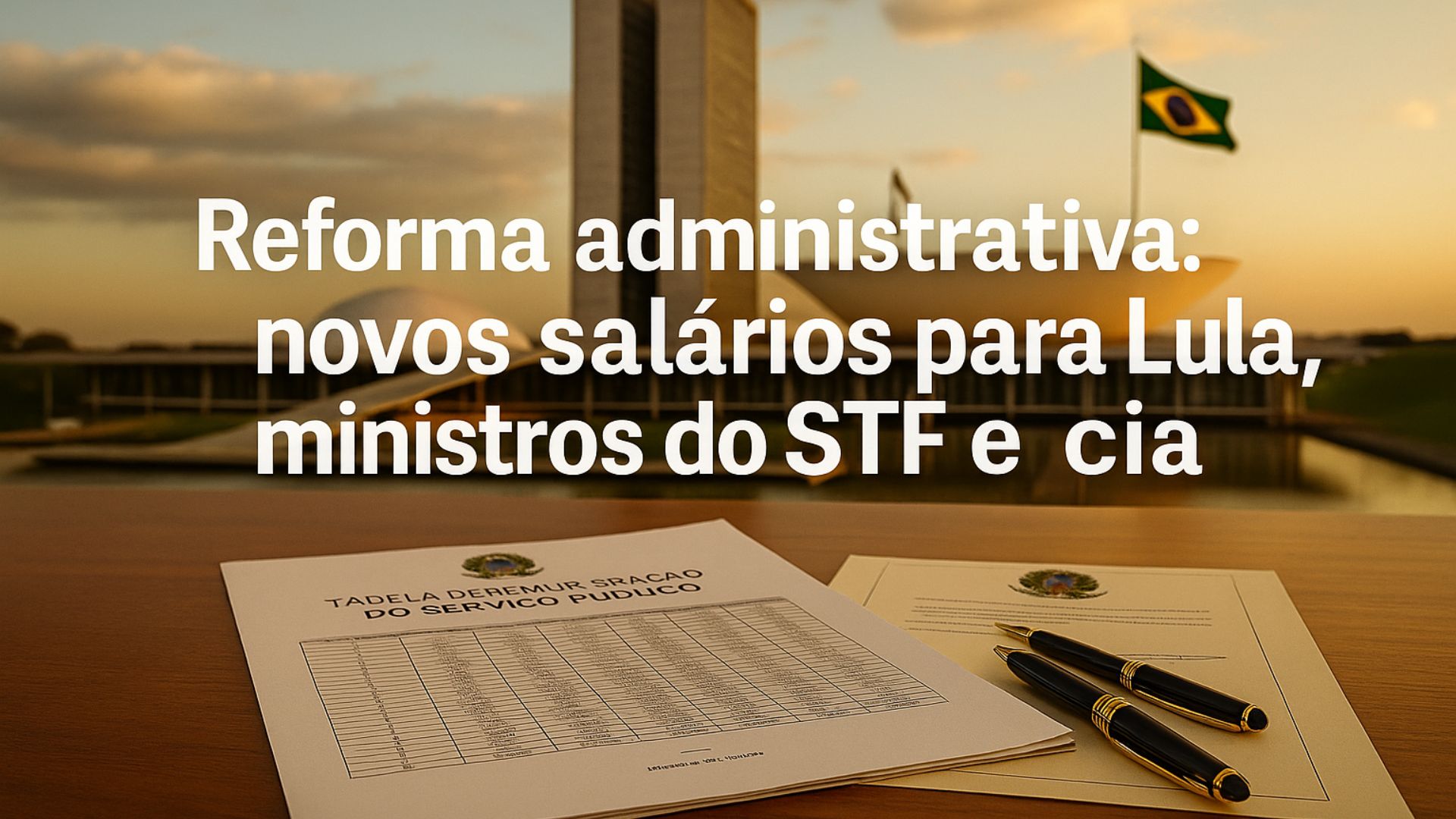
Proposal Provides for a National Wage Table for Civil Servants, Ending Extra Benefits and Limiting Compensation Funds. Implementation Could Take a Decade and Should Reach All Branches, from the Doorman to the President.
The administrative reform proposal submitted to the Chamber provides for a single salary table for each federative entity, valid for all branches, with gradual implementation over up to ten years.
The measure aims to reduce wage asymmetries and curb excessive salaries by adopting common adjustment rules and clear limits for compensation funds close to the ceiling for civil service, currently R$ 46,366.19.
What Changes with the Single Table
The table will gather, in a single reference, the careers and positions of each entity — from the base to the top — guiding salaries from the minimum wage to the constitutional ceiling.
-
Inflation in March reaches 0.88% according to IBGE and pressures the Brazilian economy, impacting family budgets and requiring more strategic decisions to maintain financial control.

-
In Paraná, distributor Pacto connects 100% of the load in Coronel Vivida to batteries: a BES of 10 MW and 20 MWh costs just over R$ 30 million and lowers the local tariff now.

-
With a dependence of up to 80% on gas imported from the United States, Mexico is responding with a robust energy strategy, betting on shale gas, creating a scientific committee, and preparing to expand natural gas production to reduce vulnerability and strengthen its energy security in the coming years.

-
The United States proposes to Brazil a critical minerals agreement with a minimum price to combat Chinese dumping and priority for investment, but the Planalto is blocking the signing out of fear of upsetting China and due to electoral calculations in a year of competition.

Instead of fragmented negotiations by category, adjustments would apply to the entire table, avoiding differentiated gains that fuel distortions among equivalent careers.
This set is part of the elimination of privileges and is presented in a technical dossier with about 70 proposals.
According to the rapporteur and coordinator of the working group, deputy Pedro Paulo (PSD-RJ), standardization is central to providing transparency and predictability.
In a public statement, he summarized the guideline: “Everyone has to be on the table: the doorman, the administrative assistant, and Lula.”
The idea is for the Union, states, Federal District, and municipalities to enact their specific laws to establish the table, respecting the common ceiling and general guidelines.
Excessive Salaries and “Extra Benefits”: New Limits
To tackle excessive salaries, the proposal details what constitutes compensation funds and what constitutes salary funds, closing loopholes that allowed routine payments to be classified as compensation, outside the ceiling and without Income Tax.
There is also a budget limit for expenditures on compensation by agency and, for those receiving 90% or more of the ceiling, a monthly limit of 20% of the salary for aid such as food, health, and transportation.
The document also prohibits leave being converted into cash and restricts retroactive compensation, measures identified as recurring sources of large payments.
The guideline particularly targets structures with benefits created by administrative acts, a practice associated with the growth of extras above the ceiling in segments of the Judiciary and the Public Ministry.
The Size of Inequality Today
Excessive salaries are a minority phenomenon, but symbolic.
Surveys based on administrative records indicate that only 0.06% of civil service workers in statutory regimes regularly received above the ceiling.
In 2022, the reference ceiling was R$ 39,293, a value that has been adjusted to reach R$ 46,366.19 in 2025.
On the other end, the median salary is far from the ceiling.
Estimates based on data from RAIS 2022 indicate that half of people working in the public sector earn up to R$ 3,391.
Experts emphasize that inequality intensifies between branches and spheres: at the municipal level, where the majority of contracts are concentrated, median values are significantly lower than those at the federal level.
How the Ceiling Would Look and Who Falls Under the Rule
The salary ceiling for public service is equivalent to the subsidy for ministers of the Supreme Federal Court and has increased in increments since 2023, reaching R$ 46,366.19 in 2025.
The reform reaffirms the ceiling as the limit for all public agents, including political agents and members of autonomous bodies, and makes clear that daily allowances and legitimate reimbursements must be episodic, based on verified expenses and without permanent character.
The single table would apply to all branches and agencies of each entity, which ends the practice of parallel tables and career projects with increments disconnected from fiscal reality.
The expectation is that, with a clear scaling of complexity and public salary ranges, corporate disputes will lose ground.
Implementation and Transition Challenges
The transition is long: the proposed maximum deadline is 120 months from the promulgation.
As the Constitution prohibits nominal salary reduction, any convergence will require raising floors and aligning steps, which imposes fiscal costs and coordination with existing career laws.
The design envisions that each entity will approve its own law establishing the table and restructuring careers under homogeneous criteria.
Studies that supported the working group indicate that the current multiplicity of plans and gratuities creates opacity and a cascade effect of advantages.
By precisely defining what constitutes compensation and imposing a global ceiling for this type of expenditure, the authors hope to reduce incentives for “extra benefits” and litigation over the ceiling’s reach.
What Experts Say and the Expected Impact
For Humberto Falcão, a professor at Fundação Dom Cabral, the single table is a tool for organizing the career system and correcting distortions among equivalent positions that currently receive different amounts.
Meanwhile, Jessika Moreira, from the People First Movement, argues that the differences between entities — especially between small municipalities and more structured administrations — fuel disparities and require general rules combined with local execution capacity.
The reading of both converges on one point: without excessive salaries and with clear parameters for benefits, it becomes more feasible to align similar careers and reduce the gap between lower and upper salary levels.
The effect, however, will depend on the final calibration in Congress and fiscal discipline during the transition stage.
From this design, what should be the priority: to accelerate convergence in the careers at the base or to first tackle the benefits above the ceiling?









-

-

2 pessoas reagiram a isso.