





 Portuguese
  English
  Spanish
  6 min of reading
  4 comments


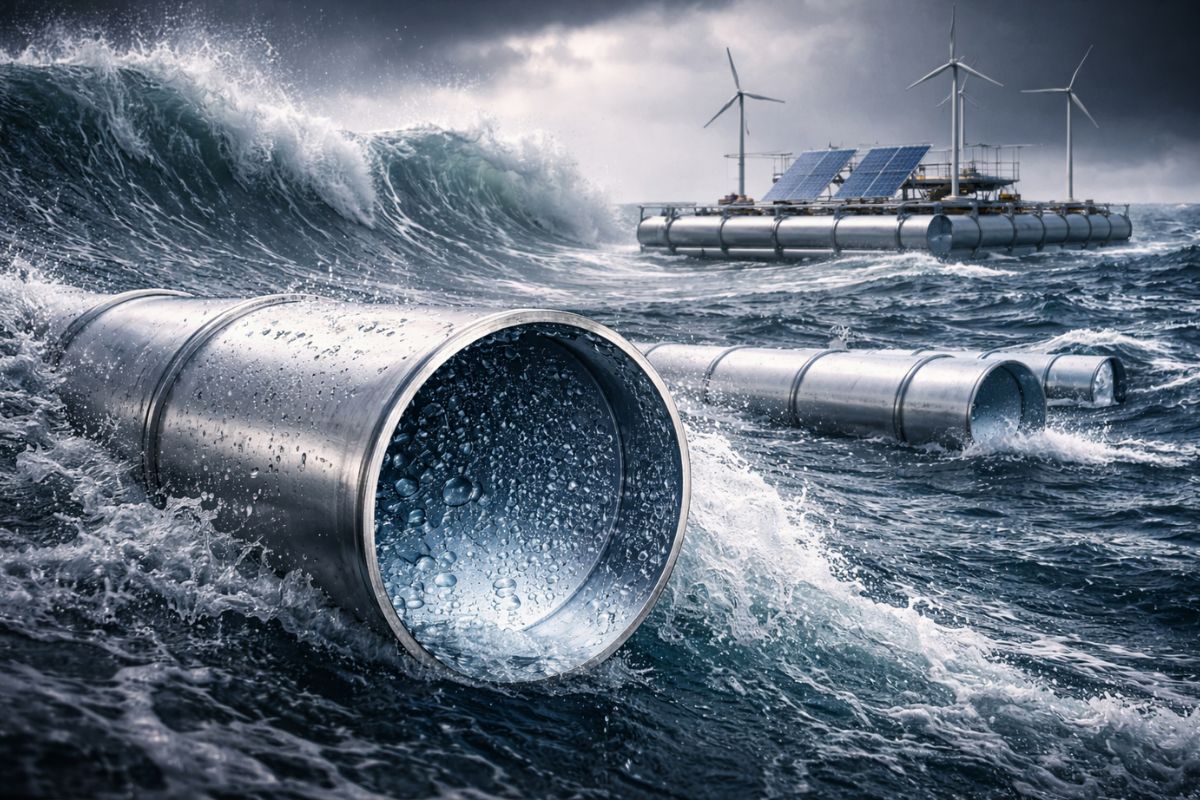


With a Diameter of About One-Fifth of an Inch, Aluminum Tubes from the University of Rochester Receive Chemical Microcavities That Trap Air Bubbles Through Superhydrophobicity, Resist Saltwater and Algae, Float Even When Punctured, and Can Be Stacked into Rafts for Ocean Wave Energy in Numerical Tests
In February 2026, researchers from the University of Rochester presented a way to make aluminum tubes practically “unsinkable,” even when they suffer holes and damage. The bet is simple in theory and demanding in execution: trap air bubbles inside the aluminum tubes using superhydrophobicity, with results described in a study published the previous month in the journal Advanced Functional Materials.
The group led by Chunlei Guo described that the structure can be assembled into larger sets to form rafts, platforms, and devices aimed at wave energy, exploring an ocean resource that is still underutilized. The same demonstration, however, leaves an open technical question: will the air bubbles remain trapped the same way outside the lab?
The Physics That Makes Metal Float When Air Is Trapped

Aluminum is one of the lightest metals, yet it is still about 2.7 times denser than water. A solid block will sink, which gives an idea of the challenge of keeping aluminum tubes reliably on the surface without relying on a “perfect” hull that fails at the slightest damage.
-
(Video): Italian pilot lands plane on moving train at 120 km/h and achieves unprecedented feat in aviation, even with a narrow runway and without direct visual contact.
-
It seems to have come out of a science fiction movie: A Brazilian city where it rains almost every day, recording over 4,000 mm per year, driven by climatic factors — a direct result of its strategic location in the Amazon.

-
The water crisis that could change everything this year has already begun; it’s not just about the climate, it affects technology, raises product prices, and can halt entire companies without warning.
-
A Japanese mason transforms raw granite into small cups and handcrafted utensils, collects giant stones, cuts with precision, and impresses with detailed manufacturing and finishing.

In boats and empty cans, buoyancy comes from the internal air, which weighs less than the displaced water.
The classic problem occurs when the hull is punctured: water enters, air exits, and the object loses buoyancy.
In aluminum tubes, the strategy is to prevent water from invading the cavity and expelling the air bubbles, even when there are localized and repeated damage.
Superhydrophobicity as a Trap for Air Bubbles in Microcavities
The proposed solution begins at the surface.
The researchers created, through chemical attack, microscopic microcavities in the walls of the aluminum tubes, altering how water interacts with the material and creating points where air can remain protected.
Due to surface tension, droplets cannot fill these microspaces and tend to roll out almost immediately.
This behavior is called superhydrophobicity, an extreme repulsion to water.
In practice, superhydrophobicity helps keep the interior dry and holds air bubbles in place, reducing internal corrosion and making it harder for algae to grow inside the aluminum tubes, a detail that matters in saltwater.
What Nature Has Taught About Superhydrophobicity and Survival
The declared inspiration came from organisms that use repellent surfaces to manipulate air and water.
Diving bell spiders trap air close to their bodies to breathe underwater, and fire ants connect to build waterproof “rafts” during floods, using trapped air as functional protection.
The analogy helps understand the mechanism, but also points out limitations: in animals, the microstructure is renewed and operated on small scales.
In engineering, reproducing superhydrophobicity with stability requires manufacturing control and consistency in the surface pattern in each aluminum tube so that air bubbles do not escape at weak points when the sea imposes abrasion and impact.
Why Aluminum Tubes Outperformed Discs in Stability
Before arriving at aluminum tubes, the same group had already shown a floating structure with two parallel superhydrophobic discs connected by a plastic pin.
The layer of air between the discs was preserved because superhydrophobicity prevented water from invading the narrow gap, sustaining air bubbles between the surfaces.
The limit appeared when the assembly was tilted and pushed down: the air could be expelled. The geometry change sought robustness.
Aluminum tubes, especially with an internal dividing wall, make it difficult for water to flow from one end to the other and reduce the chance of pushing the bubble out. Once again, the central detail is the same: superhydrophobicity keeping air bubbles trapped.
Tests with Saltwater, Algae, and Direct Damage
To test resilience, the researchers placed weight on the aluminum tubes in saltwater and in water with growing algae.
As the water is repelled, the interior remained dry, with a lower risk of internal corrosion and without a favorable environment for algae to settle, a critical point for any structure that aims to remain in constant contact with the ocean.
The most sensitive point was the verification under mechanical damage: even with punctures and holes, the aluminum tubes continued to float.
The practical statement from the lab is straightforward: the structure “still floats.” The leap now is in duration, because the sea does not test for minutes, but rather for weeks and months, with temperature variation and repeated loads.
Wave Energy and the Scale Argument for Ocean Platforms
The aluminum tubes are narrow, with an approximate diameter of one-fifth of an inch, but can be stacked and welded into sets, forming “rafts” and larger structures.
The proposal is to transform simple modules into surfaces capable of supporting equipment and, potentially, collecting wave energy from the ocean’s swells, replacing the logic of a single hull with many redundant units.
The team also mentioned numerical analysis indicating that stacking some layers of aluminum tubes could produce a structure capable of surviving the worst ocean conditions.
The argument is that buoyancy does not depend on a single perfect hull, but rather on many cavities with air bubbles trapped by superhydrophobicity, a redundancy that tolerates localized damage and still maintains enough air volume.
What Still Separates the Lab from Open Water
An outside researcher, Andreas Ostendorf, a professor of applied laser technology at Ruhr-University Bochum in Germany, evaluated the idea as interesting and potentially “disruptive,” but pointed out that there is still work to be done to demonstrate performance in real-world situations.
The main doubt is not whether the principle works, but whether it scales and holds up over time in aggressive environments.
The framing of the project avoids promising “infinite energy” and shifts the focus to applications: floating platforms, wave energy devices, and even recreational uses, such as a floating chair.
For aluminum tubes to become ocean infrastructure, the decisive question is operational: how many air bubbles remain trapped after months of abrasion, dirt, and impacts, and what is the failure point when superhydrophobicity degrades?
From Optics to Functional Metal, the History Behind the Tubes
The described line of research involves decades of trial and error to alter material properties with microscopic patterns on the surface.
In 2008, Chunlei Guo and Anatoliy Y. Vorobyev used lasers to mark metals in a way that maintains a smooth feel but changes how light is absorbed and reflected, producing aluminum with a golden appearance and titanium in navy blue.
Later, the group also explored the opposite of repellency, creating superhydrophilic surfaces on silicon, with microscopic channels that attract water and were suggested as a way to cool chips.
On another front, the lab combined dark metals with thermoelectric devices to convert heat into electricity, arguing that it is possible to harness “waste heat” from various sources, from the sun to hot parts of vehicles.
This history helps explain why aluminum tubes have become the current target.
Research on aluminum tubes suggests that superhydrophobicity can do more than repel water: it can trap air bubbles with enough stability to keep metal floating, even when punctured.
If the idea survives outside the lab, it paves the way for wave energy platforms and modules that tolerate damage and continue operating in the ocean.
In practice, would you trust a raft made from aluminum tubes to support equipment at sea, or would the doubt about the wear of superhydrophobicity and loss of air bubbles be too great? If your city could test a prototype, would you place it in a protected bay or straight into open water?






O que atrapalha nosso país, e a corrupção desenfreada, desse desgoverno que está no poder.
Eu tenho uma ideia melhor ainda: e se invés de confiar o alumínio no limiar do afundamento com essa nova técnica a gente simplesmente soldar uma chave de cada lado do tudo fazendo ele boiar com muito mais eficiência hein?
Parabéns aos pesquisadores. Alguém tem que pesquisar e criar. Enquanto isso em alguns lugares é só samba e futebol. Daí o atraso tecnológico.
Flávio, samba e futebol não são inimigos da ciência não viu!? O Brasil é rico o suficiente para manter cultura, entretenimento, esporte, tecnologia e CIÊNCIA. O inimigo da ciência são os interesses capitalistas que gostam da coisa rápida e do lucro fácil e investem pesado na deseducação do povo, entende???