





 Portuguese
  English
  Spanish
  4 min of reading
  0 comments


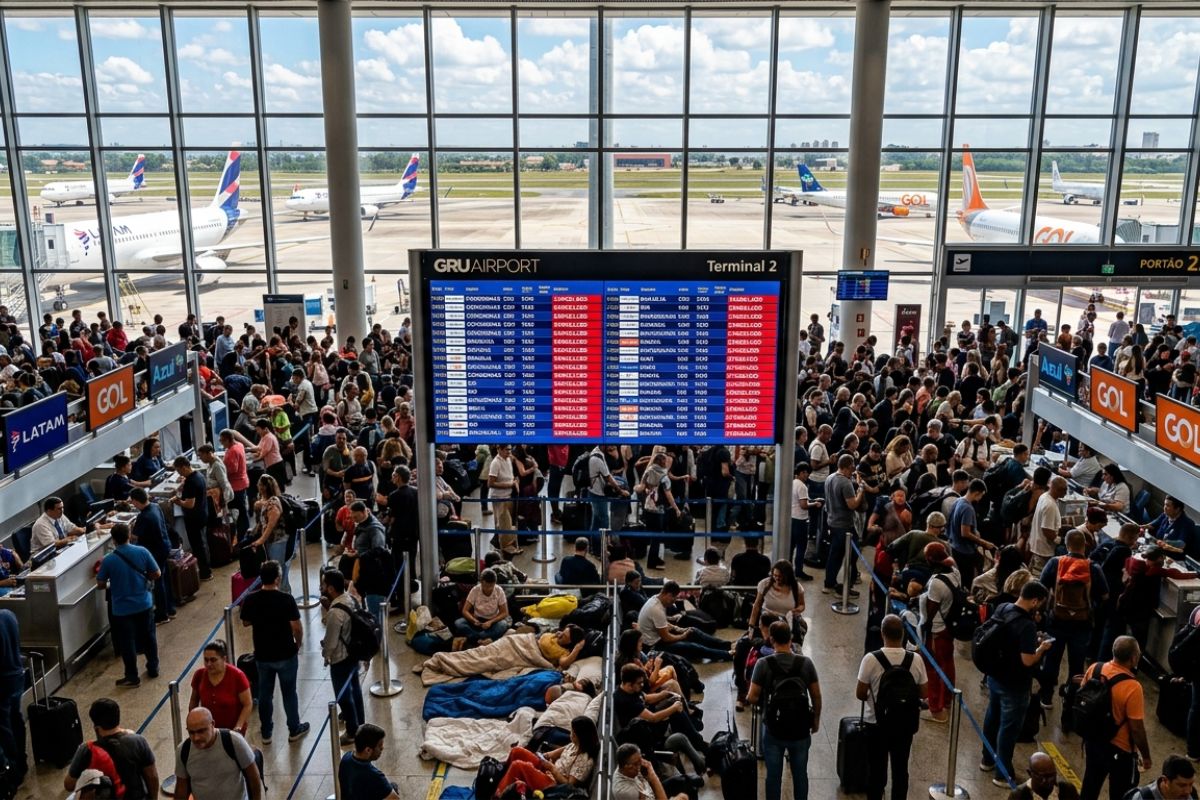
36-minute paralysis at the main hubs of the country cancels flights, derails connections, and leaves passengers at the airport, while Procon monitors and rights come into play
Almost 24 hours after the suspension of operations at the two main airports in São Paulo, passengers were still facing the repercussions this morning. A smoke incident at the Regional Airspace Control Center of the Southeast Region halted landings and takeoffs for more than half an hour and cancels flights and connections that depend on Guarulhos and Congonhas.
The problem was not limited to São Paulo: with tight schedules and aircraft operating almost without breaks, delays and rescheduling are piling up. When a hub is down, the entire network feels it, and the cascading effect appears on multiple routes, on a national scale, with passengers left without boarding and nights spent at the airport.
What happened in air traffic control
Investigations revealed that the smoke incident at the control center led to the interruption of operations for more than half an hour.
-
Inflation in March reaches 0.88% according to IBGE and pressures the Brazilian economy, impacting family budgets and requiring more strategic decisions to maintain financial control.

-
In Paraná, distributor Pacto connects 100% of the load in Coronel Vivida to batteries: a BES of 10 MW and 20 MWh costs just over R$ 30 million and lowers the local tariff now.

-
With a dependence of up to 80% on gas imported from the United States, Mexico is responding with a robust energy strategy, betting on shale gas, creating a scientific committee, and preparing to expand natural gas production to reduce vulnerability and strengthen its energy security in the coming years.

-
The United States proposes to Brazil a critical minerals agreement with a minimum price to combat Chinese dumping and priority for investment, but the Planalto is blocking the signing out of fear of upsetting China and due to electoral calculations in a year of competition.

Landings and takeoffs were suspended for 36 minutes, enough time to disrupt the sequence of scheduled flights at Guarulhos and Congonhas.
The immediate result was visible early on: at least seven flights were canceled at both airports, still as a reflection of the blockage from the previous morning.
In a network that relies on punctuality, any interruption of this kind cancels flights and pushes delays for the rest of the day.
Why Guarulhos and Congonhas pull the cascade effect


Aviation experts point to two main reasons. The first is structural: the airports in São Paulo are the largest connection centers for national and international flights. Many people coming from other cities need to pass through São Paulo to continue their journey.
When Guarulhos or Congonhas stop, the passenger who depends on a connection is left without an immediate option. One cited example was the traveler coming from Joinville who needs a connection in São Paulo to reach Fortaleza.
If the hub is down, the entire journey is down, and the system quickly cancels flights in sequence or pushes rescheduling to later times.
Tight schedules make delays take time to disappear
The second reason is the way companies operate: very tight schedules, almost without breaks. An aircraft departing from São Paulo can make several routes in the same day, in sequence, with little room to absorb problems.
This is even more significant because part of the fleet is leased. With aircraft costing a lot per month, the logic is to keep the aircraft in use as much as possible.
When an event takes an aircraft out of service, keeps it on the ground, and cancels flights, recovery is slow because there are not enough breaks to create “extra flights” and resolve everything at once. The adjustment happens gradually, over the course of operations.
Numbers of impact and the sensation of chaos in the terminal
On the afternoon of the same day of the incident, the estimate was that almost one-third of flights at the airports in São Paulo had been affected.
There were reports of delays exceeding 30 minutes in a considerable portion of operations, and the effect was also seen on the national scene.
In the terminal, the impact becomes a direct experience: many people who were to board ended up spending the night at the airport. There are reports of passengers sleeping on the sidewalk and on the cold floor, and even when hotel offers were made, the distance presented did not justify the travel. In such situations, the feeling is one of abandonment, but there are clear rules when cancels flights and delays prolong.
Your rights when flights are canceled or delayed: assistance and solution
Procon employees were at Congonhas to monitor assistance. According to the stated rule, rights evolve according to the waiting time: from 1 hour, communication, such as free internet access, after 2 hours, food, and after 4 hours, accommodation and transportation, when necessary.
In addition to assistance, the consumer has two main paths when cancels flights: full reimbursement of the amount paid or rebooking on another flight to the same destination.
Procon reported that it notified the companies to provide clarifications and comply with the legislation, reinforcing that the passenger is the one who pays the bill in the end.
Quick question: have you ever experienced a situation where the airport shuts down and cancels flights in sequence, and the airline actually offered the assistance and solution it promised?







Seja o primeiro a reagir!