





 Portuguese
  English
  Spanish
  5 min of reading
  0 comments


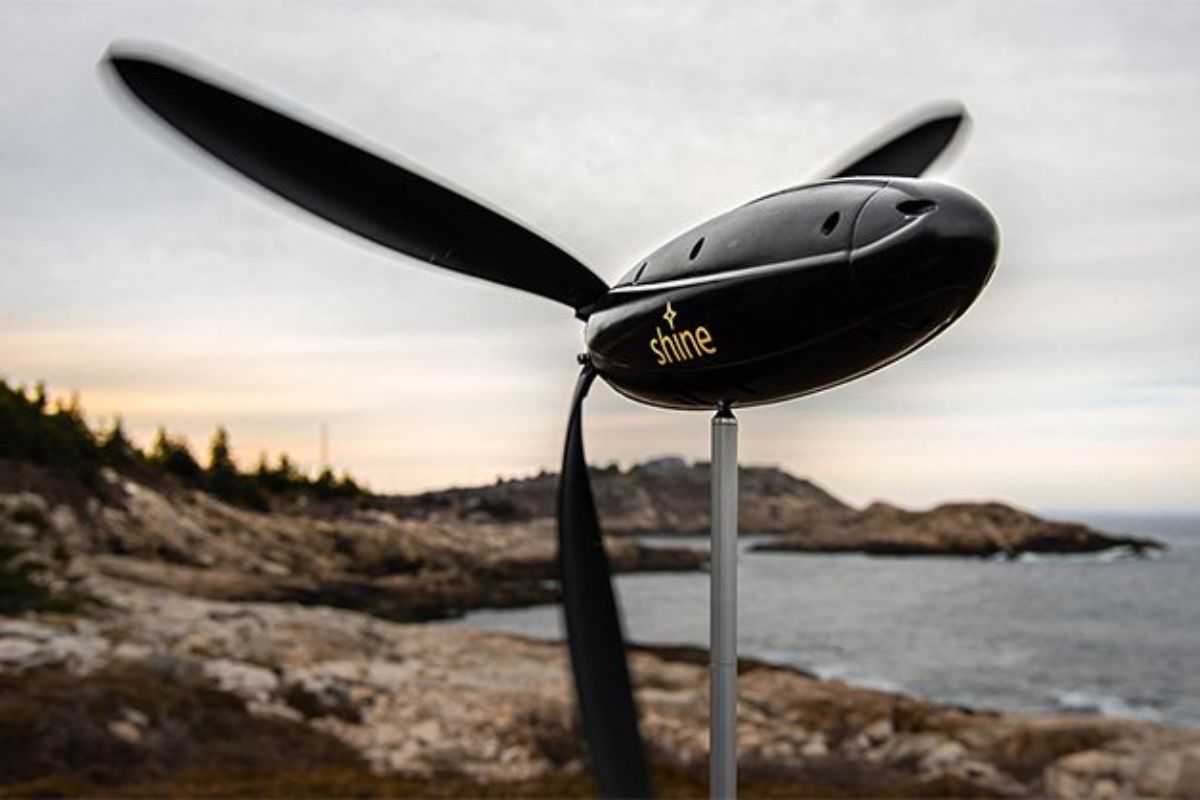
The portable wind turbine Shine 2.0 weighs 1.4 kilos, is the size of a water bottle, generates up to 50 watts of power with winds starting at 13 km/h, and charges cell phones, laptops, and power stations working day and night, in rain or shine.
Portable solar panels dominate the renewable energy market for campers, van travelers, or those working off the electrical grid. But a Canadian wind turbine called Shine 2.0 wants to change that equation with a simple argument: it works when the sun doesn’t shine. Weighing 1.4 kilos and the size of a water bottle, the wind turbine generates up to 50 watts of power with winds starting at 13 kilometers per hour and continues to produce energy day and night, in rain, overcast, or full sun.
The device is the evolution of Shine 1.0, which sold 2,300 units in the United States, Canada, and Europe since its Kickstarter campaign in 2021. The new version of the wind turbine features USB-C charging with 75 watts output, increased power from 40 to 50 watts, and the ability to charge laptops, drones, and power stations, as well as cell phones. The crowdfunding campaign on Indiegogo has already raised over 772 thousand dollars from nearly 1,500 buyers, and the devices are expected to be shipped to backers soon.
How the Shine 2.0 wind turbine works in practice

The principle is straightforward. The wind turbine has a 90-centimeter support that fits inside the body of the device for transport, and when assembled, it automatically rotates according to the wind direction.
-
It is 95% water, controls blood sugar, strengthens bones, and almost no one eats it: maxixe is the most forgotten vegetable in Brazil and one of the most powerful you could put on your plate today.

-
Man surprises by building a boat made of ice capable of floating on water.

-
The longest-serving employee at Apple, who joined at a young age, witnessed the big tech nearly go bankrupt and today has accumulated millions in stock after decades of quiet investment within the company.

-
Measuring 15.3 meters in wingspan, the Russian fighter Sukhoi Su-35, weighing 34 tons, stays in the air and performs impossible maneuvers at 2,400 km/h.
Just stake the support into the ground, sand, or a stable surface and let the wind do the work. The system starts generating energy with winds of 13 km/h and operates up to winds of 45 km/h.
The technical differentiator of the Shine 2.0 wind turbine is an integrated charge controller called MPPT (Maximum Power Point Tracking), which optimizes efficiency even when wind speed changes rapidly. This means that the wind turbine extracts the maximum possible energy at every moment, without waste.
Settings can be managed through a mobile app connected via Bluetooth, which shows the status of the internal battery, real-time performance, and the amount of energy generated.
What the Shine 2.0 wind turbine can charge

The list of compatible devices has grown compared to the previous version. The wind turbine features a USB-C port with 75 watts output, allowing for direct charging of laptops, something the Shine 1.0 did not do with its USB-A port of only 13 watts. Cell phones, tablets, drones, cameras, GPS, and other field electronics are also charged without issue.
With an optional 12-volt adapter, the wind turbine can also power portable power stations, significantly expanding storage capacity for those needing more autonomy.
The internal battery of 12,000 mAh acts as a backup: even without wind, the device can be charged at home before a trip and used like any conventional portable charger.
It is a layer of security that ensures power regardless of the local weather conditions.
Why the wind turbine has advantages over solar panels in certain situations
The comparison with solar panels is inevitable and, according to the manufacturer, favorable to the wind turbine in specific scenarios. “Unlike solar energy, it can generate energy day and night, rain or shine,” said Vanessa Ferguson, spokesperson for Shine, to the specialized site GearJunkie.
In coastal, mountainous, and open landscapes, where the wind is more constant, the wind turbine produces energy continuously while solar panels depend on direct light.
On the other hand, in dense forests where the wind does not penetrate, solar panels remain the better option. The wind turbine needs open space and at least 13 km/h of constant wind to operate.
Those camping on the coast, traveling in RVs, living in vans, or working in field research in open areas find in the wind turbine a complement or even a superior alternative to solar energy. The choice depends on the destination: if it is windier than sunny, the wind turbine wins.
Who is buying the wind turbine and how it is used in the real world
The audience for Shine 2.0 goes beyond traditional campers. The wind turbine is used by long-distance travelers, people living in vans, surfers, field researchers, and residents of cabins who need power off the grid.
Ocean explorers who rely on constant sea breezes are another natural audience, as are RV travelers who install the wind turbine on the roof of the vehicle for continuous charging while parked at camp.
Shine also positions the wind turbine as a solution for emergency preparedness at home. Power outages caused by storms, cyclones, or issues with the power grid leave families without access to communication and lighting.
A portable wind turbine that works precisely when the weather is severe and the wind blows strongly can keep cell phones charged and essential electronics functioning during the most critical moments.
How much the Shine 2.0 wind turbine costs and what comes next
In the Indiegogo campaign, the Shine 2.0 wind turbine costs 400 dollars in the “Early Bird” phase, which represents a 30% discount off the final price of 571 dollars.
Optional accessories include an extended 1.8-meter support for 138 dollars, which allows capturing less turbulent winds at greater heights, and the adapter for power stations for the same price. The campaign remains open and has already surpassed 772 thousand dollars in fundraising.
The brand has already announced plans for an even more powerful wind turbine, the Shine 3.0, with a nominal power of 100 watts and output of up to 200 watts from the internal battery, aimed at larger devices and charging vehicles or batteries. Mounting options for vehicles are also in development, designed for use when the car or van is parked.
The portable wind turbine, which for a long time was seen as an unstable and unreliable solution, may finally be finding its place in the renewable energy market.
Would you use a portable wind turbine the size of a water bottle to charge your devices while traveling? Do you think it can replace solar panels or does it work better as a complement? Leave your thoughts in the comments. The discussion about portable energy is heating up, and this type of product could change the way we travel.








Seja o primeiro a reagir!