Portuguese
  Spanish


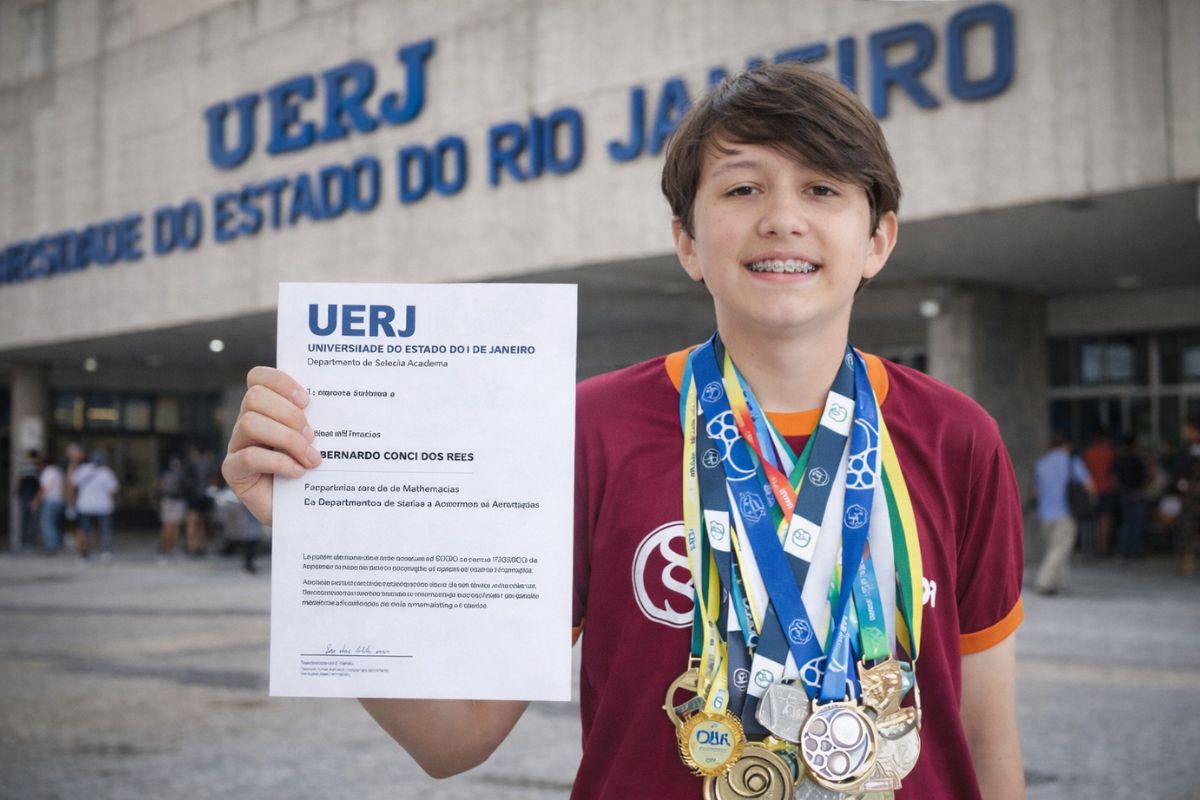

Bernardo Manfredini, 12 years old, a seventh-grade student in elementary school, was approved in the UERJ entrance exam for Mathematics after taking the test out of curiosity, accumulating more than 80 medals in knowledge olympiads and was identified as a person with high abilities.
At just 12 years old and attending seventh grade in elementary school, Bernardo Vinício Manfredini achieved something that most students only attempt years later: he was approved in the entrance exam of the State University of Rio de Janeiro (UERJ) for the Mathematics course. The most surprising thing is that Bernardo did not take the test because he needed to. He did it out of curiosity, to understand how a college selection process works and to test what he already knew. “When I saw the result, I was very happy. This means that the content I studied is putting me on the right path to achieve something in the future,” he told Terra.
Bernardo’s story goes far beyond early approval. The teenager has already accumulated more than 80 medals in knowledge olympiads, including gold in the State Mathematics Olympiad of Rio de Janeiro (OMERJ), national silver in the Brazilian Mathematics Olympiad for Public Schools (OBMEP), and bronze in the Brazilian Mathematics Olympiad (OBM). In addition, Bernardo was identified as a person with high abilities, that is, gifted. The family, however, made it clear from the beginning: he will not enroll in university now. The entrance exam was just a test.
How the idea for Bernardo to take the UERJ entrance exam at 12 years old came about
The initiative came from Bernardo himself. He was curious to know how a selection process for entering a college in the Exact Sciences area worked. After verifying that it was possible to enroll her son, his mother, teacher Luzia de Fátima Manfredini, 45, completed the registration.
-
Bruno Guimarães, 28, Misses Crucial Penalty Against Norway in World Cup After Replacing Vinicius Jr.

-
Inspired by a school lesson on Africa’s water crisis, a young boy raised money through chores to fund a well that transformed a Ugandan community.

-
Brazilian Construction Worker Moves to France, Earns Up to €2,500 Monthly with Home Renovations, Gains Social Media Attention

-
US Navy Sinks USS Oriskany with 230 kg of C-4, Creating World’s Largest Artificial Reef in 37 Minutes





The agreement from the beginning was that Bernardo would take the test just to know the process, without any intention of enrollment or grade acceleration.
The UERJ entrance exam works in two stages. The first phase has 60 multiple-choice questions involving Languages, Mathematics, Natural Sciences, and Human Sciences.
The second phase is a written exam with an essay and tests of specific subjects according to the chosen course. Bernardo passed the first phase and, in the written exam, took tests in Mathematics and Physics. He says he solved the questions thinking as if he were in one of the knowledge olympiads he has been participating in for years.
Bernardo’s journey with Mathematics since the age of 3
The passion for numbers appeared very early. Bernardo’s mother remembers that, even before school age, her son was already paying attention to the numbering of houses on the streets, noticing that the numbers were increasing or decreasing and reading traffic signs at 3 or 4 years old.
Numbers have always been present in Bernardo’s life naturally, even before any formal stimulation.
In the first year of elementary school, the teacher noticed that Bernardo had a much higher ease and interest in Mathematics than expected and did not limit him to the content of his grade. She began to seek more advanced materials and allowed him to progress at his own pace.
It was at this moment that Bernardo began to advance rapidly in mathematical learning, which would later lead him to knowledge olympiads and, at 12 years old, to approval in the UERJ entrance exam.
Bernardo’s more than 80 medals in knowledge olympiads
Since 2024, Bernardo has been taking extra Mathematics classes aimed at preparing for academic olympiads. The result is more than 80 medals in competitions that include state, national, and international level tests.
The gold in OMERJ, the national silver in OBMEP, and the bronze in OBM are highlights of a curriculum that few adults could accumulate.
The knowledge olympiads were fundamental for Bernardo to develop the ability to solve problems under pressure, manage time, and deal with university-level questions even before finishing elementary school.
He himself recognizes that it was this experience that prepared him for the UERJ entrance exam: the questions in the second phase were solved with the same logic he applies in competitions. For Bernardo, the entrance exam and the olympiads are part of the same universe of intellectual challenges.
What Bernardo does besides Mathematics and how the family supports his development
Despite his passion for numbers, Bernardo’s routine is diverse. He studies in the morning at Colégio Silva Serpa, in São Pedro da Aldeia, in the Lakes Region of Rio de Janeiro, and in the afternoon he takes classes in table tennis, programming, robotics, chess, piano, and Mandarin.
The family makes a point of broadening the range of activities so that Bernardo develops in multiple areas, not just in Mathematics.
Mother Luzia explains the family’s philosophy: “We have always followed his path. He has always shown the interest he had, and we try to find opportunities to see if he continues to enjoy it.” Bernardo was born in Araraquara, in the interior of São Paulo, and moved with his parents to Rio de Janeiro.
The family support includes accompanying their son in competitions, ensuring he has access to advanced materials, and at the same time preserving Bernardo’s right to be a 12-year-old teenager with varied activities and time to grow.
Why Bernardo will not enroll in UERJ and what the approval really meant
Despite the approval, Bernardo’s parents do not intend to accelerate his grade or seek enrollment in university through legal means. The agreement from the beginning was to use the entrance exam as a learning experience.
Luzia explains that the goal was for Bernardo to understand the process: how to deal with nervousness, how the documentation rigor works, how the questions compare to the olympiads, and what it is like to be in a room with older competitors.
For Bernardo, the UERJ entrance exam served as fuel to want to study more. He says that the Physics and Mathematics questions he couldn’t solve in the test became material for later study. “I decided to pick them up later and studied a bit more to have a little more content.
The entrance exam really motivates me more in this area,” he stated. At 12 years old, with more than 80 medals and a university approval on his resume, Bernardo has already proven what he knows. Now he continues doing what he loves most: learning.
What do you think of Bernardo’s story, approved at UERJ at 12 years old? Do you believe that children with high abilities should be encouraged to test their limits or that childhood should be preserved from academic pressures? Leave your comments. Stories like this generate reflections that go far beyond the classroom.