





 Portuguese
  English
  Spanish
  5 min of reading
  0 comments


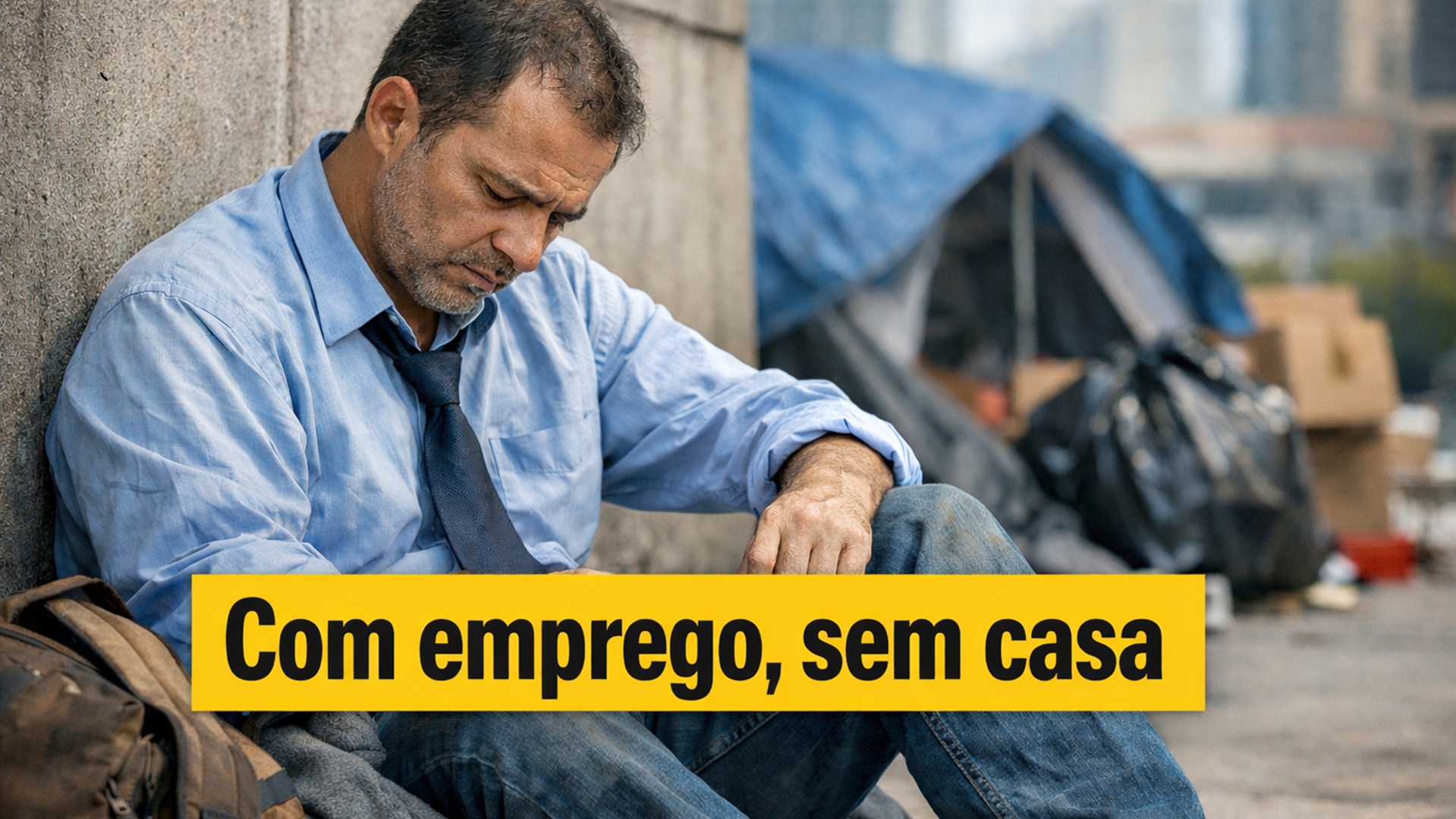
The Investigative Report by Deutsche Welle Unveils the Severe Housing Crisis in Berlin by Following the Exhausting Routine of Wage Workers Who, Hindered by Bureaucracy and High Rents, Are Forced to Live on the Streets or in Temporary Shelters While Keeping Their Formal Jobs Up to Date.
In the early hours of the morning, while Berlin still sleeps under the European cold, an invisible reality moves through the streets of the Neukölln neighborhood. A recent report from Deutsche Welle (DW) brought to light the lives of men like Denny Wagner and Attila Kokas.
Both challenge the stereotype of a homeless person: they are not unemployed, do not beg, and strive to maintain a neat appearance. Denny is a cook; Attila is a gardener. However, at the end of the day, neither of them has a home to return to.
DW’s investigation reveals a growing phenomenon in Europe’s largest economy: the “Homeless Workers.”
-
Inflation in March reaches 0.88% according to IBGE and pressures the Brazilian economy, impacting family budgets and requiring more strategic decisions to maintain financial control.

-
In Paraná, distributor Pacto connects 100% of the load in Coronel Vivida to batteries: a BES of 10 MW and 20 MWh costs just over R$ 30 million and lowers the local tariff now.

-
With a dependence of up to 80% on gas imported from the United States, Mexico is responding with a robust energy strategy, betting on shale gas, creating a scientific committee, and preparing to expand natural gas production to reduce vulnerability and strengthen its energy security in the coming years.

-
The United States proposes to Brazil a critical minerals agreement with a minimum price to combat Chinese dumping and priority for investment, but the Planalto is blocking the signing out of fear of upsetting China and due to electoral calculations in a year of competition.

They are thousands of people who, despite having formal employment and income, have been pushed out of the housing market due to scarce housing, bureaucracy, and the high cost of living in German metropolises.
The Exhausting Routine Documented by DW
The reporting team followed the grueling routine of Denny Wagner. At 5:30 AM, he is already at the bus stop. “It’s warm in here,” he tells DW, valuing the thermal comfort of public transport that many overlook.
Denny works in the kitchen of a homeless shelter, a cruel irony captured by the report.
He serves hearty meals to other homeless individuals, knowing exactly what they feel as he himself has been living the drama of not having a fixed residence for almost six months.
“Living on the streets is more stressful than working,” Denny confided to the reporters. He explains that life on the streets requires a constant state of alertness, from six in the morning until ten at night.
There is no real rest. “If you stay on the street all day, it drains you. I know from personal experience,” he reports.
Meanwhile, DW followed the steps of Attila Kokas, a Hungarian who has lived in Germany for seven years. A gardener for a charity organization, the Berlin City Mission, Attila also collects trash and cleans the building.
His routine is marked by fear and survival strategy. He wakes up at dawn, often at 3 AM, to catch the train to work without being noticed by inspectors, as he cannot afford fare.
To the report, Attila showed how he chooses his sleeping spots: always with walls protecting two sides to avoid surprise attacks. “I won’t have to stay half awake to guard my stuff anymore… so that no one steals anything while I’m not looking,” he said, expressing the simple desire to sleep in peace.
The Distinct Profile of the New Homeless
DW’s investigation highlights a crucial point: not all homeless individuals fit the profile of substance dependence or chronic unemployment.
Denny, for instance, had a stable life, family, and a twelve-year job before a separation and a move to Berlin left him vulnerable. After being mugged and losing his documents, he fell into the traps of bureaucracy and homelessness.
The head of the shelter where Denny works confirmed to DW that the cook is a valuable exception. “He knows what he needs to do to get out of this.
Others are also gradually doing this, but they use drugs and drink alcohol. Denny does none of that.” The employer provides practical support, allowing Denny to shower and do laundry at work, compensating for the lack of basic infrastructure in his current life.
Attila shares this sobriety. He came from Hungary in search of better conditions, but faced the complexity of the German system. “German bureaucracy is different from Hungarian bureaucracy. And I still have to figure out how it works,” he explained to the report.
The Housing Crisis in Numbers
The Deutsche Welle report contextualizes the stories of Denny and Attila in a larger scenario. According to estimates cited by the broadcaster, there are more than half a million people without housing in Germany. Of these, about 50,000 actually live on the streets or in emergency shelters.
The reasons listed by DW are varied: unemployment, debt, family breakdowns, and increasingly, gentrification and the lack of affordable housing.
In large centers like Berlin, obtaining an apartment requires not only money but also a series of documents and guarantees that someone in a homeless situation— even if employed—can hardly manage to gather.
Precarious Housing and Temporary Solutions
The DW team gained access to the places where these workers rest. To protect Attila’s privacy, the exact location of his overnight stay was not revealed, but he showed the camera his “survival kit”: thermal mattress, sleeping bags, and the relentless search for corners shielded from the wind and hostile gazes.
Denny, on the other hand, showed the report his current residence: a wooden hut of only four square meters, funded by the city. The place has no running water, electricity, or bathroom.
The heating is improvised with a small gas stove, which he turns on for a few hours to make the temperature bearable. “You can practically stay in shorts,” he says optimistically, showing that his comfort level has been drastically adjusted by necessity. To charge his cell phone—his only connection to the modern world—he depends on the outlets at work.
The Bittersweet Conclusion
The DW report followed a pivotal moment in Attila’s life: the news that he had secured a room in a transition shelter. Social worker Barbara Breuer communicated the news over the phone. However, the reaction captured by the cameras was not one of euphoria but of contained disappointment.
Upon receiving the keys, Attila realized he would have to share a kitchen and bathroom with other residents. After years of insecurity on the streets, his dream was the total privacy of a place of his own. “Yes, it’s warm, and you’ll also have a bit of privacy,” the social worker tried to console him.
For Attila, it’s a roof, but it’s still not the home he envisioned to regain his full dignity.
The Deutsche Welle article closes with a reflection on the persistence of these workers. Denny Wagner maintains pragmatism: “I just need to find a place that I can afford. That would be enough. After all, I make good money.”
Through the lenses of DW, the story of Denny and Attila serves as a social alert. It exposes how work, historically seen as the great equalizer and guarantor of stability, is no longer sufficient to protect citizens from falling to the margins of society in one of the richest nations in the world.









-

Uma pessoa reagiu a isso.