Portuguese
 Spanish


With a journey of about 35 minutes between the departure and arrival platforms, the rail service connects the United Kingdom and France and allows freight companies to keep goods in the same trailer even when part of the route is traveled by rail.
Truck drivers who transport goods between the United Kingdom and mainland Europe can cross the English Channel without using ships, aboard trains specially designed to carry heavy vehicles.
The service operates through the Channel Tunnel under the name LeShuttle Freight, connecting Folkestone, England, with Coquelles, near the French city of Calais.
-
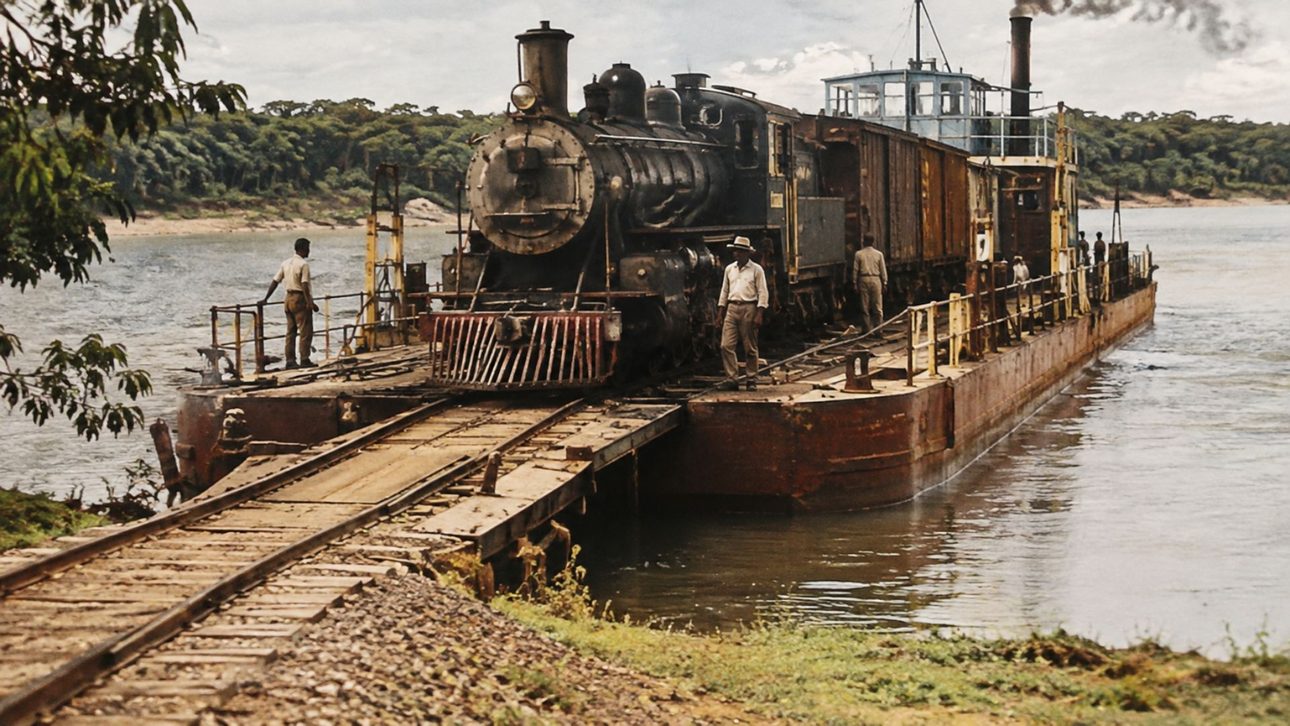
Tracks reached the Paraná River and continued onto a ferry that carried railcars from one bank to the other before the Francisco de Sá Bridge connected the railway

-
From scanner-read labels to flights to Manaus, Total Express enhances its Black Friday delivery network with a machine sorting 220,000 packages daily
-
BR-304 to be diverted for about 40 days in Mossoró to install station with weigh-in-motion to screen trucks before enforcement scale
-
From a six-screen control room, operators remotely manage a 50-meter quay crane in Santos, moving containers with the help of 20 cameras
According to Getlink, the group responsible for the service, each train consists of two electric locomotives, three loading and unloading cars, and 31 or 32 vehicle-carrying railcars, each able to accommodate trucks weighing up to 44 metric tons.
Unlike conventional freight trains, which carry goods directly in railcars or containers, this system transports the road vehicle itself, including the cab, trailer, and products packed for delivery.
How trucks board trains in the Channel Tunnel
At the terminal, drivers check in and go through border control procedures. After completing these steps, each vehicle is directed to the queue for its assigned train, where it waits for permission to board.
Truck drivers drive their own vehicles onto the train’s loading structure and continue to the parking space assigned to them in one of the vehicle-carrying railcars.
Each train is about 800 meters long, with one locomotive at each end and platforms designed to carry heavy vehicles. It has capacity for up to 32 trucks at a time.
After parking, drivers leave their cabs and wait for the shuttle bus that takes them to the car reserved for the professionals making the crossing.
Drivers travel in a car separate from the trailers
Known as the Club Car by the operator, the car for truck drivers is part of the same train carrying the vehicles, but is located apart from the platforms where the trailers are parked.
When they arrive at the destination terminal, drivers are taken back to their trucks and drive off the train, following the rail structure until they reach the road network.
For freight companies, the change in transportation mode does not alter the cargo unit used for the journey, since the goods remain packed in the vehicle, eliminating the need to transfer boxes or pallets to conventional railcars.
The same vehicle combination can therefore be used for the road portions of the trip before and after the crossing, without requiring the cargo to be rearranged for its passage through the Channel Tunnel.
Channel Tunnel carries thousands of trucks each month
In September this year, LeShuttle Freight carried 102,014 trucks across the English Channel, an 8% increase from the same month in 2025, according to the traffic report released by Getlink.
Between January and September 2026, the cumulative total exceeded 883,000 trucks carried by the rail service.
Train frequency can reach six departures per hour in each direction, equivalent to one departure every ten minutes during peak periods.
That interval describes the service frequency during peak hours, not the individual wait time for each truck driver, which depends on boarding availability, demand and terminal operating conditions.
Rail crossing links road freight routes
The terminals connect to highways used for international freight transport, with access via the M20 motorway on the British side and the A16 in France.
The rail segment is just one leg of truck journeys that may have begun in other parts of the United Kingdom or in different countries across continental Europe.
Although the journey between the platforms takes about 35 minutes, logistics planning must also account for arrival check-in, border controls, waiting to board and vehicle clearance.
Using the train does not eliminate the documentation and customs requirements for international freight, which continue to apply to carriers crossing the border between the United Kingdom and France.