Portuguese
 Spanish


China’s Unitree and Star Plus Legend launched the UNI-DOGGIE in Shanghai, a roughly 19-kg collectible robot dog with 12 joint motors, a snout-mounted camera and a top speed of 2 m/s. It costs 43,900 yuan, and 2,000 units will be made, Gizmochina reported on November 24, 2026
China’s Unitree launched the UNI-DOGGIE, a collectible robot dog priced at 43,900 yuan, with Hong Kong-based Star Plus Legend. Gizmochina compiled the full specifications on Tuesday, November 24, 2026.
The technology site Gizmochina published the report that Tuesday, in an article by Joane. The robot had debuted earlier, on Friday, November 6.
Chinese portal IT Home records the launch at the 9th China International Import Expo (CIIE) in Shanghai. State-run newspaper Global Times also reported the debut, on November 9.
-
Briggs & Stratton launches SimpliPHI 16, a 16-kWh home battery with LFP chemistry and expansion to 512 kWh, now available for preorder for extended power during outages

-
Differ Power unveils 9-in-1 heat pump with built-in 6 kW hybrid inverter and support for 7.68–15.36 kWh LFP batteries for solar-powered homes in Europe
-
Amflow launches UE Carbon and UE Carbon Pro urban e-bikes featuring Avinox motor, 600 Wh battery, up to 132 km range, priced at $3,499 and $3,899
-
Litespeed launches the Distortion, a titanium electric gravel bike with Mahle X20 motor and $9,999 starting price in the U.S.

In Brazil, São Paulo-based XD4Solutions describes itself as Unitree’s official representative, according to Economic News Brasil on August 17, 2026. The UNI-DOGGIE is not listed in the catalog cited.
At the Central Bank’s closing exchange rate of R$0.8789 per yuan on November 24, 2026, the retail price of 43,900 yuan works out to about R$38,600.
Specifications: 72 x 37 x 71 cm and about 19 kg
Standing upright, the UNI-DOGGIE measures 72 x 37 x 71 cm, according to IT Home. China’s state broadcaster CGTN reported a height of 71 cm on November 7.
The robot weighs about 19 kg, the same figure reported by Global Times, IT Home and Gizmochina. U.S. site The Gadgeteer gives the weight in U.S. units: about 42 pounds.
The robot has four legs and can walk on hard floors, carpet, short grass and tile. Those are the surfaces listed by IT Home for the robot dog.
Its look follows the cyberpunk style, a term used by CGTN and IT Home to describe the robot’s design.
12 aluminum-alloy motors at the joints
The joints in all four legs use 12 precision aluminum-alloy motors, according to Global Times and IT Home.
Gizmochina describes them as 12 precision motors at the joints, without specifying the material.
Its movements include running, jumping, walking on its front legs, Chinese lion dance steps and dancing. IT Home also lists a heart gesture and a handshake.
Gizmochina describes the UNI-DOGGIE as more of a collectible with robotics features than a working robot.
Unitree makes other quadruped robots, including the Go2 series, aimed at mobility and practical applications.
Speed: 2 m/s, or 4.5 miles per hour
Global Times, IT Home and Gizmochina report a top speed of 2 meters per second. The Gadgeteer gives the top speed as 4.5 miles per hour, the unit used in the United States.
The robot dog can climb steps up to 16 cm high and ramps as steep as 40 degrees. The Gadgeteer gives the maximum step height as 6.3 inches and the ramp angle as the same 40 degrees.
U.S. channel B.C. Begley posted a 1-minute-27-second video in English about the launch on November 9, 2026.
The description says the robot costs 43,900 yuan, or about US$6,600, and that 2,000 units will be available worldwide. It also lists a weight of 42 pounds, 12 precision motors and a top speed of 4.5 mph.
The same description also mentions a camera in the snout and app-based control over a 4G connection.
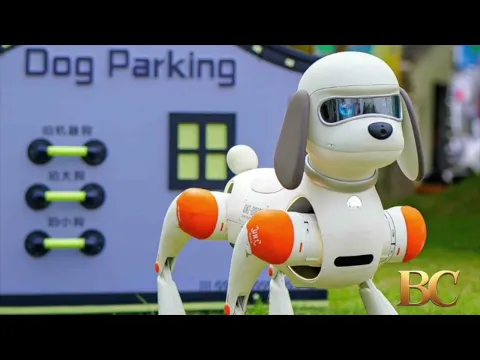

Snout-mounted camera, 4G control and remote updates
The camera is mounted in the snout and takes photos and records video as the robot follows its owner. The automatic-following system, which IT Home calls Smart Companion System 3.0, eliminates the need for a leash.
The robot is controlled remotely through a mobile app over a 4G connection. UNI-DOGGIE software receives updates over the internet through a system known as OTA.
CGTN also cites voice interaction and five facial expressions on the robot.
Price of 43,900 yuan and comparison with the Go2
All the sources list the price as 43,900 yuan.
The dollar conversion varies by the date of each report: US$6,150 in the Global Times, about US$6,600 in Gizmochina and US$6,579 in The Gadgeteer.
Gizmochina compares the price with that of the Go2 Air, a quadruped made by Unitree that starts at about US$1,600, or 11,400 yuan.
The site says the limited production run, the design and the association with artists’ brands explain much of the price difference.
The Gadgeteer uses a different model as a benchmark: the Go2 Pro, priced at US$3,990, weighing about 33 pounds and reaching a top speed of 8.2 mph.
The Go2 is sold in Air, Pro and X versions, according to The Gadgeteer.
Unitree introduced the Go2 in an official 2-minute, 17-second video published on July 12, 2023.
The English description lists a starting price of US$1,600, excluding taxes and shipping, and a standard 4D ultra-wide-angle LIDAR sensor.
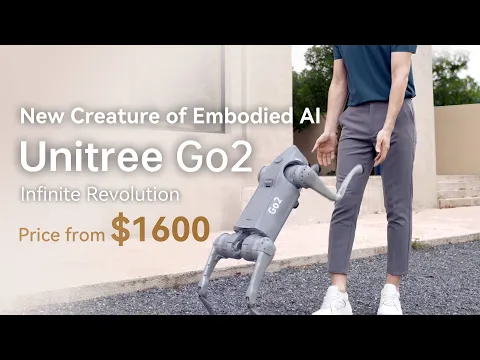
Production: 2,000 units worldwide, with 1,000 bought by a single distributor
The production run is 2,000 units worldwide, a figure cited by CGTN, Gizmochina and The Gadgeteer. The Global Times headline says 1,000 orders were placed on launch day.
IT Home reports that ADATA, a Taiwanese technology company, has already bought 1,000 units.
Gizmochina says ADATA is acting as a distributor under a deal worth more than 20 million yuan, or about US$3 million.
The contract was signed in November 2025, nearly a year before the public launch. Gizmochina says the purchase accounts for half of planned production and does not represent 1,000 individual customers.
The partnership with Star Plus Legend
Star Plus Legend Holdings is listed on the Hong Kong Stock Exchange and operates entertainment intellectual property, the Global Times reports.
The two companies formed a joint venture to develop and exclusively operate products from the partnership.
Under the division of responsibilities described by Gizmochina, Unitree handles robotics and engineering. Star Plus Legend is responsible for the character, brand and marketing. The robot is also called MAJI.
Star Plus Legend says the two companies are developing other consumer robots featuring entertainment brands, including quadrupeds and humanoids for concerts and performances.
Uses listed by the Global Times include companionship at home, outdoor outings, collectors’ gatherings, commercial performances and playtime between parents and children.
Where to see the robot: Pandabot Cafe in Hong Kong
Star Plus Legend operates the Pandabot Cafe in Hong Kong. The venue features a robot barista, a Unitree G1 humanoid that dances and a virtual assistant, Gizmochina reports.
The robot dog is part of the cafe. The Gadgeteer reports that the location is in Tsim Sha Tsui and was scheduled to open on November 11, 2026.
Unitree in Brazil
XD4Solutions operates in São Paulo, offering technical training and integration services.
The lineup cited by Economic News Brasil includes Unitree’s Go2 Pro and B2 quadrupeds and H1 and G1 humanoids.
Earlier, in December 2024, drone importer Gohobby brought a humanoid robot made by the company to Brazil.
The first buyer was the Center for Technological Sciences at the State University of Santa Catarina (Udesc), in Joinville, Santa Catarina, the Monitor Mercantil reported on December 19, 2024.
In the same report, the Go2 is identified as Unitree’s most sought-after model among those imported by Gohobby. The company’s robot dog is resold by Smart Center, in Balneário Camboriú, Santa Catarina.
Unitree went public on the Shanghai Stock Exchange in 2026, with a valuation of about US$9 billion.
In 2025, the company had revenue of 1.699 billion yuan and adjusted net income of 590 million yuan.
China’s robot market
The Global Times cites data from China’s Ministry of Industry and Information Technology. Revenue at major industrial robotics companies exceeded 300 billion yuan in 2025.
The sector’s average annual growth rate topped 20% over the past five years. Consultancy Smart Analytics Global estimates that about 19,100 humanoid robots were delivered worldwide in the first half of 2026.
More than 97% of those humanoids were made in China, according to the same estimate, reported by the Xinhua news agency in August. Half of the 2,000-unit production run of the UNI-DOGGIE remains reserved for ADATA.