Portuguese


The industrial project covers the Nobres and Cuiabá plants, sets annual cement capacity at 1.2 million metric tons and is expected to create more than 150 jobs during construction.
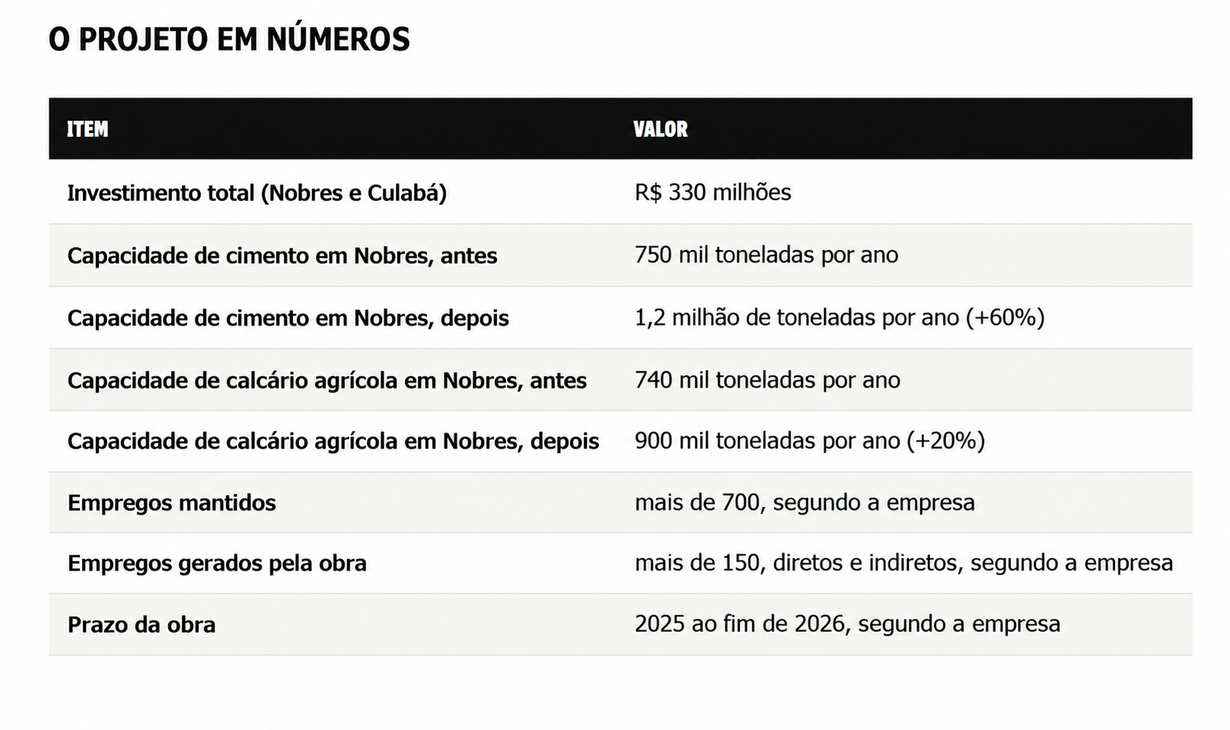
Votorantim Cimentos is expanding and modernizing its operations in Brazil’s Mato Grosso state through an investment program worth R$330 million. A November 13, 2026, report by Radar Capex said the project covers the company’s Nobres and Cuiabá facilities. The company originally announced the investment in August 2025 and set the end of 2026 as the target for completing the work.
In Nobres, the company plans to raise annual cement production capacity from 750,000 to 1.2 million metric tons. The increase amounts to 60% and involves installing a new grinding facility.
-
Neodent Opens R$2 Billion Factory in Curitiba, Expanding Complex to 80,000 m² and Aiming for 15 Million Implants Per Year with Potential 2,000 Jobs by 2031

-
LG’s Paraná Factory Utilizes Robots to Produce a Refrigerator Every 14 Seconds at Maximum Speed
-
DiKoko to Invest R$ 72.2 Million in New Coconut Factory in Brazil’s Largest Coconut Producer, Creating 439 Jobs and Expanding Industrial Processing in Ceará

-
Manufacturer Invests Over $4 Billion to Build Advanced Packaging Factory for HBM Memory Used in Artificial Intelligence in the U.S.


Votorantim Cimentos also expects the project to create more than 150 direct and indirect jobs during construction. The program also includes improvements to agricultural limestone production, storage and logistics infrastructure.
New grinding facility to increase cement production by 60% in Nobres
The Nobres plant is one of the program’s main project sites. The company plans to install a new cement grinding facility to expand its industrial capacity.
The expansion will allow the plant to produce an additional 450,000 metric tons of cement per year. Total capacity will rise from 750,000 to 1.2 million metric tons a year.
The increase marks a significant change to the plant’s production structure. It began operations in 1991.
The facility currently makes cement under the Itaú brand and also serves agribusiness by producing agricultural inputs.
However, increased installed capacity does not mean the company will immediately produce at that level. Actual output will depend on demand, equipment utilization and operating conditions.
The modernization is also expected to improve service to customers in Mato Grosso and other regions served by the company.
Agricultural limestone production to expand by more than 20%
The investment is not limited to cement. Votorantim Cimentos also plans to increase production of agricultural limestone, an input used to reduce soil acidity.
The company says annual capacity is expected to rise from 740,000 to 900,000 metric tons.
That represents an increase of about 160,000 metric tons per year, equivalent to an expansion of more than 20%.
The company sells these products under Viter, its agricultural inputs brand.
Agricultural limestone plays an important role in farming because it helps correct soil chemistry and improves plants’ access to nutrients.
The expansion therefore brings the cement industry closer to one of Mato Grosso’s main economic activities: agribusiness.
The state is also attracting investment in other production chains. In October, for example, Polato Sementes announced an industrial expansion worth about R$100 million in Pedra Preta, including increased seed-processing capacity.
Although the projects serve different markets, both involve investment in industrial infrastructure linked to agriculture.
Votorantim Cimentos upgrades storage and logistics infrastructure
Alongside new production facilities, the company included improvements to storage and logistics in its investment program.
In Nobres, the project includes a new warehouse for product storage and upgrades to material-handling infrastructure.
In December 2025, Viter began operating a 6,300-square-meter warehouse with capacity to store approximately 50,000 metric tons of agricultural limestone.
The facility has a dedicated loading point and its own scale. This allows the company to better manage product storage and shipments.
The space also makes it possible to maintain inventory during periods of higher humidity and outside the agricultural season.
This capacity is important for an industry that needs to align its production pace with demand from farmers.
However, the warehouse entering operation does not mean that all work under the program has been completed. The expansion of the cement grinding facility has its own timeline.
R$330 million investment also includes Cuiabá plant
Although the expansion in Nobres accounts for a significant part of the project, the total investment of R$330 million also includes the Cuiabá facility.
In Mato Grosso’s capital, Votorantim Cimentos plans to modernize facilities and increase the use of industrial waste.
One of the main measures involves installing a plant to shred end-of-life tires.
The initiative will be managed by Verdera, the company’s business unit specializing in waste management and sustainable disposal.
After shredding, the tires can be sent for co-processing in cement kilns.
In this process, the industry uses certain waste materials as an energy source, replacing some conventional fuels.
The technology also helps reduce the need to send tires to landfills or unsuitable disposal sites.
However, the process requires specific environmental and operational controls to ensure the materials are treated properly.
Using tires as fuel could reduce petroleum coke consumption
Co-processing is one of Votorantim Cimentos’ initiatives to reduce its consumption of fossil fuels.
In cement manufacturing, kilns must reach high temperatures to turn raw materials into clinker, an essential component of the product.
The industry has traditionally used fuels such as petroleum coke to supply some of that energy.
The company is seeking to increase the share of alternative fuels in its operations.
By shredding the tires, the Cuiabá facility will be able to send the material to the kilns for energy recovery.
The project is intended to reduce petroleum coke consumption and contribute to the company’s industrial decarbonization strategy.
However, the company did not provide a specific estimate in the announcement of the new plant’s annual emissions reduction.
Therefore, the investment’s actual environmental impact cannot yet be calculated based on the disclosed data alone.
Construction could create more than 150 jobs in Mato Grosso
Votorantim Cimentos estimates that construction work in Nobres and Cuiabá will create more than 150 direct and indirect jobs.
The company also plans to preserve the more than 700 existing jobs at the two industrial facilities.
The work involves activities that typically require professionals in construction, industrial assembly, maintenance and engineering.
Services associated with the expansion include electromechanical assembly, metal fabrication, heavy-load handling and industrial equipment installation.
However, the Radar Capex survey presents these activities as potential opportunities for suppliers. It does not confirm specific contracts or open hiring processes.
Those interested in working at the facilities should therefore follow Votorantim Cimentos’ official recruitment channels.
Other industrial investments are also driving activity in Mato Grosso. One example is the R$575.3 million in financing approved by BNDES, Brazil’s development bank, to expand a corn ethanol plant in the state.
ALD Bioenergia’s project is expected to increase production capacity and generate approximately 400 indirect jobs during construction.
Although the initiatives are in different sectors, both highlight the importance of industrial expansion in driving demand for specialized services.
Project is part of a national R$5 billion investment plan through 2028
The investment in Mato Grosso is part of a broader Votorantim Cimentos program.
In 2024, the company announced a R$5 billion investment plan for Brazil through 2028.
The strategy includes industrial modernization, production capacity expansion, operational efficiency and sustainability initiatives.
The company is also seeking to improve its competitiveness and strengthen service to regional markets.
In a statement released in August 2025, the company’s global CEO, Osvaldo Ayres Filho, emphasized the importance of its Mato Grosso operations to long-term planning.
The executive also linked the expansions to increased production capacity, storage and logistics efficiency.
The work in Nobres and Cuiabá is therefore part of a national growth strategy, not a standalone initiative.
Industrial expansion accompanies new investments in Brazilian plants
Votorantim Cimentos’ expansion comes amid investment across several of Brazil’s industrial sectors.
Companies in the food, chemicals, pharmaceuticals and consumer goods sectors are also developing projects to increase production.
In Pernambuco, for example, Ypê announced an expansion program worth more than R$220 million at its industrial complex in Itapissuma.
The plan includes new production lines and expanded storage capacity.
As in Mato Grosso, the project combines investment in production with logistics improvements.
However, each project has its own timeline and conditions. It is therefore not possible to say that all of them will reach full capacity immediately after construction is completed.
When will Votorantim Cimentos’ expansion be completed?
Under the company’s original schedule, construction began in 2025, with completion expected by the end of 2026.
Work on some of the infrastructure has already progressed. Viter, for example, began operating its new storage warehouse in December 2025.
However, the company has yet to publicly confirm that all the other planned work under the program has been completed.
With the new cement grinding facility, the Nobres plant is expected to reach an installed capacity of 1.2 million metric tons of cement per year.
Agricultural limestone production could also reach 900,000 metric tons per year.
In Cuiabá, the modernization includes a tire-shredding project and the use of waste for energy.
The coming months will therefore be important for tracking the completion of the remaining facilities and the expansion’s operating results.
The R$330 million investment strengthens Votorantim Cimentos’ presence in Mato Grosso and expands the company’s industrial capacity.
The project also combines cement production, agricultural inputs, logistics and waste reuse at two strategic facilities.
Could investments like this create more job opportunities and strengthen industry in Mato Grosso in the coming years?
Sources: Radar Capex, a report published on November 13, 2026; Votorantim Cimentos, an official statement issued on August 4, 2025.