






 Portuguese


Honda WR-V EX 1.5 CVT 2018 costs R$ 78,1 thousand in the Fipe, achieves up to 12.4 km/L, has 116 hp and a 363-liter trunk.
The Honda WR-V EX 1.5 CVT 2018 costs R$ 78,156 in the September 2026 Fipe table, a price that places the Japanese compact utility in a competitive range for those looking for an automatic used SUV under R$ 80,000. According to Webmotors, the national average listed for the same version is R$ 80,968.53, although some units are offered below the official reference depending on mileage, region, and condition.
Another figure that enhances the model’s appeal is its fuel consumption. The Brazilian Vehicle Labeling Program registered up to 12.4 km/L with gasoline on the highway, in addition to 11.7 km/L in urban cycles. The 2018 WR-V combines these figures with a 1.5-liter naturally aspirated engine producing up to 116 hp, CVT automatic transmission, 363 liters of trunk space, and a body length of just 4 meters, making it particularly suited for urban and family use.
Honda WR-V 2018 costs R$ 78,156 in Fipe in September 2026
The used WR-V stands out because its 2018 EX version now occupies the price segment just below R$ 80,000. The September 2026 reference is R$ 78,156, a decrease of 0.67% compared to the R$ 78,682 reported in the previous month. In July, the same configuration was priced at R$ 78,205.
-
Jeep Renegade Longitude 1.8 Automatic 2019 Costs R$ 71,627, Offers 11 km/L, Features Six-Speed Transmission, Placing One of Brazil’s Most Famous SUVs Below R$ 80,000

-
Owner Drives 100,000 Miles in 2026 Toyota Prius in Just 8 Months, Shares Maintenance History and Results: 10 Oil Changes, 13 Tire Rotations, No Major Failures

-
GWM Sells 9,924 Cars in August, Surpasses Honda in Brazil for the First Time by 247 Units, and Places Haval H6 Among Top 10 Bestsellers
-
Honda Asks Suppliers to Cut Costs by Up to 30%, Aims for $9.4 Billion in Savings by 2030 and Turns to Chinese Parts in Response to BYD’s Rise


However, listings show a much wider price range. Webmotors reports units priced between approximately R$ 66.5 thousand and R$ 95.9 thousand, while the national average calculated by the portal is at R$ 80,968.53.
This means that a unit priced below the Fipe reference may exist, but a standalone price should not automatically be viewed as an opportunity without checking mileage, history, and condition.
The EXL 2018 version remains slightly above. In September 2026, its Fipe price is R$ 80,064. For those setting R$ 80,000 as a hard limit, the EX is the configuration that fits most accurately within this price range.
1.5-liter engine delivers 116 hp with no turbocharger
Under the hood is the well-known 1.5 16V FlexOne four-cylinder engine, also used by Honda in models like the Fit and City from that generation. This engine is naturally aspirated, with no turbocharger, and produces 115 hp on gasoline or 116 hp on ethanol at 6,000 rpm.
Torque reaches 15.2 kgfm with gasoline and 15.3 kgfm on ethanol, both at 4,800 rpm. These are modest figures compared to current small turbo engines, but represent a different mechanical approach based on a displacement of 1,497 cm³, natural aspiration, and i-VTEC technology.
This characteristic makes the WR-V appealing for buyers who do not prioritize sporty performance.
The maximum power appears at a relatively high regime, and the response lacks the low RPM torque peak typical of modern turbocharged engines. In compensation, this engine family has been widely used by Honda in Brazil for years.
CVT transmission was the only automatic option offered for the WR-V
All versions of the first Brazilian WR-V were launched with CVT automatic transmission, with no manual option at the debut. This system operates with continuously variable ratios instead of using a conventional sequence of five or six fixed gears.
Honda recalibrated the setup for the WR-V, which shared the same mechanical base as the Fit and City. The drivetrain is front-wheel drive, consistent with the vehicle’s urban purpose and markedly different from SUVs designed for heavy off-road use.
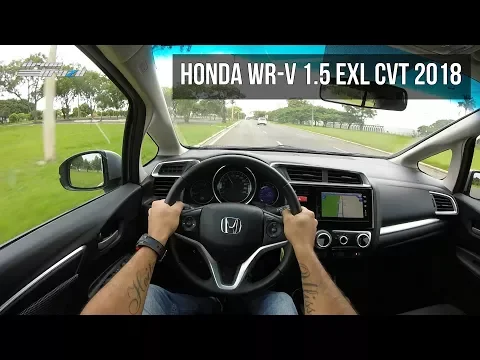

For those facing daily traffic, the combination of electric steering and CVT eliminates the clutch pedal and manual shifts.
However, a buyer of a used unit should check if the transmission fluid changes and maintenance followed the manufacturer’s recommended intervals for that specific unit.
Fuel economy reaches 12.4 km/l on the highway
The official fuel economy is one of the strongest selling points of the WR-V 1.5. According to Inmetro data, the EX and EXL versions with CVT achieve 8.1 km/l in the city and 8.8 km/l on the highway with ethanol. With gasoline, the figures increase to 11.7 km/l in urban use and 12.4 km/l on the highway.
This energy performance positions the model favorably for its time, especially considering its elevated body design.
The official label classified the WR-V in the compact SUV category, recording energy consumption of 1.79 MJ/km.
With a tank close to 45 liters, theoretical highway range exceeds 550 km by multiplying capacity by certified fuel economy. In practice, real range varies based on speed, traffic, terrain, tire condition, load, air conditioning, fuel used, and driving style, so it should not be interpreted as guaranteed distance per tank.
4-meter body design makes urban use easier
The WR-V measures approximately 4 meters in length, 1.73 meters in width, and 1.60 meters in height, with a wheelbase of 2.555 meters. These compact dimensions suit a vehicle commercially positioned as an SUV, making parking and maneuvering in tight spaces easier.

The origin explains these proportions. The project was developed from the Honda Fit architecture but received a specific body and modifications aimed at delivering a more robust appearance and greater suitability for uneven streets. In its 2017 presentation, automotive media noted that the WR-V was about 5 centimeters taller in suspension than the Fit.
The ground clearance reaches approximately 207 mm, an important figure for those navigating speed bumps, garage entrances, and damaged pavement.
The front suspension features an independent McPherson setup, while the rear operates with a torsion beam.
363-Liter Trunk Finds Support in Modular Rear Seats
Even with a length of just 4 meters, the WR-V offers 363 liters of trunk capacity. This figure places it in a range sufficient for groceries, luggage, and everyday family use, although there are significantly larger modern compact SUVs in this regard.
One of the most interesting features inherited from the Fit’s architecture is the modularity of the rear seats. This system allows for folding the seatbacks to create a larger longitudinal area and also raising the seats, opening up vertical space within the cabin for taller items.

This arrangement enhances versatility without increasing external dimensions. For those who occasionally transport bicycles, boxes, plants, larger luggage, or other volumes not easily accommodated in a conventional trunk, this flexibility can be as significant as the liters stated in the technical specifications.
WR-V EX Already Comes with Four Airbags, Rearview Camera, and Cruise Control
The EX 2018 configuration, which appears with a Fipe price of R$ 78,156, left the factory equipped with four airbags—two front and two side. It also features ABS brakes, electronic brake distribution, an ISOFIX system for child seats, and three-point seatbelts for all five occupants.
In terms of comfort, the list includes electric steering, air conditioning, cruise control, a trip computer, electric windows and mirrors, a multifunction steering wheel, height adjustment for the driver’s seat, and height and depth adjustments for the steering column.
The model also received a rearview camera, fog lights, LED daytime running lights, and 16-inch alloy wheels. The EXL version added curtain airbags, raising the total to six, plus a 7-inch multimedia center with integrated navigation in the original configuration.
WR-V Was Born in Brazil to Fill the Gap Between Fit and HR-V
The first WR-V was closely linked to the Brazilian market. It was initially presented at the 2016 São Paulo Auto Show and officially launched in March 2017 as a 2018 model, developed to fit between the Fit and HR-V within the Honda lineup.
Upon arrival at dealerships, the EX version cost R$ 79,400, while the EXL was priced at R$ 83,400. Interestingly, nine years later, the Fipe price for the 2018 EX is again close to its nominal launch price, at R$ 78,156, although this comparison does not account for inflation or the buying power of money over the period.
At that time, Honda was betting on a vehicle smaller than the HR-V but with a higher driving position, a sturdier body than the Fit, and only a CVT transmission. This combination partly explains why some still seek used WR-Vs.
Used Market Already Offers Units Below the Fipe Price
Although the official reference is R$ 78,156, national listings show that there are examples available for lower prices. A recent survey by Webmotors found a 2018/2019 EX CVT listed for R$ 75,999, while another 2017/2018 unit was priced at R$ 79,990.
The platform itself indicates a general price range of approximately R$ 66,500 to R$ 95,900 for the 2018 EX model. This range highlights how the price of a used car depends much more on the individual vehicle than merely on the year and version.
Before purchasing, the evaluation should include maintenance history, mileage, documentation, tires, suspension, brakes, air conditioning, electrical components, and the functioning of the CVT transmission. An independent inspection can also identify structural repairs or signs of collisions that may not be visible in photographs.
R$ 78,000 WR-V Combines Fuel Efficiency, Compact Size, and Familiar Mechanics
The Honda WR-V EX 1.5 CVT 2018 occupies a peculiar position in the market today. For R$ 78,156 on the Fipe table, it offers a package that includes an aspirated engine of up to 116 hp, CVT transmission, electric steering, a rearview camera, cruise control, four airbags, 16-inch wheels, and a modular rear seat.
Its strongest rational argument lies in the combination of dimensions and fuel consumption. With a length of only 4 meters, a trunk capacity of 363 liters, and an official fuel economy of 11.7 km/l in the city and 12.4 km/l on the highway with gasoline, it remains appealing.
For primarily urban use, it remains a competitive option even several years after leaving dealerships.
However, there are significant drawbacks, particularly the absence of traction and stability controls in the 2018 line, and the technology level is lower than what is found in current SUVs. On the other hand, buyers will also find a traditional mechanical configuration without a turbocharger, featuring a 1.5 engine and CVT transmission.
It is precisely this balance that keeps the WR-V relevant among used cars. At around R$ 78,000, it offers highway fuel economy of up to 12.4 km/l, a versatile cabin, city-friendly size, and aspirated mechanics, positioning itself as an alternative for those seeking a compact automatic SUV without entering the price range of current new models.


