





 Portuguese
  English
  Spanish
  7 min of reading
  0 comments


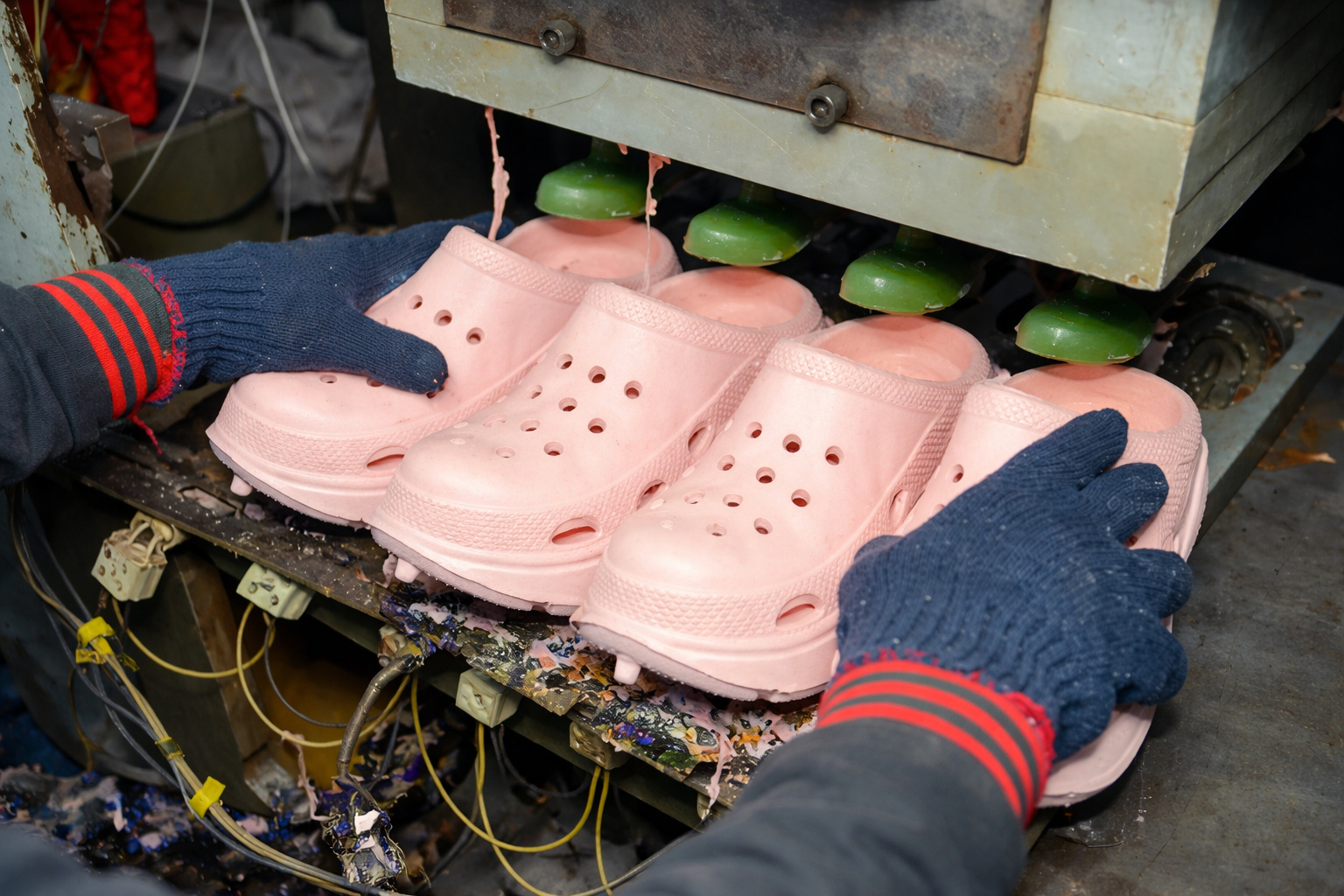
Production line of foam slippers, the famous Crocs, reveals industrial process with molding, cutting, and finishing in continuous sequence
In India, the production of foam slippers in a factory, in models that many people associate with Crocs, impresses with the steady rhythm of the line. The process is direct, repetitive, and very well organized: blocks of material enter in sequence, go through molding, cutting, drilling, assembly, and finishing, until they come out as ready pairs, with the same shape, the same appearance, and a flow that almost doesn’t waste time between one stage and another.
What stands out is not just the speed. It’s how simple tasks, when fitted together correctly, can sustain large production without chaos. Each phase depends on the previous one. Each visual adjustment prevents errors later on. And each operator helps keep the line moving smoothly, without unnecessary pauses and without breaking the pattern of the pieces.
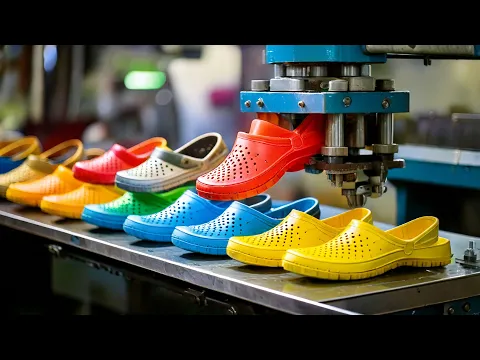

India and foam slipper factory: the rhythm starts before the machine closes
Everything starts with the lightweight foam blocks positioned near the machines. They are organized in stacks, already within an arrangement that facilitates the continuous supply of the line. There is no excess movement or loose improvisation. The material enters in an orderly manner because the cadence of production depends precisely on this well-executed first step.
-
Archaeologists find 16th-century silver coin.

-
An 86-year-old farmer rejected a proposal of R$ 76 million to sell his land and surprised everyone by turning down an AI data center on his 105-hectare farm, negotiating for only R$ 10 million for environmental preservation.

-
You have probably crossed paths with it and didn’t even notice: the Brazilian tapiti rabbit lives hidden in the forests and may be disappearing without anyone noticing.

-
Explorers investigate one of the most secret locations in the United States.

In practice, the blocks are manually placed on the feeding surfaces. This gesture seems simple, but it secures a good part of the fluidity of the process. The operator aligns the material by eye, corrects the position when necessary, and prevents the piece from going crooked to the next stage. This visual control, although basic, prevents misalignment, reduces interruptions, and keeps the factory working without losing momentum.
Production of the foam slipper, the famous Crocs grows in an increasingly technical sector
This scene of an organized line relates to a larger movement in the industry. Invest India treats the country as the second largest producer and consumer of footwear in the world and points to the advancement of the non-leather footwear segment, driven by investments, industrial clusters, and public support. At the same time, FDDI acts as a nationally important institution focused on design, testing, qualification, and production, indicating that the foam slipper factory today operates with much more method than improvisation.
This pressure for standards also has a regulatory explanation. The Indian quality control structure for footwear reinforces the need for consistent pieces, with repeatable measurements and finishes, which helps to understand why production values alignment, visual checks, and mechanical repetition from the very first contact with the raw material.
Metal molds give the foam slipper and Crocs the basic shape
After feeding, comes the stage that really changes the appearance of the material. The foam block moves to molding, where metal molds come into action to define the initial design of the slipper. It is there that the piece stops being just raw material and starts to look like a product.
The operation is quick. The material enters between plates that close under pressure. Then, it opens again. Closes once more. The cycle repeats in a continuous rhythm, forming several units with the same pattern. This opening and closing movement serves not only to save time. It ensures visual and structural uniformity, something indispensable when production occurs on a large scale.
At this stage, the piece is still not ready. It comes out with the basic shape defined, but without the final finish. Even so, it already carries what the line needs to preserve from then on: symmetry, regular measurement, and reliable repetition.
The factory enters the cutting phase, and production gains a clean outline
With the initial design ready, the slippers move on to cutting. It is at this point that presses, blades, and cutting molds eliminate what remains of the material and leave the outline more precise. The excess that previously surrounded the piece is removed, and the shape begins to resemble what the consumer sees in the final product.
The units are positioned and pressed against cutting molds. The contact defines the edges, removes the scraps, and sharpens the design. The effect is immediate: the piece comes out cleaner, more regular, and much closer to the standard required for the continuation of the line.
The accumulated residues around show exactly what happened there. There is material loss at this stage, yes, because the goal is to separate what is part of the slipper from what is just waste from the process. This cut is what prevents crooked edges and helps maintain uniformity between pairs.
Drilling prepares the fit and prevents errors in assembly
After cutting, production moves on to drilling. Rotating tools and fixed supports appear as the center of this stage because it is here that the fitting points are created. Without these well-located holes, the assembly loses firmness, and the final product may come out misaligned.
Each unit is placed in an exact position. The tool then drills the material at specific points, always with very rapid repetition. The pattern needs to be identical from one piece to another. This is not a small detail. It ensures that the components fit where they should, firmly and without slack.
The channel Tastie, which released images of the process, highlights precisely this point: repetition and alignment are not embellishments of the industrial line, but conditions for assembly to continue without error and without delay.
Crocs, Croslite, and foam slippers: why this type of footwear attracts so much attention
In the world of molded footwear, the name Crocs has become a popular shortcut for many people to refer to this type of product. However, technically, the brand works with Croslite, a closed-cell resin that the company itself describes as lightweight, soft, and odor-resistant. In 2024, the company reported achieving 25% bio-circular content in this material, showing how innovation in raw materials and industrial scale are already intertwined in the sector.
This background helps explain the fascination that foam slipper factories evoke. The public sees a simple product, but behind it, there is an increasingly significant conversation between comfort, lightweight material, industrial repetition, and economies of scale. Not by chance, Andrew Rees, CEO of Crocs, summarized this reasoning by talking about building a “future-ready” business, an idea that now fits well in the entire sector, from raw material to finishing.
Manual assembly secures the firmness of the product on the production line
With the holes ready, the manual assembly stage begins. Small components are fitted into the drilled points until the complete structure of the slipper is formed. It is a job of constant repetition, but it requires attention. It is not enough to just place the piece. It is necessary to press at the right point and feel if the fit is indeed firm.
The operator uses manual force to insert the components. The movement is repeated many times, always at a fast pace, because the line cannot lose speed. Still, haste does not replace care. If the fit fails here, the problem will appear in the product’s use later.
When this phase ends, the slipper is already functional. All the main parts have been integrated, and the piece stops being a molded body to become an item ready for the final adjustments.
The manual finishing changes the appearance of the foam slipper in the factory in India
Even assembled, the product still goes through finishing. It is at this point that manual sanding and abrasive surfaces come into play, used to remove small imperfections that remain on the edges or in contact areas.
This work improves the appearance and also the feel of the piece. The edges become smoother, visible irregularities disappear, and the set gains a more uniform appearance. Manual control makes a difference because it allows for detail-by-detail corrections, without relying solely on what came out of the machines.
Small residues reappear at this stage, a natural result of fine-tuning. However, now the function is not to define the shape, but to visually clean the product and make it more pleasant to the hands and feet.
Production concludes with organization of pairs and ready for distribution
In the final stretch, the slippers are organized in pairs and stacked. The movement is also manual and follows the same reasoning as the beginning of the line: order prevents errors. By correctly grouping the units, the operators prevent mixing of pairs, facilitate visual checks, and leave the output ready for transport and storage.
This closure clearly shows why production works. There is no loose stage. From the entry of the foam block to the final stack of ready pairs, everything depends on continuous sequence, human attention, and controlled repetition.
Ultimately, the factory transforms a lightweight raw material into a large volume of standardized product without resorting to a process that is too complicated. The secret lies in the sum of objective actions: properly feeding the line, molding under pressure, cutting excesses, drilling with precision, assembling firmly, correcting in finishing, and organizing the output. When machines and manual work fit together this way, the result appears in the constant rhythm, the reduction of failures, and the number of pairs produced in a short time.
And you, what stands out most in this type of production: the speed, the precision, or the manual work in finishing? Leave your comment and share this post with those who like to see how a factory works from the inside.
What did you think of the manufacturing process of ‘crocs’? Share your opinion or send it to someone who likes to know how things are made.









Seja o primeiro a reagir!