





 Portuguese
  English
  Spanish
  3 min of reading
  0 comments


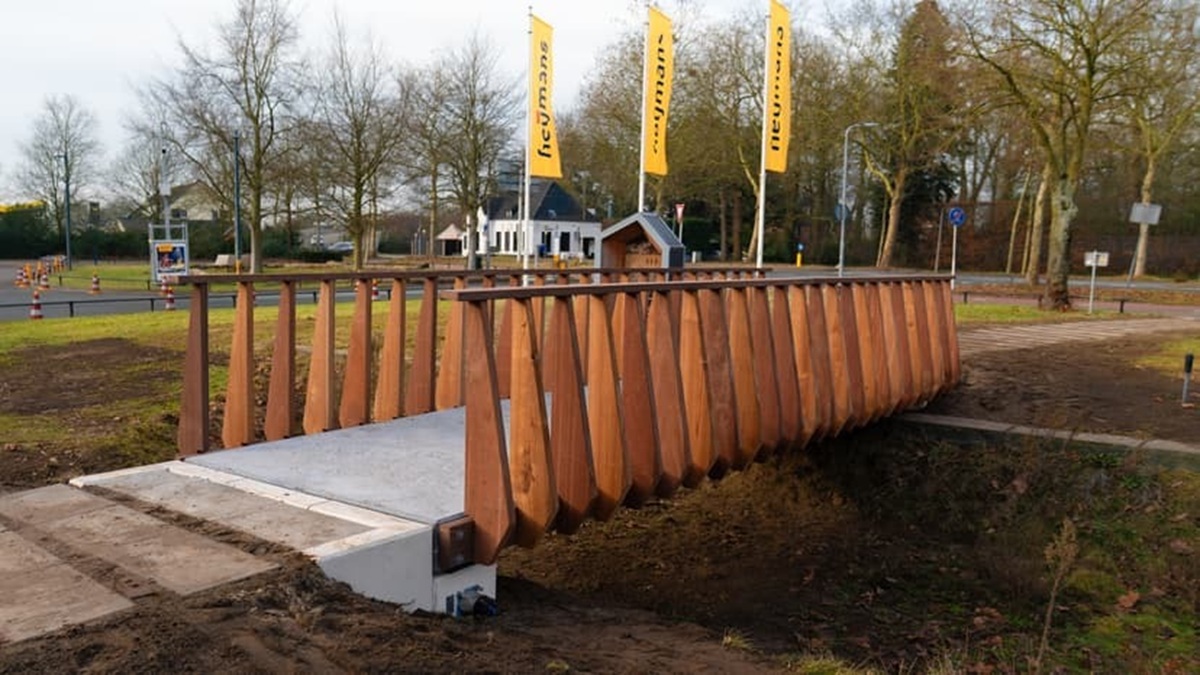
The 7-Meter Footbridge Built in the Netherlands Uses Carbon-Neutral Structural Concrete, Substituting 30% of Conventional Cement with Mineralizing Material, Incorporating 75% of Circular Raw Materials and Sequestering Nearly 66 kg of CO2 Just in the Deck, According to the Project’s Architects
Heijmans and the climate technology company Paebbl revealed what they describe as the world’s first bridge built with carbon-neutral concrete, utilizing partial cement substitution, recycled materials, and permanent carbon dioxide storage technology.
The footbridge, located in the Netherlands, was constructed with a length of 7 meters and aims to demonstrate that structural concrete can be produced without contributing to climate change, while maintaining the technical performance and structural resistance required.
Structure Uses Concrete Without Primary Sand or Gravel
The project employs a concrete mix that replaces much of the conventional materials with recycled alternatives capable of storing carbon, completely eliminating the use of primary sand and gravel.
-
Students from São Gonçalo surprise Brazil by securing a spot in an international robotics competition with extreme dedication and an innovative project

-
Internal link resolution test
-
A cold front with up to 100 mm of rain advances across Brazil and will turn the long holiday weekend into winter weather with a sharp drop in temperature in the South and Southeast.

-
Asteroid 300 million km away reveals all DNA bases



According to the project partners, the final composition results in concrete made with 75% circular raw materials, combining Paebbl’s CO2 mineralizing material, biochar, and recycled aggregates.
Despite the unconventional formulation, the concrete met all structural resistance requirements set for the application, demonstrating technical feasibility for use in real infrastructure.
Deck Sequesters Nearly 66 kg of CO2 Permanently
In addition to the emissions reduction associated with the materials, the bridge also acts as a carbon storage element, permanently retaining carbon dioxide within the concrete.
Only in the deck of the structure, nearly 66 kg of CO2, equivalent to 146 pounds, were sequestered, directly contributing to bringing the mixture used to total carbon neutrality.
This process occurs because Paebbl’s material fixes CO2 in a stable mineral form, preventing the gas from returning to the atmosphere over time.
Substitution of 30% of Cement Reduces Embedded Carbon
In the mix applied to the bridge, 30% of the original cement was replaced by the carbon-storing material developed by Paebbl, representing the highest substitution rate ever achieved by the company in structural concrete.
According to the project’s data, this change resulted in a reduction of nearly 30% in embedded carbon when compared to a reference concrete that already had low emissions.
Cement production accounts for about 8% of global carbon emissions, making the reduction of its content one of the main technical and environmental challenges in modern construction.
Technology Accelerates Natural Mineralization at Industrial Scale
Paebbl’s material works by accelerating the natural processes of carbon dioxide mineralization by a factor of one million, according to the technology developers.
Instead of releasing CO2 during its production, the process captures the gas and transforms it into a stable mineral incorporated into construction materials, changing the role of concrete from emitter to carbon storage.
Nick Vervoort, innovation manager at Heijmans, stated that the bridge proves that carbon-neutral structural concrete is already a technical reality and not just a future goal, even in demanding applications.
Project Brings Together a European Consortium of Specialized Companies
The project was executed by a consortium of Dutch and European partners, with Heijmans responsible for the leadership, coordination, and execution of the work.
HCM Cement provided the cement formulation, while Van der Kamp BV was responsible for the concrete production.
CarStorCon Technologies integrated biochar into the mix, and Urban Mine provided the recycled aggregates used in the structure.
Bridge Serves as a Showcase for Large-Scale Application
Ana Luisa Vaz, vice president of Products at Paebbl, stated that the 30% cement substitution rate demonstrates that carbon-storing materials are already ready for real infrastructure, not limited to decorative or non-structural uses.
The company claims that its materials can permanently store up to 300 kg of CO2 for every 1,000 kg produced, reducing embedded carbon in construction by up to 30%.
Together, the partners believe that the bridge sets a new standard for circular and carbon-neutral structural concrete, pointing to a future where buildings and infrastructures can act as long-term carbon sinks, rather than large emitters.





-

-

-

-

-

-

32 people reacted to this.