






 Portuguese
  Spanish


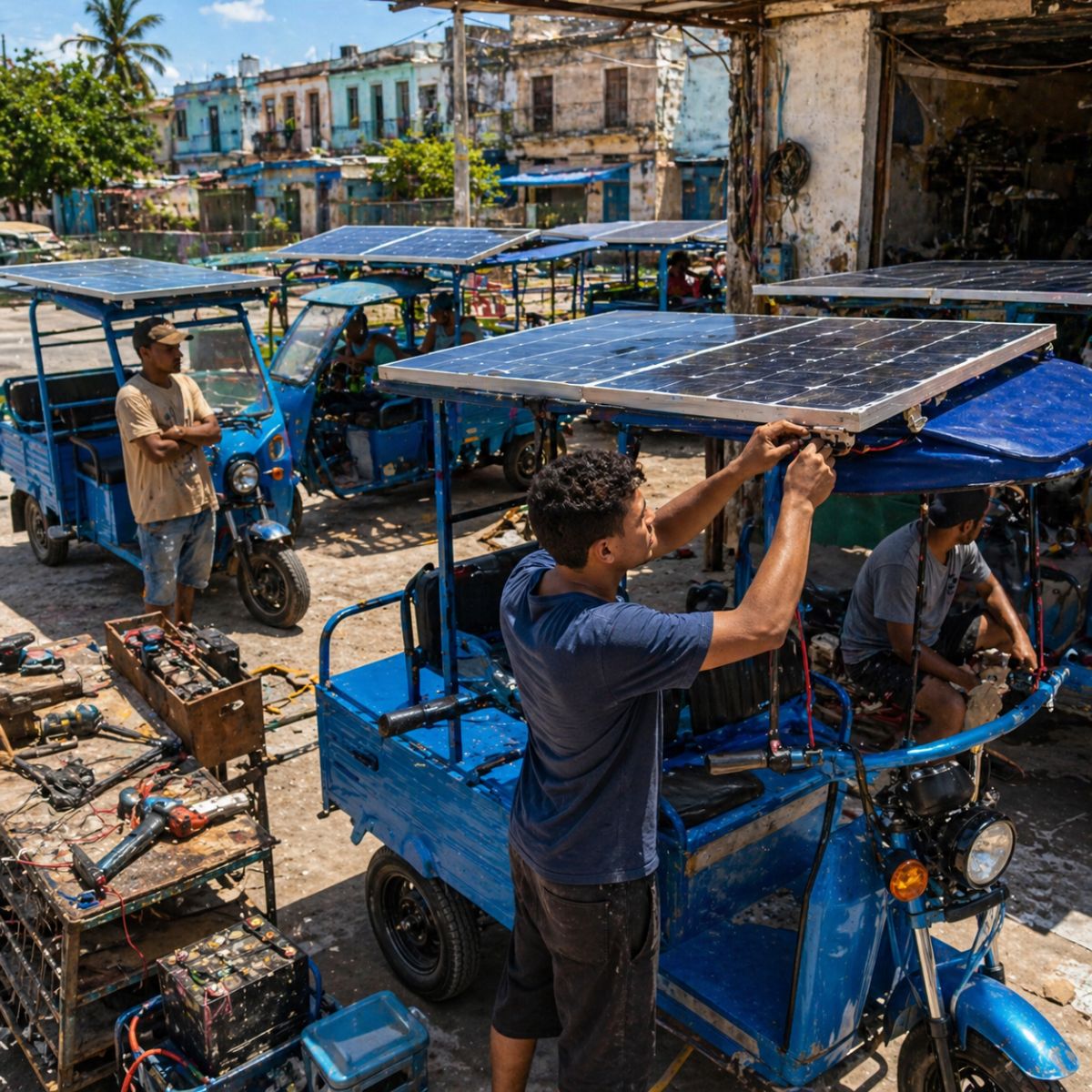


Amidst the energy crisis and gasoline shortage in Cuba, young entrepreneur Yadán Pablo Espinosa, 21, has installed solar panels on more than 15 electric tricycles circulating on the island. With the support of his father, three brothers, and a friend, he manufactures his own iron supports and installs panels with capacities between 550 and 650 W, which provide direct energy to the vehicles’ motors. The initiative increases the tricycles’ autonomy and prevents the battery from discharging during long workdays.
Cuba is without fuel, without energy, and seemingly without a way out, but a 21-year-old found one. Yadán Pablo Espinosa set up a homemade solar panel operation that has already equipped more than 15 electric tricycles circulating on the island’s streets, increasing the vehicles’ autonomy and saving the livelihood of workers who depend on them to transport goods. The installation allows the panel to provide constant and direct energy to the tricycle’s motor while it is in motion, and when the vehicle stops, the received energy charges the battery.
The venture was born from a simple question: what should be the autonomy of a tricycle? Espinosa realized that solar panels could provide enough power to supplement the motor’s consumption during peak solar light hours, keeping the tricycles running longer without relying exclusively on the battery. With 550 to 650 W panels and iron supports that transform into useful covers for the vehicles’ roofs, the young Cuban created a solution that the island’s government failed to offer.
How the installation of solar panels on tricycles works

According to information released by the newspaper AGENCIA EFE, the system Espinosa developed is direct and efficient. The solar panel is installed on the tricycle’s roof on a handcrafted iron support, creating a cover that protects the driver from the sun and rain while generating energy. During peak solar light hours, the power provided is approximately 2,600 W depending on the type of panel, a value that does not cover all the motor’s consumption but provides a constant source that reduces the demand on the battery.
-
Dairy Farm Prevents Manure Lagoon Overflow with High-Powered Tractors and Industrial Pumps, Turning 100,000 Gallons of Waste into Fertilizer

-
Masked Man Claims to Have Traveled to 2118, Predicts World War Starting with North Korea and Reveals Secret CIA Technology

-
At 54, Brazilian Artisan Turns Textile Waste into a Successful Handbag Brand, Earning Over $6,000 Monthly

-
Brazilian Entrepreneur Sells $50,000 Monthly in Sustainable Luggage Made from Recycled Bottles, Eyes International Market


When the tricycle is in motion, the panel’s energy goes directly to the motor, complementing the battery. When the vehicle stops, all the energy captured by the panel is directed to recharge the battery, which means that stops for deliveries or rest turn into free recharging sessions. The result is a vehicle that runs more hours a day, covers greater distances, and depends less on outlets on an island where blackouts are part of daily life.
The impact for workers who depend on tricycles
Electric tricycles are an essential work tool for thousands of Cubans who transport goods, food, and passengers in cities where public transport is precarious and gasoline is a luxury item. Without sufficient battery autonomy, many workers were forced to end their day earlier or refuse long rides and deliveries, losing income their families needed.
Joanis Castro, one of Espinosa’s clients who works in goods transport, says he immediately accepted the installation proposal. Users report that, thanks to the panels, the vehicles perform better and the battery does not discharge during long workdays. For workers like Castro, the difference between a tricycle with and without a solar panel can be the difference between supporting their family or being stranded without income.
The energy crisis that turned a problem into a business


Cuba faces one of the worst energy crises in its history, with constant blackouts, fuel shortages, and an electrical infrastructure that cannot support demand. The economic pressure from the United States exacerbates the situation by hindering the import of oil and parts for power plants, leaving the island in a cycle of scarcity that affects everything from hospitals to food transport.
In this scenario, the Cuban government began promoting electric tricycles as an alternative to gasoline-powered transport, but the solution brought a new problem: the electrical energy to charge the batteries is also scarce. It was this gap that Espinosa identified and turned into a business, offering an energy source that does not depend on the electrical grid or fossil fuel, only on the sun that shines over Cuba practically all year round.
A family enterprise that operates without government support
Espinosa did not receive state funding, subsidies, or formal training. The enterprise operates with the support of his father, three brothers, and a friend, who together manufacture the iron supports, acquire the panels, and carry out the installations. The structure is homemade, but the results are professional: more than 15 equipped tricycles and a growing list of clients as workers see the benefits in their neighbors’ vehicles.
The operation reveals something about the entrepreneurial spirit that survives in Cuba despite economic restrictions. Without access to bank credit, free imports, or an organized supply chain, a 21-year-old managed to set up a micro-industry that solves a real problem for real people. Clients are already talking about equipping future tricycles with panels from day one, a sign that demand exceeds the production capacity of the small family workshop.
What Espinosa’s case says about Cuba’s energy future
The story of a 21-year-old saving workers with solar panels is both inspiring and revealing. Inspiring because it shows that practical solutions can emerge from where least expected. Revealing because it exposes the Cuban system’s inability to solve basic energy and transport problems that affect the daily lives of millions of people on the island.
The sun is Cuba‘s most abundant resource, and solar energy is the most obvious answer for an island that cannot import enough fuel. But while the government discusses policies and awaits external investments, a young man with iron supports and 650 W panels is doing what he can with what he has. The scale is small, but the model is replicable, and each equipped tricycle is a worker who keeps moving and a family that keeps eating.
Do you know any similar story of someone who created a homemade solution for a problem that the government doesn’t solve? Tell us in the comments what you think of this young Cuban’s initiative and if you believe solar energy can be the way out of Cuba’s crisis.







Marvelous model for larger scale funding and scaling to cover the automotive industry.
Government support essential for further improvement for export
why we should help cuba they were always our friends and a most popular vacation desenation for the past oh 30 years let’s send them fuel .Cuba will never be a trump victory .He can’t speak the language .can he speak English .?
America wants to take over the world, it makes small countries indebted by giving loans, and then it keeps its blackmail, while it is the so-called peace in the world.