






 Portuguese
  Spanish
  8 min of reading
  0 comments


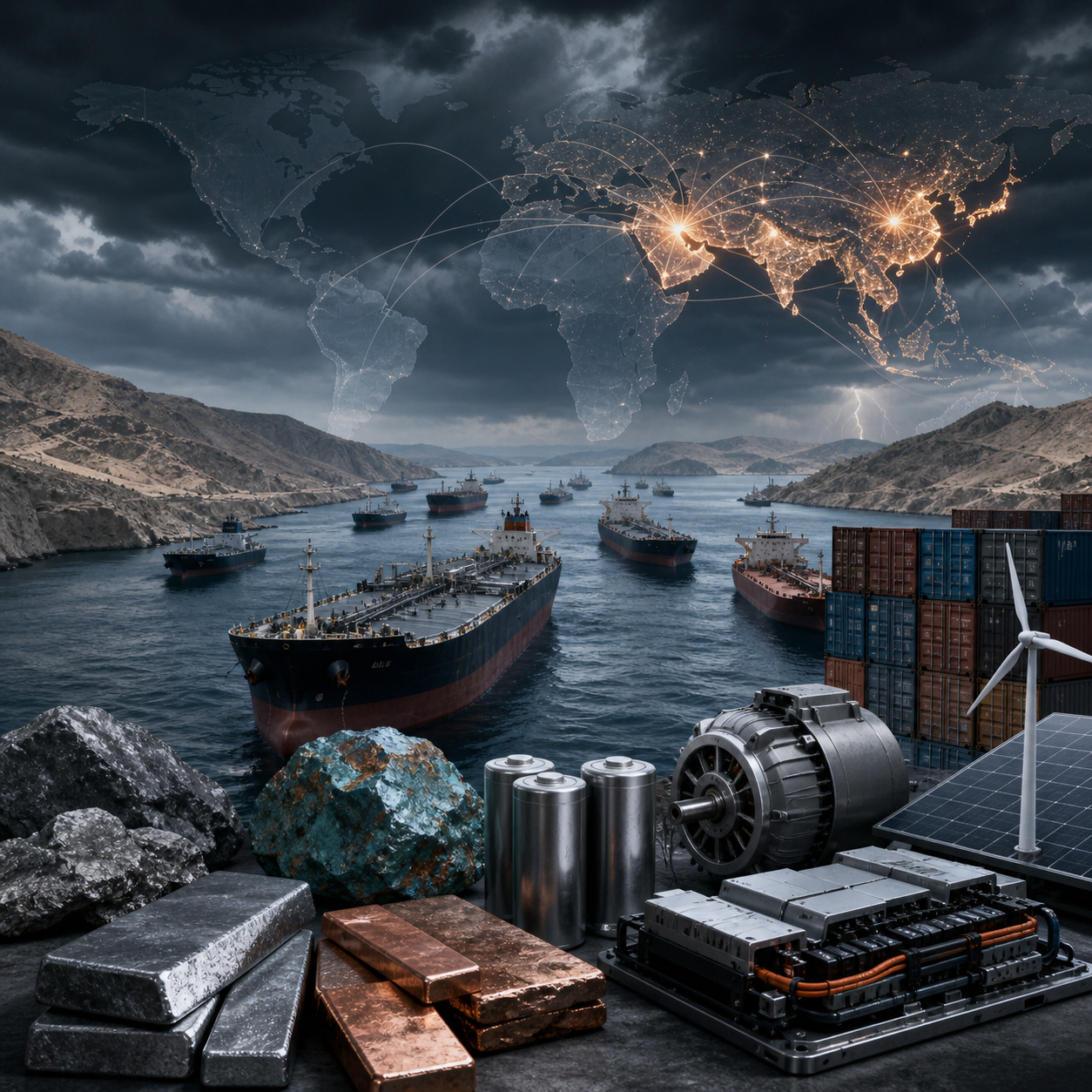
Crisis in Hormuz and Chinese control of rare earths expose global dependence on oil, critical minerals, and strategic industrial chains.
According to the International Energy Agency, the supply shock produced by the closure of the Strait of Hormuz in 2026 removed approximately 9 million barrels per day of oil and over 10 billion cubic feet per day of natural gas from the global market, at the same time that the West began to face another strategic vulnerability: dependence on critical minerals processed by China. China controls approximately 90% of the global processing capacity for rare earths, a group of 17 elements used in permanent magnets for wind turbines, electric vehicle motors, guidance systems, artificial intelligence processors, and solar panels.
In April 2025, Beijing imposed export controls on seven heavy rare earth elements, and in October 2025, it expanded restrictions to twelve of the seventeen elements.
The oil crisis and the critical minerals crisis have different causes, actors, and geographies. But both expose the same structural problem: entire global supply chains were built with priority for low cost and immediate efficiency, not for geopolitical resilience. When does it end? No one can say for sure.
-
Trump’s wall advances at a rapid pace: government promises to complete a barrier of over 3,000 km by 2027 while drones and cartels turn the US border into a new field of technological dispute

-
China prepares mBridge, a new digital payment system with blockchain that promises transactions in seconds, lower fees, and the advancement of the digital renminbi while aiming to reduce dependence on the dollar in global trade.
-
Chinese aircraft carrier Liaoning conducts about 170 takeoffs and landings in the Western Pacific, but Japanese surveillance turns the training into a regional alert: Beijing denies specific targeting while Tokyo monitors the fleet that passed 590 km from Miyakojima, reigniting tension in Asia.

-
China did not like the decision by the U.S. to place BYD, Alibaba, and Baidu on a list linked to the Chinese military sector.


The Strait of Hormuz concentrates oil, natural gas, and a logistical risk that no market can quickly replace
The Strait of Hormuz is a maritime corridor between Iran and Oman that connects the Persian Gulf to the Indian Ocean. A decisive portion of the world’s traded oil and liquefied natural gas passes through it, making this choke point one of the planet’s most sensitive energy routes.


There is no alternative route of equivalent scale. The Suez Canal and the Cape of Good Hope allow cargo to be rerouted between the Mediterranean and the Indian Ocean, but they do not replace, in terms of speed, cost, and volume, the oil coming from the Persian Gulf. When the Strait closes, or operates in a severely limited way, the global energy market feels it almost immediately.
The practical closure of the Strait in 2026, linked to the conflict between the United States and Iran, removed about 9 million barrels per day of crude oil and derivatives from the market, according to a Reuters report. The same crisis pushed prices above US$111 per barrel and triggered warnings of a global supply crunch.
Oil above US$100, naval blockade, and strategic reserves show the speed of the global energy shock
The United States responded with the available tools: increased domestic production, expanded energy exports, and the use of emergency instruments to cushion the supply shock. Reuters reported that the U.S. began to act as a kind of balancing supplier, expanding exports and using strategic reserves to reduce some of the pressure on markets.
Still, normalization did not come quickly. WTI surpassed US$100 per barrel in April, while Brent exceeded US$111 amid the near-total blockade of the route and uncertainty over negotiations between Washington and Tehran.
Later reports indicated that prices reached over US$126 amid fears that the blockade could last for months.
While the Strait remains closed or partially blocked, the world that depends on Gulf oil pays a premium that was not in the budget of governments, companies, or families. The energy crisis ceases to be just a problem of barrels and becomes a direct shock to inflation, logistics, fuels, fertilizers, and production costs.
Energy transition reduces oil dependence but increases exposure to critical minerals dominated by China
The obvious response to the oil shock is to accelerate the energy transition: more solar energy, more wind power, more electric vehicles, and less dependence on hydrocarbons from geopolitically unstable regions. The argument is technically correct, but it leads directly to the second strategic bottleneck.
Wind turbines need permanent neodymium, dysprosium, and terbium magnets. Electric vehicle motors use the same magnets. Solar panels, batteries, chips, sensors, defense systems, and industrial equipment depend on supply chains involving rare earths, gallium, germanium, graphite, nickel, cobalt, manganese, and other critical inputs.
China dominates several of these industrial stages on a scale difficult to replace. In addition to controlling between 85% and 90% of global rare earth processing capacity, Beijing also has a dominant presence in segments such as graphite, tungsten, antimony, and cobalt refining. The energy transition does not eliminate geopolitical dependencies; it exchanges part of the dependence on oil for mineral and industrial dependencies.
Chinese export controls on rare earths exposed the vulnerability of electric vehicles, defense, and clean energy
China achieved its current dominant position through a long-term strategy. Since the 1980s, the Chinese government subsidized mining, separation, refining, and manufacturing of rare earth-based products to the point of making many competitors’ production economically unviable.
The phrase attributed to Deng Xiaoping, “The Middle East has oil, China has rare earths,” summarizes this strategy. The West took decades to treat this dependence as a matter of economic, industrial, and military security.
In April 2025, China implemented the first wave of export controls on seven heavy rare earth elements. The measure required licenses for shipments and affected elements such as samarium, gadolinium, terbium, dysprosium, lutetium, scandium, and yttrium.
The second wave of restrictions created extraterritorial reach and expanded Chinese control over global supply chains
In October 2025, Beijing expanded control to twelve elements, adding five new metals to the list: holmium, erbium, thulium, europium, and ytterbium.
The most sensitive change was the extraterritorial clause, which began to require Chinese approval for products made outside China if they contain materials of Chinese origin or use Chinese mining, processing, or magnet manufacturing technology.
This means that a factory in Germany, the United States, or another country could be exposed to Chinese regulation if it depends on materials, equipment, or technology of Chinese origin in strategic components. The measure shifted the debate from trade to industrial sovereignty.
Following the meeting between Xi Jinping and Donald Trump in South Korea, part of the second wave was suspended for one year, until November 2026. The first wave, from April, remained in effect. The European Parliament also noted that the April and October controls affected the European Union, especially due to its reliance on rare earths for digital, green, and defense industries.
The 12 to 18-month window does not solve the rare earth supply chain, it only sets the deadline to start reacting
Industry analysts warn that Western countries have a short window to act before vulnerability prolongs. But acting on rare earth mining and processing does not mean solving the problem in months.
A rare earth mine can take six to fourteen years from discovery, licensing, infrastructure, and commercial production. A separation refinery, a critical stage dominated by China, can take five to ten years to be built and commissioned. A neodymium-iron-boron permanent magnet factory also requires years of investment and technical expertise.
The difficulty lies in the intermediate link. Mining is just the beginning. Separating, refining, and transforming oxides into high-performance magnets requires technology, scale, environmental control, and market. The 12 to 18-month window is not the deadline to solve the dependence, but to initiate projects that may only reduce vulnerability in one or two decades.
Gulf oil and Chinese rare earths reveal the same flaw in Western industrial strategy
Dependence on Gulf oil was built over decades of political and economic choices that prioritized short-term cost over long-term resilience. Dependence on Chinese rare earths followed a similar logic, with the added caveat that there were explicit warnings in national security reports.
China executed its strategy with consistency. When it dominated extraction, it subsidized processing. When it consolidated processing, it moved into components. When it gained scale in components, it strengthened final products and made non-Chinese alternatives progressively less competitive.
Most Western companies chose dependence because it was cheaper. The problem is that economic efficiency is not the same as strategic security. When two global bottlenecks close at the same time, oil in the Gulf and rare earths in China, the question is no longer how much it costs to produce cheaper, but how much it costs not to have an alternative.
Brazil enters the crisis with oil, rare earth reserves, and an still incomplete industrial chain
Brazil occupies a peculiar position in both crises. It is an oil producer, with pre-salt consolidating the country as a net exporter, but it still imports diesel and derivatives in significant volumes. An international oil shock quickly transmits to industrial fuels, fertilizers, freight, and agribusiness logistics costs.
In the rare earths crisis, the country has an asset that most Western countries do not possess: reserves. Brazil appears as the holder of the world’s second-largest rare earth reserve, behind China, with approximately 21 million tons of rare earth oxides, according to data cited by sectoral studies based on the USGS.
What Brazil still lacks on a sufficient scale is the industrial chain to transform these reserves into high-value products. The decisive stage lies in separation, refining, and magnet manufacturing, precisely the links that make raw ore a strategic component for electric vehicles, turbines, defense, electronics, and artificial intelligence.
Brazilian rare earths can become a geopolitical asset if the country advances beyond raw mining
With the West seeking alternatives to Chinese supply, Brazil is sitting on an asset whose geopolitical value has grown rapidly. Reuters reported in 2025 that the Brazilian government was evaluating financial guarantees and incentives to stimulate the mining, processing, and industrialization of strategic minerals, trying to prevent the country from being restricted to exporting raw materials.

The challenge is to transform reserves into a productive chain. This requires geological research, licensing, intensive capital, chemical engineering, element separation, environmental control, and long-term industrial buyers. Without this chain, Brazil remains rich in potential but poor in its ability to capture strategic value.
The window is real, but it will not stay open indefinitely. If China loosens restrictions, prices may fall. If other countries advance faster, they will occupy space in long-term contracts. Brazil has the geological ingredients, but still needs to build the industry that transforms rare earths into technological power.







-

-

-

7 people reacted to this.