





 Portuguese
  English
  Spanish
  3 min of reading
  0 comments


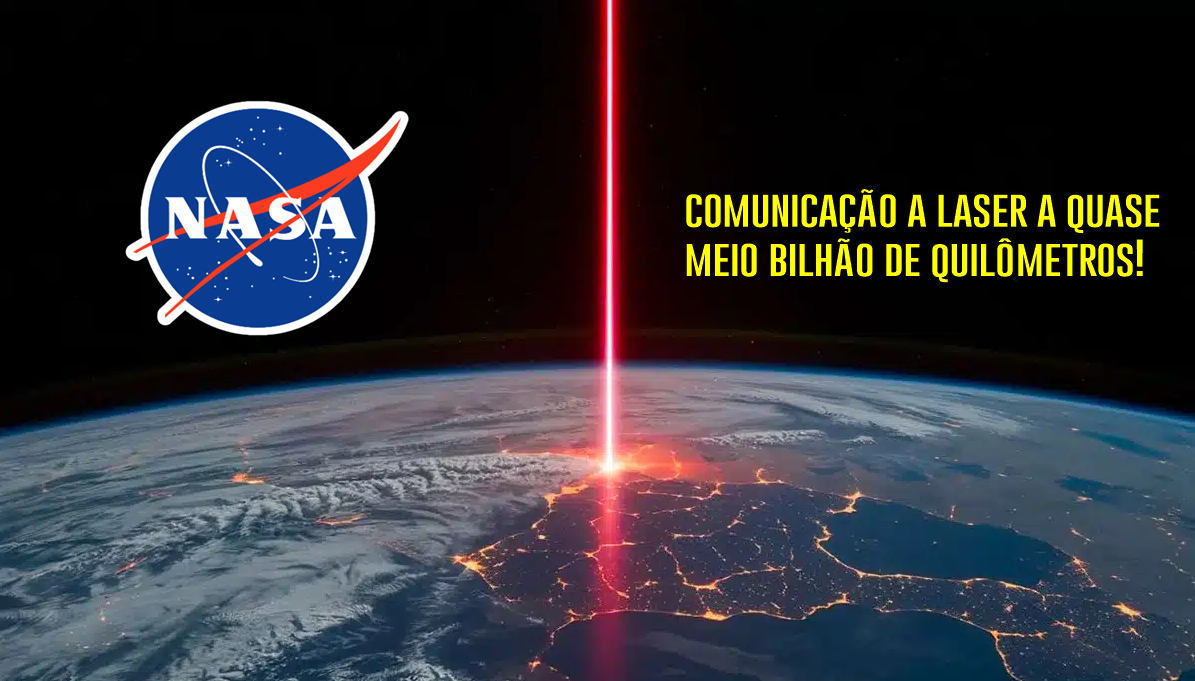
NASA Innovation: Laser Communication Over Long Distances Establishes New Era in Space Connectivity, Linking Our Planet to Deep Space
The recent advancement by NASA in using laser communication marks a new chapter in space exploration. While communication via radio waves has been widely used in the past, laser systems promise up to 100 times more efficiency in data transmission, transforming the way we connect with deep space.
Laser communication is not just about speed. It offers potential for more complex missions and greater data transmission. With this new technology, future missions will be able to:
- Send high-resolution images and videos to Earth more quickly
- Enable near real-time communication with distant spacecraft
- Facilitate scientific experiments in remote areas of the solar system
- Support future crewed missions to Mars and beyond
Just as the Hubble Telescope expanded our view of the universe, telescopes equipped with laser communication will be able to transmit even more detailed images in less time. The implications are significant and suggest a new era for scientific exploration of the cosmos.
-
JBL Flip Essential 3 SE is launched with 30W of power (20W + 10W), Bluetooth 5.4, Auracast for multiple connections, IP67 water and dust resistance, up to 12 hours of battery life, and a price of approximately R$ 660 in China.

-
A Finnish startup presented at CES 2026 the world’s first electric motorcycle with a solid-state battery that charges in 5 minutes, travels 600 kilometers, and lasts 100,000 cycles without losing capacity.

-
China launched 23 satellites into space in just 30 hours using two different rockets from two different bases in an orbital blitz that brings Beijing closer to assembling its own version of Starlink with 13,000 satellites, while Elon Musk already has 6,000 operational, and the race for space internet has never been so intense.

-
Chinese students use smart glasses with AI for cheating in university exams.

The Psyche Mission and NASA’s Cutting-Edge Laser Technology
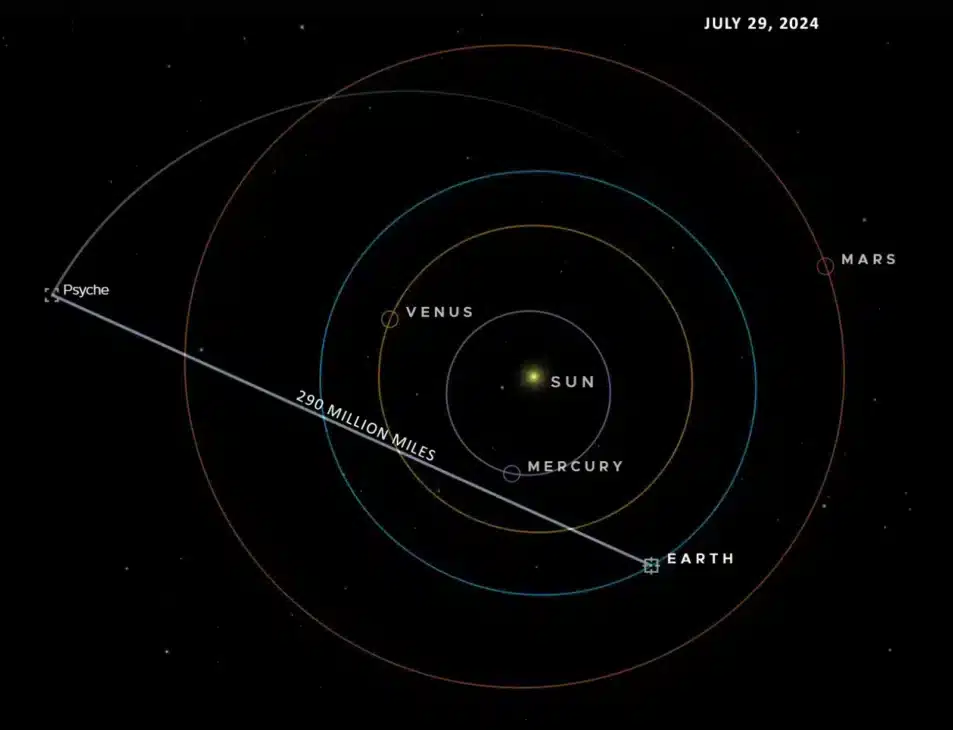
At the center of this achievement is NASA’s Psyche mission, aimed at exploring an asteroid with high metal content. Besides its original mission, Psyche now serves as a testing ground for the state-of-the-art laser transceiver developed by NASA.
To carry out the test, two ground stations proved essential:
- Palomar Observatory: responsible for receiving data
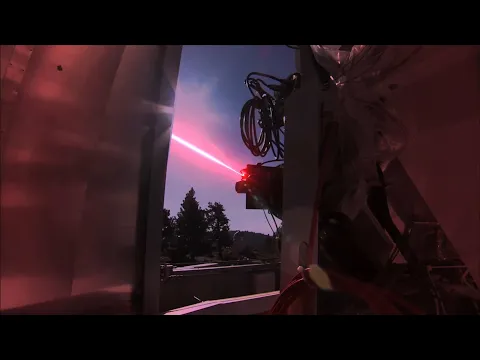
- Table Mountain Facility: transmitter of the laser signals sent to the spacecraft
Both stations utilize 7-kilowatt lasers, demonstrating the precision and efficiency needed for long-distance communications in space. The Psyche mission, from NASA, with this system, is pushing the boundaries of what space communication can achieve.

The Impact for Future Interplanetary Missions
The successful completion of this laser communication test, approximately 499 million kilometers away, opens up new opportunities for space exploration. This cutting-edge technology will enable significant advancements in future missions, especially to destinations like Mars.
Some possibilities for Mars missions with laser communication include:
- Real-Time Interactivity: faster and more efficient communication with rovers and, eventually, astronauts
- Transmission of Large Volumes of Data: sending detailed images and scientific measurements at high speeds
- Coordination of Multiple Missions: better integration among different spacecraft and ground teams
Moreover, laser communication could enable more ambitious missions, such as probes to more distant planets or moons like Europa, which has subsurface oceans, and Titan, with its dense atmosphere. Receiving data from such remote areas in a timely manner would significantly enhance our capacity for scientific discoveries.
The Beginning of a New Era in Space Communication
With each advancement in laser communication, the future of space exploration looks even more promising. This milestone represents not only a technological success but also ignites excitement among scientists and engineers worldwide. The idea that we can send data in large quantities across colossal distances opens possibilities that once seemed to belong to science fiction.
More than just a technical achievement, this advancement represents a step toward a deeper understanding of the solar system and the universe beyond. As we continue to explore these new pathways, we enhance our knowledge and the ability to better understand the cosmos. And perhaps, with time, we may answer some of the deepest questions about existence.
With each successful test, we are extending our frontiers and expanding the horizon of human knowledge. The future of space exploration, driven by laser communication technology, is bright and promises to transform our understanding of the universe.









Seja o primeiro a reagir!