Portuguese
  Spanish


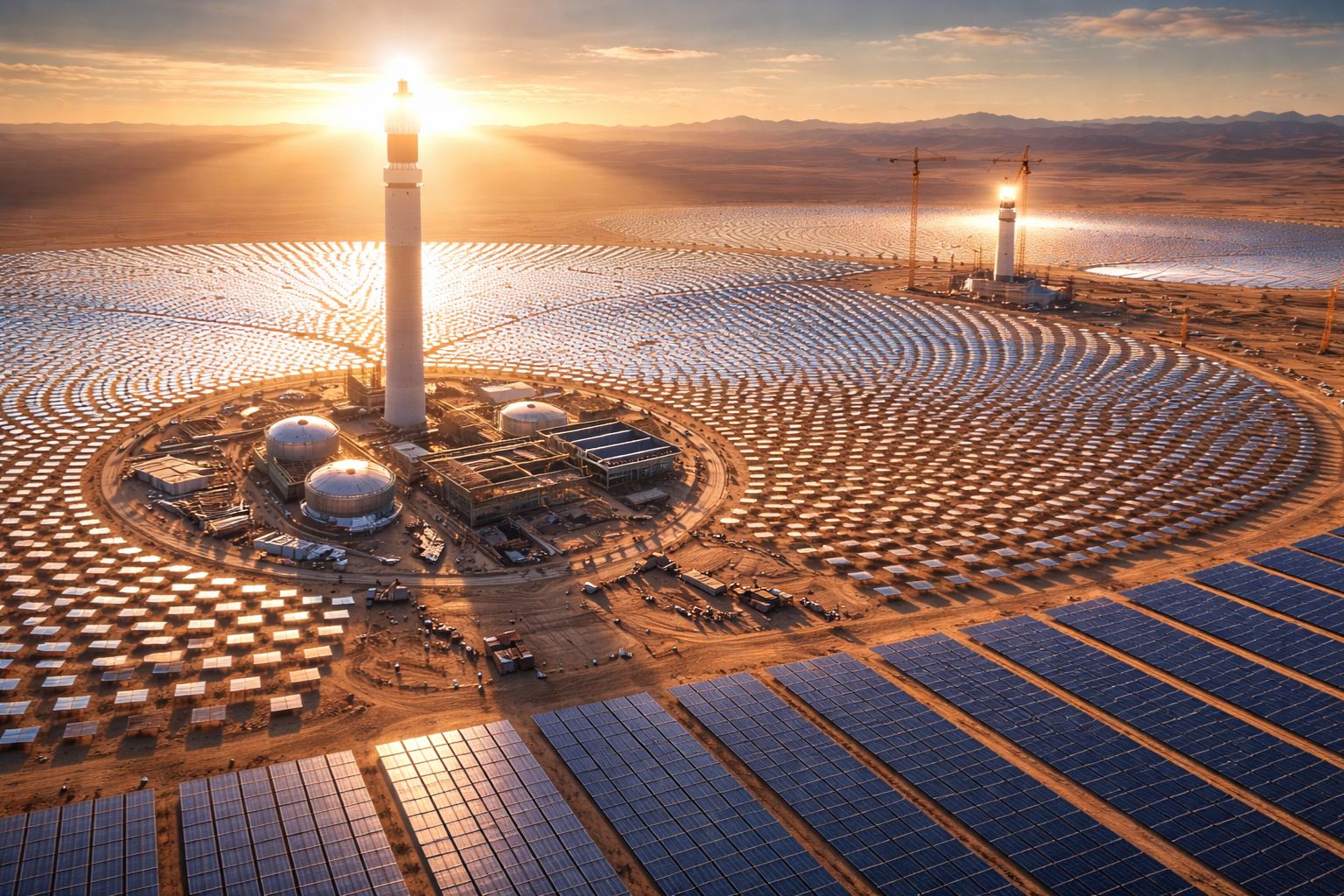

China has begun construction of the world’s largest monofacial solar power plant in Xinjiang, with a total capacity of 1.5 GW, an investment of $950 million, and a completion forecast in October. The project combines photovoltaic energy with molten salt towers that store heat and generate electricity at night without batteries.
The China has just initiated the most ambitious phase of what will be the largest monofacial solar power plant on the planet. The CEEC Hami Demonstration Project, located in the Xinjiang desert, combines 1.35 GW of photovoltaic capacity with 150 MW of concentrated solar power in molten salt towers, totaling 1.5 GW of installed capacity. The investment is approximately 6.5 billion yuan, equivalent to $951.9 million, and the plant will occupy an area of about 33 km² in the Barkol Kazakh Autonomous County, Santanghu city. The entire project is expected to be connected to the grid by June 2026, with full capacity operation in October.
What sets this project apart from any other solar power plant in the world is the integration of two technologies that solve the biggest problem of solar energy: what happens when the sun sets. China designed the plant to operate in an uninterrupted cycle: during the day, photovoltaic panels generate electricity; at night, the concentrated solar power (CSP) towers with thermal storage in molten salt take over generation, providing firm and stable energy without relying on lithium batteries or any other electrochemical storage system. This is the first time this combination operates at such a large scale.
What China is building in the Xinjiang desert

Image: China Energy Engineering Corp
According to the portal magazine, the CEEC Hami project is officially described as the largest monofacial thermal solar storage project under construction in the world. The plant combines two complementary systems: a photovoltaic park with large n-type modules designed to withstand intense ultraviolet radiation, strong winds, and sandstorms of the desert, and a concentrated solar power system with a 219-meter-high tower surrounded by thousands of heliostats, mirrors that direct sunlight to a receiver at the top of the tower.
-
In Brazil’s backyard: Tesla, by Elon Musk, announces official operations in Uruguay, where electric vehicles already make up 20% of new cars but still leaves out the largest market in the region.

-
This Mars rover may finally reveal if life ever existed on Mars.
-
A nearly 70-year-old Chinese inventor has registered 90 patents and created a device that stores water in the roots, helping seedlings survive drought while trying to transform the arid slopes of the Loess Plateau into green areas without relying on heavy irrigation.

-
Researchers want to change the way of producing rare earth magnets, reducing purification steps and making better use of the elements found in Swedish deposits.


No receptor, the concentrated temperature melts salt, transforming it into molten salt that can store heat for hours. When photovoltaic generation ceases at dusk, the molten salt is used to heat water, generate steam, and move turbines that produce electricity throughout the night. China designed the system so that the plant has no gaps in generation, eliminating the intermittency that is the main argument against solar energy as a baseload source. Construction of the CSP unit began in late 2024 and is nearing completion.
How molten salt technology allows China’s plant to operate at night
The principle is simple, although the engineering is complex. The heliostats concentrate sunlight onto a point at the top of the 219-meter tower, where the temperature reaches extreme levels sufficient to melt salt compounds. The molten salt is stored in thermally insulated tanks and retains heat for hours, functioning as a large-scale thermal battery. When electricity is needed, the hot salt is pumped through heat exchangers that generate steam to drive conventional turbines.
The advantage over lithium batteries is durability and scale. Molten salt systems can store energy for longer periods and do not suffer degradation with charge and discharge cycles, unlike batteries that lose capacity over the years. For China, which faces the challenge of integrating massive amounts of solar energy into the power grid without causing instability, CSP technology with molten salt offers what batteries cannot: long-duration storage that ensures firm energy throughout the night.
The numbers that make this the largest solar plant in the world
The scale of the project that China is building in Xinjiang surpasses any similar installation in operation. The total capacity of 1.5 GW exceeds the current record holder, the Hami Three Gorges Plant, also in China, which operates at around 1 GW combining 900 MW photovoltaic and 100 MW of CSP. Noor Energy 1 in the United Arab Emirates comes in second with a total of 950 MW. The CEEC Hami project raises the bar by 50% above any competitor.
The estimated annual generation is approximately 2.9 TWh, with 2.7 TWh coming from photovoltaic energy and 200 GWh from concentrated solar power. To put it in perspective, 2.9 TWh per year is enough energy to power over 1 million Chinese households, making the plant not just a technological demonstration project, but a real source of electricity for the national grid. China designed the plant to provide grid services that go beyond simple generation, including frequency regulation, reactive power support, and peak demand reduction.
The challenges of building in the desert that China had to solve

Image: China Energy Engineering Corp
The Xinjiang desert is not only a sunny location, it is one of the most hostile environments for electronic equipment and mechanical structures. China designed the system to withstand strong winds, extreme cold, and saline soils, conditions that destroy conventional equipment in just a few years. Protective structures have been added to the heliostats to reduce mirror breakage by 90%, an engineering solution that allows thousands of reflective surfaces to survive sandstorms that can cover the desert for days.
The 219-meter tower is described by CEEC as a reference project for large CSP plants in China. The height is necessary to maximize the capture of concentrated sunlight by the heliostats spread around, and the structure must withstand not only the weight of the receiver at the top but also the lateral forces of the wind, which can be extreme in the desert. N-type photovoltaic modules were specifically selected for their resistance to degradation from ultraviolet radiation, a critical factor in a region where solar radiation is significantly more intense than at mid-latitudes.
What the Chinese project means for the future of global solar energy
The CEEC Hami plant is being presented by China as a model for the second batch of large renewable energy bases in “deserts, Gobi, and arid lands,” a national program aimed at transforming unproductive regions into clean generation hubs. The concept of combining photovoltaics with CSP and long-duration thermal storage on a large scale addresses one of the most persistent problems of the energy transition: how to ensure reliable electricity 24 hours a day using only the sun as the primary source.
If the project works as planned after completion in October, China will have proven that it is possible to operate an industrial-scale solar plant in continuous cycle without batteries, an achievement that could reshape how the world plans renewable energy expansion. The technology is not new; CSP with molten salt has existed for decades, but it has never been implemented at this scale and with this integration. The Xinjiang desert may be on the verge of becoming the laboratory that defines the future of solar energy on the planet.
China is building the largest solar power plant in the world in the desert, with towers that melt salt to generate energy all night long. Do you think this technology can replace batteries? Would this model work in Brazil? Leave your opinion in the comments.